

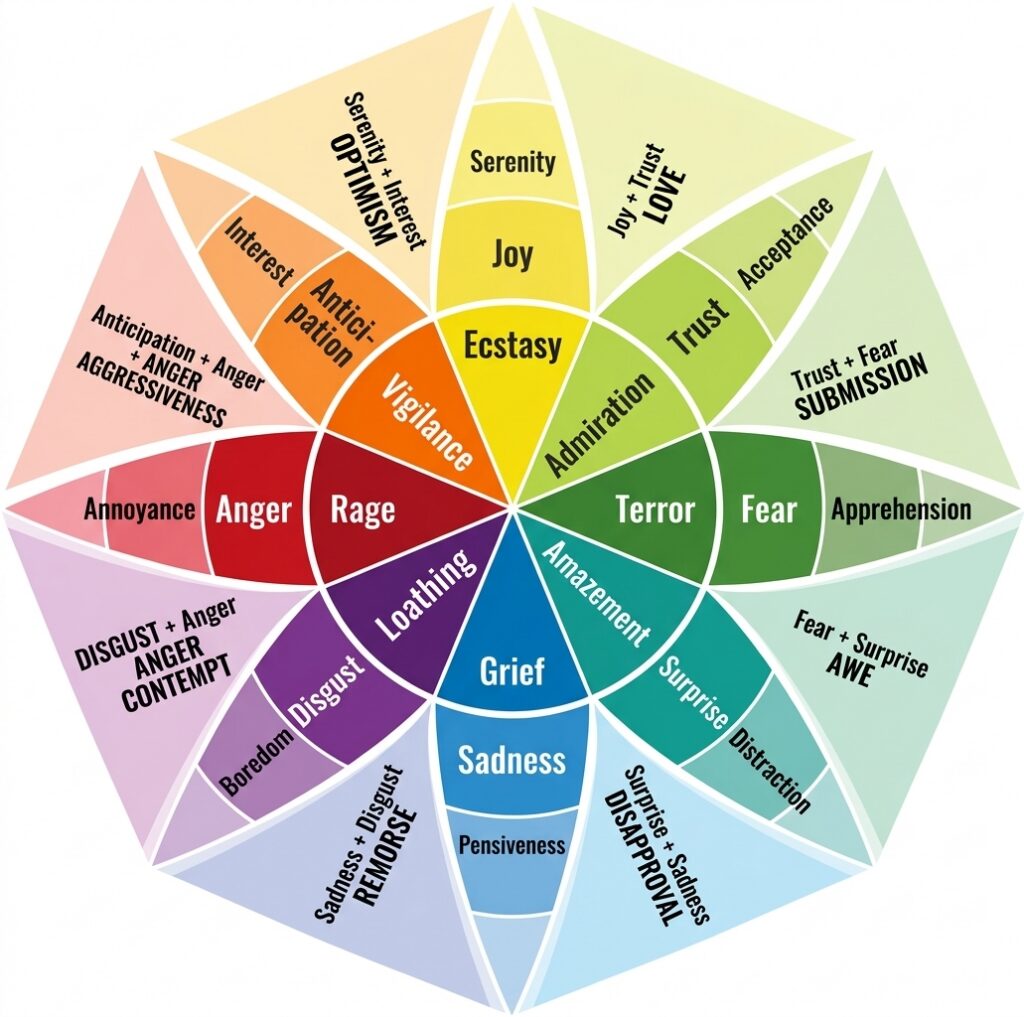
Robert Plutchik’s Wheel of Emotions — mapping the spectrum and intensity of human feelings. Modern psychology meets ancient wisdom: Robert Plutchik’s Wheel of Emotions serves as a contemporary map for the same mental fluctuations (Vrittis) described in the traditional Chakra systems. We all experience the same spectrum of human feelings.
Though the stories and events that trigger these feelings are different for each of us, the emotions themselves are universal. That is why we can relate to one another—feeling compassion when a friend experiences sorrow, or joy when something wonderful happens to them.
| Challenging Feelings | Expansive Feelings |
|---|---|
| Anger | Peace |
| Greed | Generosity |
| Envy | Gratitude |
| Despair | Joy |
| Desire / Anxiety | Contentment |
| Selfishness | Selflessness |
| Pity | Compassion |
| Hatred | Love |
Observing vs. Becoming an Emotion
There is a big difference between feeling happy or sad and becoming happy or sad. When you become an emotion, you allow it to take you over, whereas when you witness it as an observer, you feel its full expression without being carried away. Even the way you speak to yourself matters: there is a world of difference between saying “I am angry” and saying “I feel angry.” You are not that emotion; you are simply feeling it at the time. Naming an emotion out loud is also a powerful way of letting it dissipate—even in conversation, calmly asking someone, “Why are you being angry at me?” will often take the power right out of that negative energy.
Each challenging emotion has an expansive counterpart that we can actively cause to rise within ourselves to replace it. When you feel overjoyed in your heart, give yourself permission to feel that bliss fully—and even give it away, sharing it outward with the universe—while remaining unattached to it. Because emotions will always shift, learning to let joy go without grasping means you won’t feel let down when it naturally passes.
Working with Grief, Trauma, and Anger
When difficult emotions like sadness or grief arise, trying to push them away only makes them grow stronger as they force you to notice them. When you sit with the pain, acknowledge it, and let things simply be as they are, a strange thing happens: the feeling shifts, and the sadness begins to lift. Sometimes, suppressed memories or past issues from long ago may surface during meditation. Facing them can feel scary, yet exploring them is deeply healing.
Anger works in a similar way, often arriving with a sudden rush of heat that clouds clear thinking and makes us say things we don’t mean. Instead of suppressing it or lashing out, pause, take a few breaths, and notice the physical sensation without feeding the story in your mind. At the same time, it is worth remembering that righteous anger is different: if you know you are doing the right thing amongst people who are doing the wrong thing, that anger can give you the strength to stand up for what is right or walk away without being swayed. You have to believe in yourself.
Four Truths of Your Inner World
- You are not your thoughts or your emotions. You think thoughts and feel emotions—they are shifting figments in the mind, not something solid you can hold onto.
- What you think affects how you feel. Changing how you relate to your thoughts changes how you feel; we need not be helpless victims of unchangeable emotions.
- What you feel affects how you think. A low mood naturally stirs up negative thoughts until you pause and notice what is happening.
- Emotions are constantly changing. Whether positive or negative, every feeling will shift.
Impermanence & Treading Water
As humans, we tend to dislike change and get comfortable with things staying the way they are, yet impermanence is the nature of all things. Trying to cling to temporary things that have no permanent substance is like trying to hold onto the surface of water. The surface of the water is only an appearance—it is intangible, and you cannot grab it. If you tread water and keep moving with it, you stay afloat; if you stop and try to hold on, the true nature of the water asserts itself, and you sink. Meditation opens the mind to experience this changing world in all its wonder without fear, bringing us closer to inner peace.

Practical Anchor
The “Naming & Treading Water” Meditation
Let’s practice sitting with your emotions as an observer rather than letting them carry you away.
- Settle and Notice: Sit comfortably, close your eyes, and take three slow, steady breaths. Gently bring to mind a mild emotion you have felt recently—perhaps a touch of frustration, worry, or sadness—nothing overwhelming, just something familiar.
- Name It Softly: Notice where that feeling sits in your body. Is there tightness in your chest, heat in your face, or a knot in your stomach? Silently name it without attaching yourself to it: “I feel frustration,” or “I feel sadness.” Remember, you are the observer, not the emotion.
- Drop the Story: Notice if your mind wants to jump in and replay the story behind the feeling. Every time it does, gently let the story go and bring your awareness back to the simple physical sensation in your body.
- Move With It: Imagine that sensation is just the surface of water—intangible, shifting, and temporary. Instead of trying to push it away or hold onto it, simply breathe and tread water with it, allowing it to rise, shift, and soften in its own time.
- Invite the Opposite: Take one final deep breath in, and as you breathe out, invite its expansive counterpart—a quiet sense of peace, contentment, or compassion—to fill the space left behind.
(Pause for a few breaths)
Whenever you are ready, gently open your eyes.