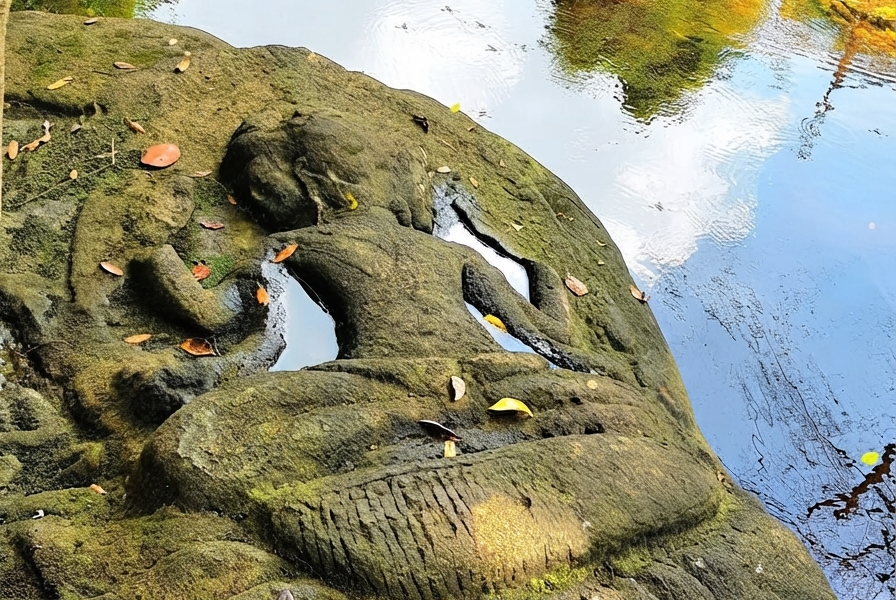
Ancient religions across Asia revered the lingam as a symbolic representation of Lord Shiva’s formless and infinite nature, embodying his divine creative energy. The lingam represents the male universal, creative force. The square mandala at the base is called the yoni, and represents the source of Feminine Creative Energy. The female activating force, divine energy, fertility, and the nurturing aspect of creation is carried by the flowing water in the yoni.
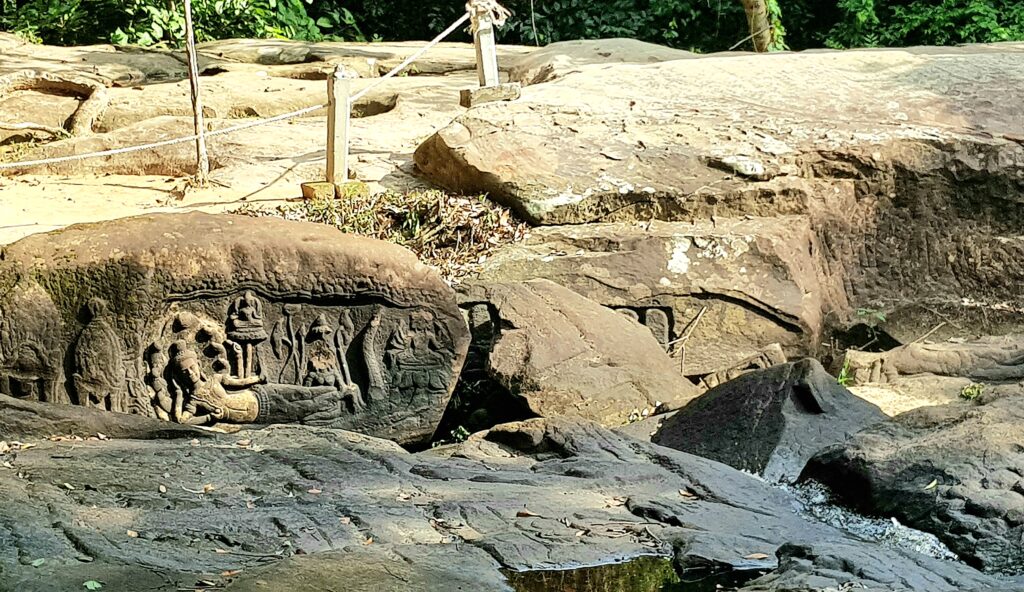
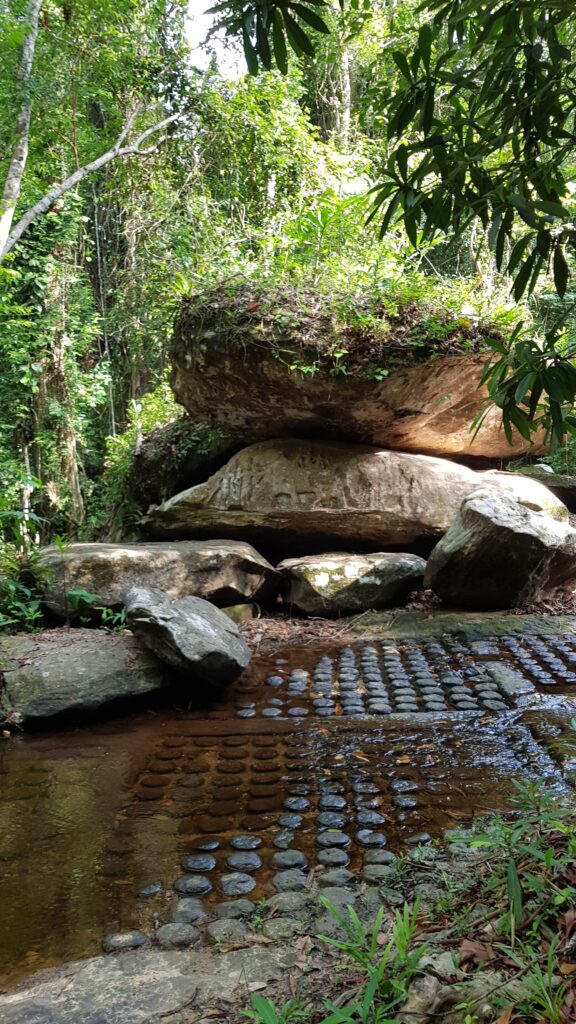
In Cambodia, I climbed to the top of a mountain to the source of a stream with ancient carvings of Shiva and countless lingams.
Kbal Spean (River of a Thousand Lingas) is a remarkable site featuring thousands of lingams and other Hindu deities intricately carved into the sandstone riverbed and banks. These carvings are believed to bless the water as it flows towards the plains of Angkor, making the water fertile to help crops grow and bring prosperity. Many ancient temples throughout the jungle also contain sculptures of lingams.
Shiva’s Cosmic Aspects
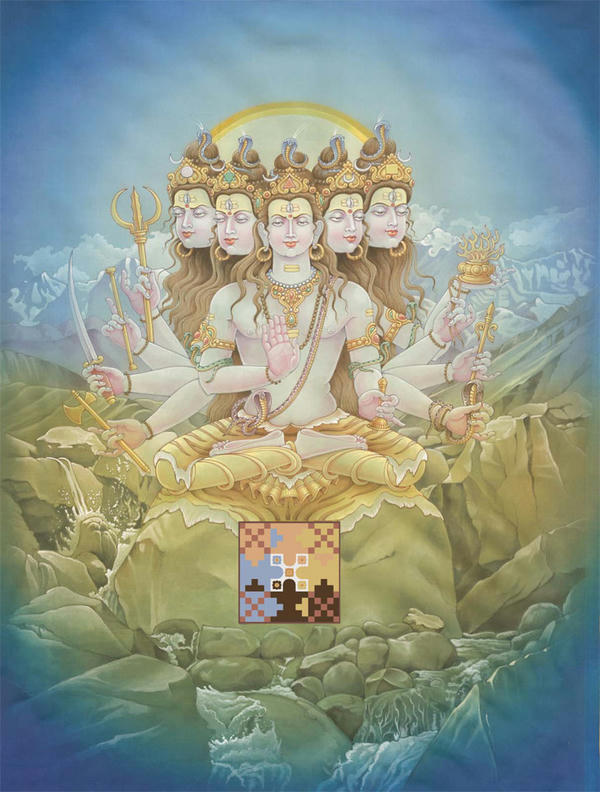
According to the Agama texts, Lord Shiva, in his all-encompassing form, is known as Sadashiva, also referred to as Panchabrahma or Panchamukha Shiva. This form embodies his five primary aspects, each represented as a face, which collectively perform the full spectrum of cosmic activities: creation, preservation, destruction, obscuration (concealment), and revelation.
The face of Tatpurusha obscures our true nature, past and future lives, and karmas, thereby allowing us the opportunity to evolve through experience. The face of Ishana can free us from this illusion. When the veil of separateness is lifted, we are granted realization of the ultimate truth.
Sadashiva signifies “eternally pure and auspicious.” The five faces of Panchamukha are profoundly associated with the five elements, the five senses, and the sacred five-syllable mantra “Na-mah-shi-vā-ya.”
The five aspects of Panchamukha are:
West Face – Creation
Sadyojata
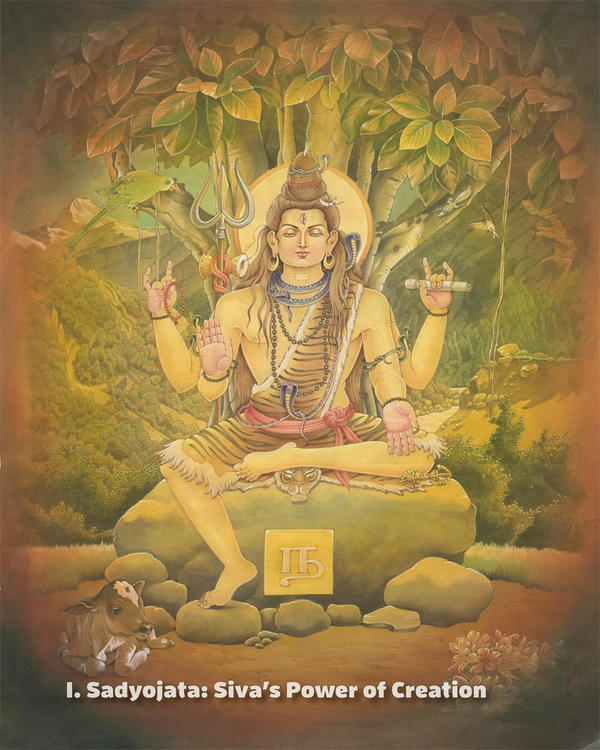
- Meaning: “quickly birthing”
- Represents: The power of creation, new beginnings, and birth. He is associated with the element of Earth (prithivi).
- Colour: White (or Crystal/Pearly lustrous)
- Direction: West
- Mantra: Na
- Symbolism: This face symbolizes Shiva’s benevolent and creative aspect, responsible for manifesting the universe.
- Description: Sadyojata is white in colour, in the likeness of a boy with a charming face, besmeared with sandalwood paste, adorned with white flowers. One hand displays the boon-granting varada mudra and another the fear-not abhaya mudra.
North Face – Preservation/Sustenance
Vamadeva
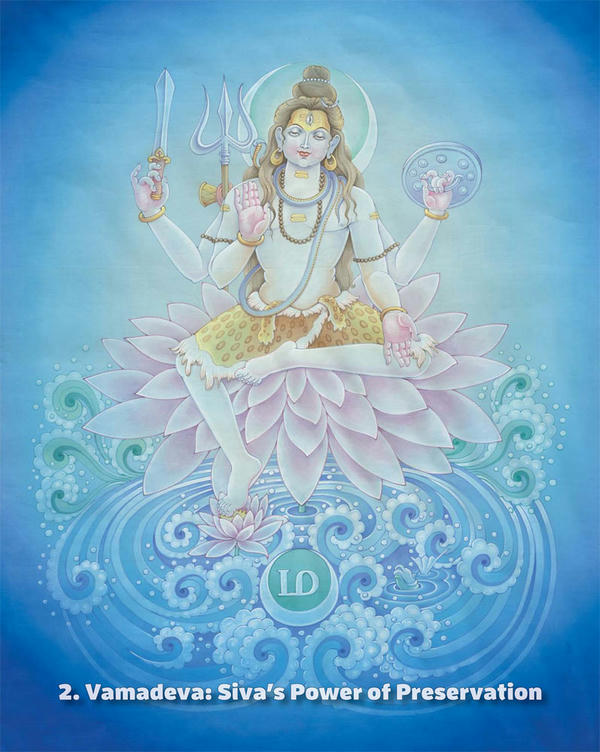
- Meaning: “lovely, pleasing”.
- Represents: The power of preservation, sustenance, and beauty. He is associated with the element of Water (Jala).
- Colour: Red (or Saffron/Blood Red)
- Direction: North
- Mantra: Ma
- Symbolism: This face embodies Shiva’s graceful and nurturing aspect, maintaining harmony and life in the cosmos. It’s sometimes considered his female aspect.
- Description: Vamadeva is red in colour, with a handsome face and aristocratic bearing, wearing rich apparel, a turban and garlands of flowers. He holds a sword and a shield.
South Face – Destruction/Transformation
Aghora
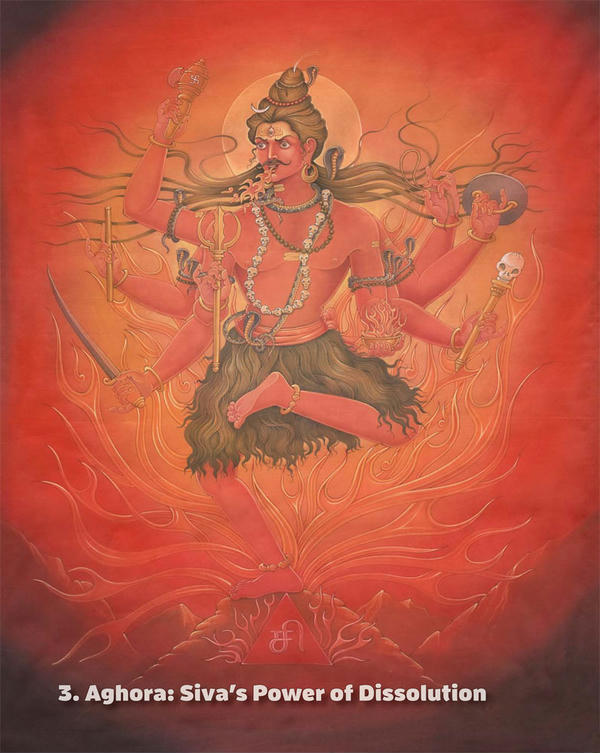
- Meaning: “non-terrifying”
- Represents: The power of destruction, dissolution, and transformation. He is associated with the element of Fire (Agni).
- Colour: Blue-black (or Smoky/Dark Cloud)
- Direction: South
- Mantra: Si
- Symbolism: This fierce aspect of Shiva symbolizes the necessary destructive force that clears away the old and obsolete, paving the way for renewal and regeneration. It represents the darker, yet essential, side of existence.
- Description: Aghora Deva is the colour of dark cloud and is adorned with crescent studded crown and beautiful earring. Though His expression is pleasant, His appearance is dreadful, with long, projecting teeth, and a tawny coloured beard, moustache and matted hair. He is adorned with snakes and scorpions and a garland of skulls. The four hands on the left side hold a fire, khatvanga (a staff with a skull at its top), shield and noose. The four hands in the right side hold a trident, hatchet, sword and staff.
East Face – Concealment/Obscuration
Tatpurusha
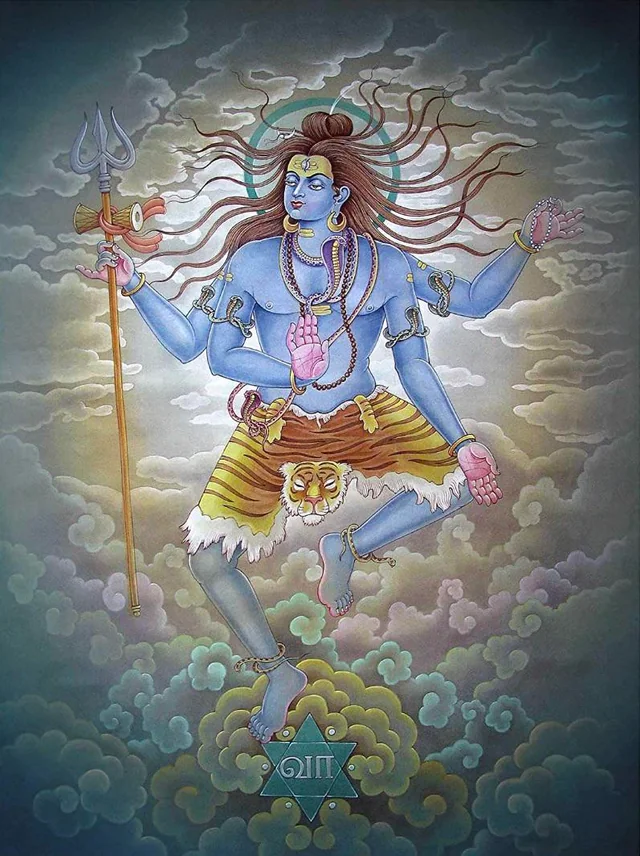
- Meaning: “supreme soul”
- Represents: The power of concealment or obscuring grace. He is associated with the element of Air (Vayu).
- Colour: Gold (or Yellow)
- Direction: East
- Mantra: Ma
- Symbolism: This face represents Shiva’s power to veil the truth from souls, allowing them to experience the world and evolve through illusion (Maya). It signifies introspection and inner wisdom.
- Description: Tatpurusha Deva is gold in colour, dressed in yellow silken cloth, head adorned with a crown and crescent moon. In one hand he holds a string of beads and in another His trident staff.
Upward Face – Revelation/Liberation
Ishana
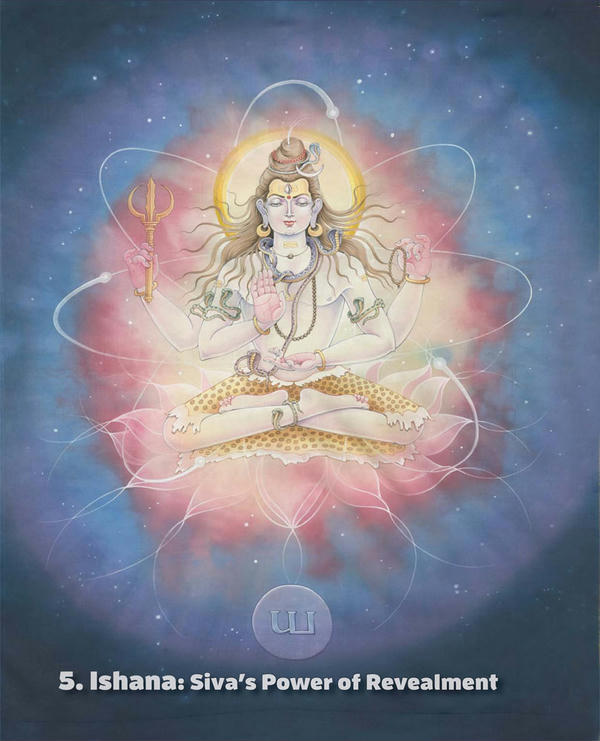
- Meaning: “ruler”, The controlling Lord of Sadshiva.
- Represents: The power of revealing grace and liberation. He is associated with the element of Ether/Space (Akasha).
- Colour: Crystal
- Direction: Upward (or Zenith/Skyward)
- Mantra: Ya
- Symbolism: This is the supreme and transcendent aspect of Shiva, representing ultimate consciousness and the power to free souls from the illusion of separateness, leading them to self-realization and unity with the divine.
- Description: Ishana Deva is pure crystal in colour, with three eyes. In one hand he holds a trident and in another a string of beads. His two other hands present the abhaya (fear not) and dhyana (meditation) mudras. Bearing a crescent on His crown, His form is charged with benevolence.
These five aspects collectively represent the entirety of Shiva’s cosmic play, encompassing creation, preservation, destruction, the veiling of reality, and ultimately, liberation.