
Traditional Concepts

https://www.artzolo.com/search?q=chakras Kunuku bhushayya
Introduction
- Within your brow is the inner guru and the seat of command.
- Ajna means “command” or “perception”.
- The function of Ajna is intuition and clarity.
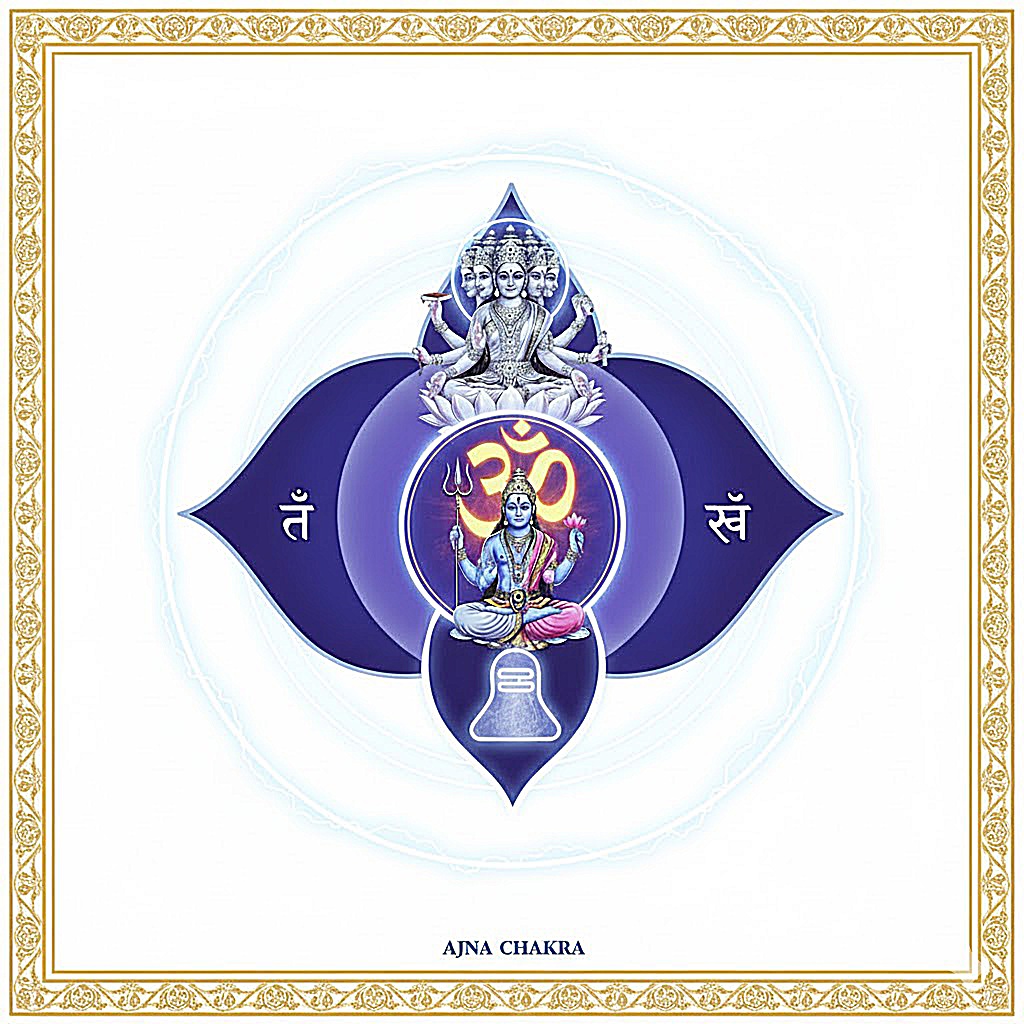
- It is represented as a lotus with two, white petals (representing Ida and Pingala).
- The Bija Mantra is OM.
- The element is mind.
- The sense is beyond physical senses (extra-sensory perception).
- There is no animal symbol, as this chakra transcends the elemental world.
The lotus, Ajna is pure white like the moon.
Ajna means ‘command’. It governs the energy dynamics of the subtle body,
Once Kundalini reaches this point, the spiritual consciousness is fully activated, allowing the practitioner to “command” or govern the energy dynamics of their subtle body.
When you gain command of Ajna chakra you reach beyond indecision and time. As you rise beyond worldly desires and motivation you come to know intuitively what you need to do to fulfill your life’s purpose, bringing spiritual fulfillment and happiness. There is the big voice of ego bellowing at you what you ‘should’ do and there is the little voice of your true self, whispering what will lead you to happiness. When you learn to listen to the little voice, it becomes stronger and will tell you truly what path you need to follow. Then you need to find the strength and willpower to do it.
Ida and Pingala Nadi
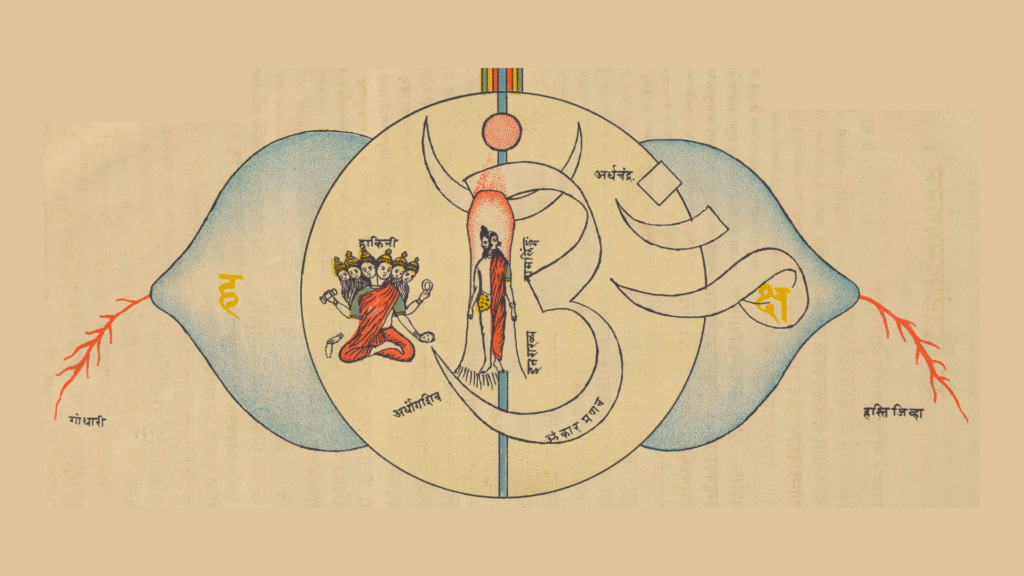
Nadi means “stream”.
Nadi Shodhana (alternate nostril breath) is a harmonizing breathing technique.
Ajna chakra represents many dual principles, and the need to transcend duality to reach enlightenment. Here the two principles of awareness must unite, Apara, worldly knowledge and para, spiritual wisdom, then one gains the blessings of bliss and impermanence.
Ida, Pingala, and Susumna Nadis all originate at the Muladhara Chakra (Root Chakra), where Kundalini Sakti lies coiled, illustrating the concept of duality with Ida and Pingala operating around the core of oneness (Susumna), which is the path to spiritual awakening. The three main channels begin at the base, and while the Susumna runs straight up the spine, Ida and Pingala run parallel to the central channel, Susumna Nadi. They all cross each other at the location of every chakra, forming a double helix pattern, or a caduceus. The crisscrossing stops at the Ajna Chakra (Third Eye), where all three channels merge before Ida and Pingala continue to their respective nostrils, and Susumna proceeds to the Sahasrara Chakra (Crown).
This spiralling path around the central column is what creates the dynamic interplay of dualistic energy (male/female, sun/moon) that defines our human experience until that duality is resolved at the Ajna, where male and female energies become neutral, bringing balance, equilibrium and a sense of oneness and unity with the cosmic laws. Duality becomes equalized.
| Feature | Idā Nāḍī (Feminine/Lunar) | Susumna Nāḍī (Neutral/Consciousness) | Pingala Nadi (Masculine/Solar) |
|---|---|---|---|
| Symbol | क्षं Ksam | ॐ Aum | हं Ham |
| Primary Energy | Feminine Energy (Sakti, Moon) | Pure Consciousness (Śiva, Fire/Void) | Male Energy (Prāṇa, Sun) |
| Flow/Nature | Cooling, Inward, Restorative, Passive | Non-Dual, Neutral, Heating (Awakening) | Heating, Outward, Action-oriented, Active |
| Color | Cool, White | Brilliant White/Gold (Light of Kuṇḍalinī) | Hot, Red or Orange |
| Origin | Starts Left of Susumna at Mūlādhāra | Runs straight up the Central Column (Spine) | Starts Right of Susumna at Mūlādhāra |
| Path | Spirals around Susumna, crossing it at each Chakra. | Runs directly through the center of the Chakras. | Spirals around Susumna, crossing it at each Chakra. |
| Termination | Ends at the Left Nostril (after Ajna Chakra) | Ascends to the Sahasrāra Chakra (Crown) | Ends at the Right Nostril (after Ajna Chakra) |
| Force | Magnetic energy | Spiritual/Causal Energy | Electrical energy |
| Psychological Function | Intuition, Emotion, Fantasy, Creativity, Philosophical thinking | Spiritual Awareness, Liberation (Mokṣa), Beyond Time/Ego | Logical thought, Analytical, Systematic thought, Valour |
Ha means the sound of sun, Ta means the sound of moon, making Hata. Following hatha yoga, with its focus on the breath, brings happiness and pleasure known only to practitioners. It can only be achieved by those who do good deeds.
Ida and Pingala are time-bound. Up to the fifth chakra, Vishuddha, the yogi also is time bound, but as Ida and Pingala end in Ajna, the yogi moves beyond time into Sushumna, a state of non-dual consciousness. Shiva represents the ultimate reality, beyond all dualities, time, and space. The Ajna Chakra is precisely the point where individual consciousness begins to merge with and directly experience this cosmic consciousness. It’s the “third eye” that sees beyond illusion into truth.
As Ajna expands, it leads to the ability perceive the thoughts and emotions of people and all living beings, as well as energies of surroundings and other manifestations, and the ability to affect (command) these energies, to wield, weave, and direct them with intention.
| Symbol | Transliteration | English Phonetics | Pronunciation Secret |
|---|---|---|---|
| हं | haṁ | Hum | Like “Humming.” Represents the “Shiva” or masculine energy aspect. |
| क्षं | kṣaṁ | Kshum | “Ksh” as in baksheish. Represents the “Shakti” or feminine energy aspect. |
Kundalini
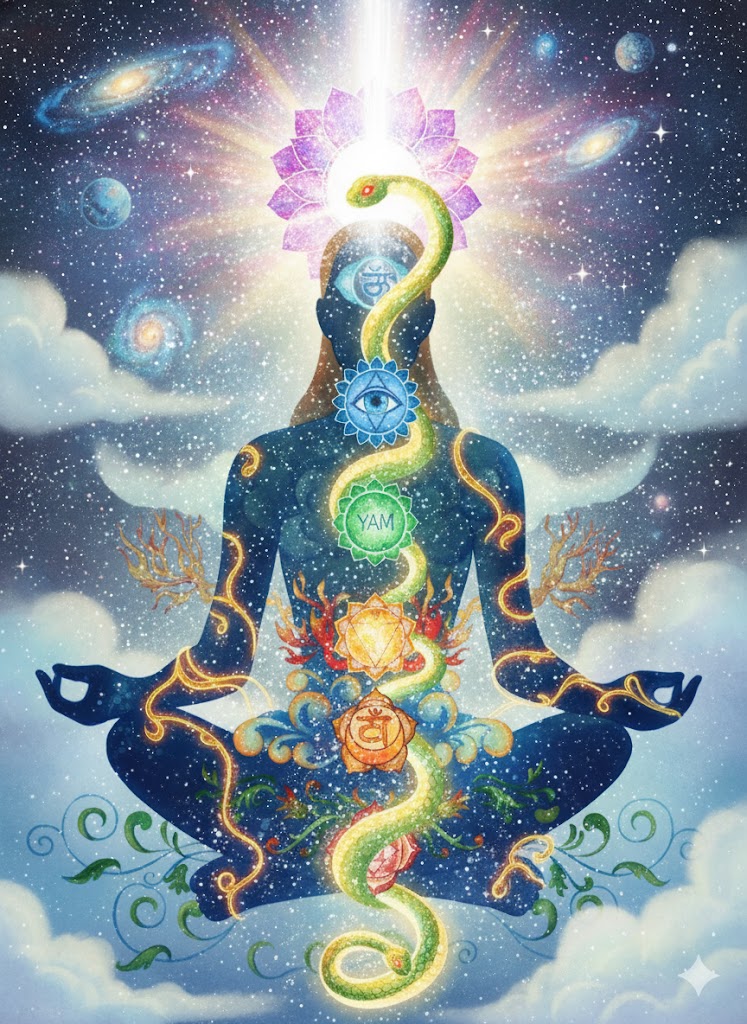
In Muladhara, Shakti, the static unmanifested Kundalini, is symbolized by a serpent coiled into three and a half circles around the central axis Svayambhu-linga at the base of the spine. The serpent lies blocking the entrance to Sushumna, the central channel with his mouth. Sushumna remains closed at its lower end as long as Kundalini is not awakened.
To awaken Kundalini, Prana (the vital air), is guided, with its circulatory movement through Ida and Pingala down to the base of the spine into the space where Kundalini lies coiled. The vital energies of the opposite forces circulating in Ida and Pingala will be unified and Shakti Kundalini will then awaken and rise up Sushumna, energizing the seven chakras.
From Muladhara chakra, Ida and Pingala alternate from the right to left sides at each chakra until they reach Ajna chakra where they meet again with Sushumna.
In Ajna chakra the meeting of the three main nadis is called Mukta Triveni. Mukta is the liberation from duality and Triveni means “three rivers” and is used metaphorically for the flow of the nadis. It is where the sacred Ganga, Yamuna, and the mythical Saraswati rivers meet. Continuing beyond Ajna chakra, Ida and Pingala end in the left and right nostrils respectively and Shushumna continues its path right up to the crown of the head (Sahasrara Chakra), where the Kundalini-Shakti meets with Shiva (Pure Consciousness), leading to the state of Samadhi.
Once the Kundalini Shakti has ascended through Sushumna to Sahasrara, the highest psychic centre at the crown of the head, it is made to reverse its course and return to rest in the base centre again.
Deities of Ajna Chakra
Deities are not just mythological figures; they are symbolic representations of the profound energetic and psychological functions of each chakra.
Ardhanarishvara
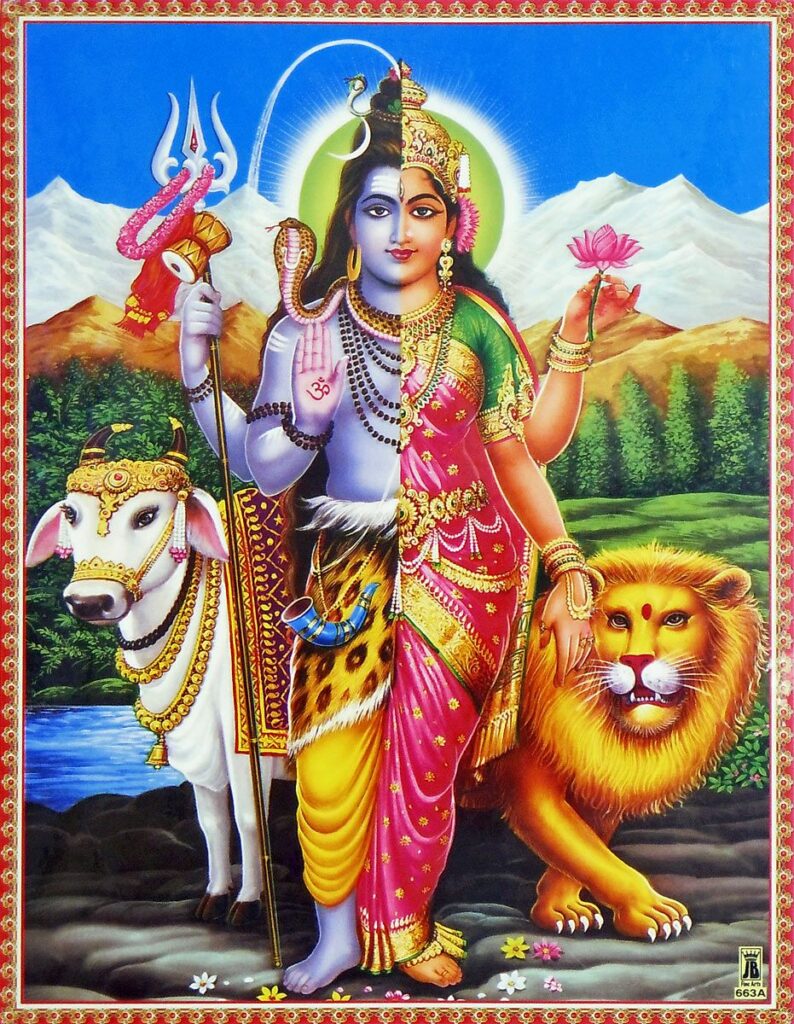
The presiding deity is Ardhanarishvara, an androgynous deity, in which the female and male principles are equally represented.
The half-male, half-female, Shiva-Shakti, is symbolic of basic polarity; the right side is male and the left side, female. The symbolic intent of the figure, is to signify that the male and female principles are inseparable. Purusha is the passive force of the universe, while Prakriti is the active, dynamic force. Both these forces must embrace and fuse with each other to generate and sustain the universe.
The sacred bull, Nandi is shown as the gatekeeper and vahana or vehicle of the Ardhanarishvara. But sometimes, portraits may depict the Nandi, the sacred bull is the bearer of truth and righteousness standing or sitting near the Shiva half and a lion near the Devi’s half.
Ardhanarishvara stands in a shining white lingam, the colour of brilliant light. The male half of Ardhanarishvara has camphor-blue skin. He holds a trident in his right hand, representing the three aspects of consciousness: cognition, will, and affection.
The female side of Ardhanarishvara is pink. She wears a red sari, and about her neck and arms are wound shining golden ornaments. She holds a pink lotus, a symbol of purity. All duality has ceased. Shiva has total command over all aspects of the self in this plane of liberation, or moksha.
The third eye of Shiva is called sva-netra, the organ of clairvoyance. As Sadashiva, the eternal one, Shiva is no longer separate from Shakti. Sadashiva’s role is to pierce the knot of Rudra Granthi (Knot of Siva/Rudra) destroying the final remnants of the individual ego, attachment to siddhis, subtle forms of the ego, and the pride associated with spiritual knowledge, transcending the duality of the mind (the two petals of the Ajna Chakra) to unite with the ultimate consciousness in the Sahasrara Chakra. This knowledge brings the breath (prana) and the mind under control of Ardhanarishvara. Most portraits show both half-forms sharing the trinetra or the third eye.
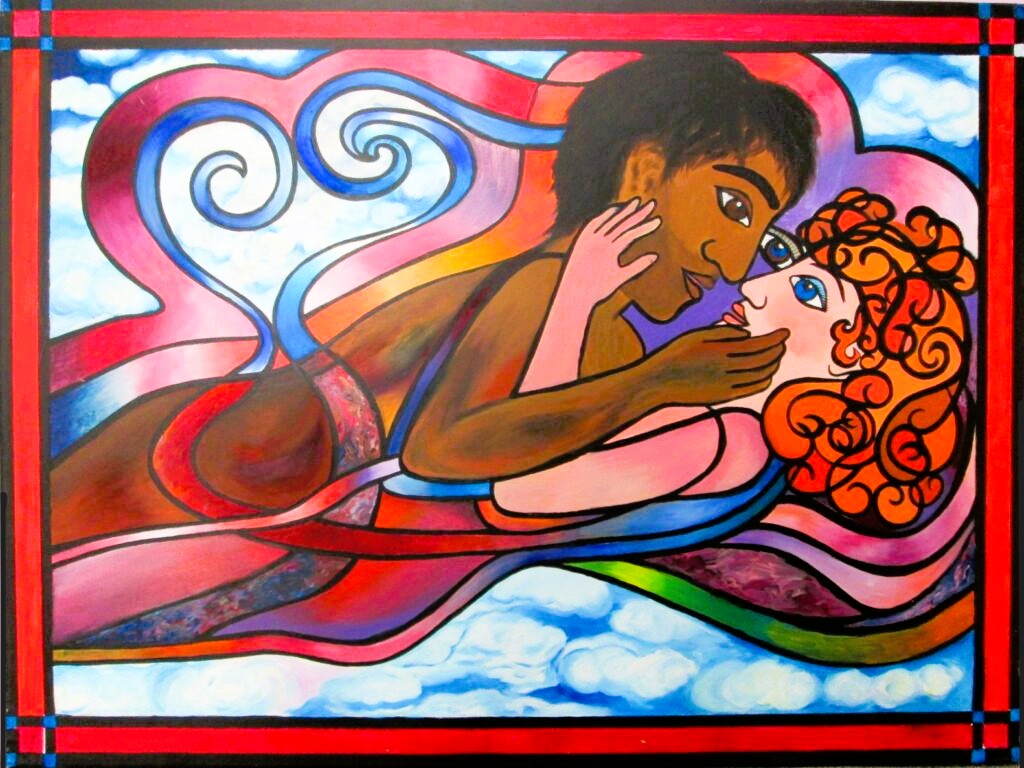
Totality lies beyond duality, in the equality of masculine and feminine energies. Two equal parts, making the whole. Parvati embodies the illusory, material world while Shiva represents abstinence from worldly pleasures to achieve spiritual goals. The fusing of these two opposites indicates that both the material and spiritual spheres have to coexist in one’s life, for it to be complete. Shiva and Shakti are inseparable and interdependent, they cannot be regarded as two individual identities.
Shiva embracing Parvati is associated with the boundless reproductive ability of Mother Nature herself. The supposedly opposing forces then become so non-dual, that it would finally become impossible to locate the masculine in the feminine and vice-versa.
Shakti Hakini
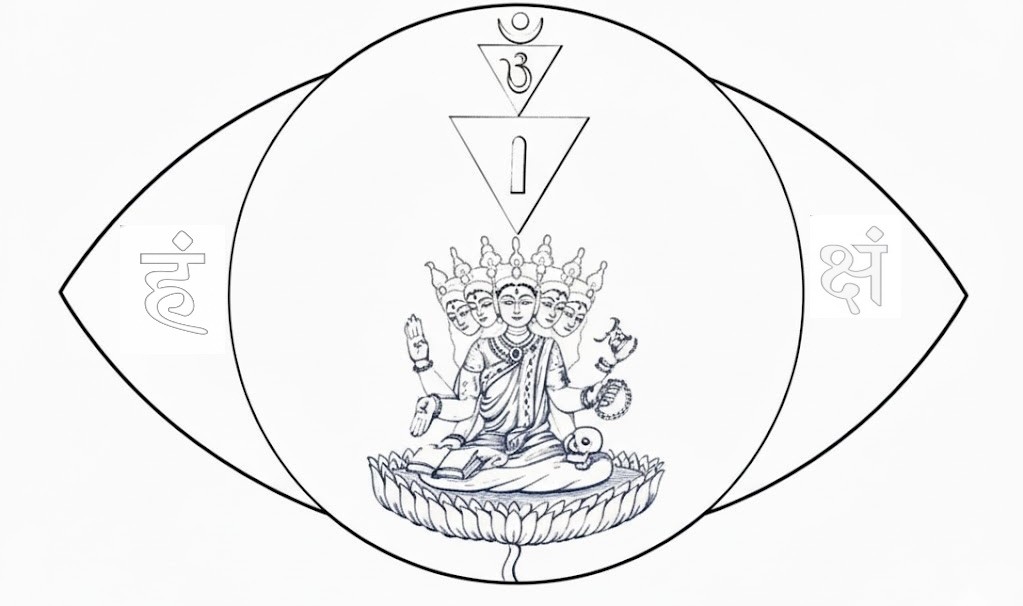
The activating energy of Ajna is Shakti Hakini, whose name suggests “power” or “ruler” represents the power of the mind, intuition, intellect, and higher knowledge. She rules over the lower chakras.
Shakti Hakini, has six faces white like the moon, symbolizing purity and the light of knowledge. The six heads represent the six senses; the mind is the 6th sense. Her six arms hold a book, symbolizing wisdom, a skull, as she is the goddess of bone marrow, a double-sided drum maintaining a steady drone, and mala beads for focusing. Two other hands are raised in the gesture driving away fear and giving favours. Her mind is pure (Shudda-Chitta). She is the goddess of bone marrow, and prefers food seasoned with turmeric (it is interesting to note that turmeric is good for bones and joints)
Focusing on her during meditation brings wisdom and clarity. Visualize her sitting in the pericarp of a white lotus with hands in Hakini mudra. Hakini Mudra brings the fingertips of both hands together for concentration. Meditation on her in Ajna enhance intuition and psychic abilities, improve memory and concentration, awakens spiritual wisdom and discernment and leads to a deeper understanding of one’s true self.
She imparts the knowledge of unconditional truth, the awareness of nonduality.
Mantra “Om Hakini namaha”