
Svadhishthana chakra is deeply intertwined with several Hindu deities and their associated symbols, each representing a facet of its spiritual and emotional significance.

Lord Vishnu (The Preserver)
Vishnu is the presiding deity of Svadhishthana, representing the youthful, life-sustaining energy of the primeval waters he moves on. He is all about tasting and sustaining life.
Vishnu has the ability to see through illusion (maya) to what is truly real. He represents the underlying consciousness that flows through all things, allowing him to maintain perfect balance as the preserver.

He has a youthful appearance, with a luminous blue complexion as deep as the ocean. He wears a golden-yellow garment and a green silk scarf. In his four arms, he holds the four classic attributes that maintain cosmic order:
Conch Shell: The primordial sound calling the soul to wakefulness.
Discus: The spinning wheel of time.
Mace: The power of mental and physical strength.
Lotus: The unfolding of consciousness and the beauty of creation.
Sacred Jewels: On his chest, he wears the gem of pure consciousness symbolizing his status as the Lord of Beauty and Fortune.
Lord Vishnu represents the purity that allows us to master our desires. Varuna represents the element of water itself
Lord Varuna: The Celestial Guardian
The Sustainer of Life: The Sovereign of the Subconscious and Dispenser of Cosmic Law

- Varuna is the ancient ruler of the vast celestial and earthly oceans, representing the element of water and acting as the ruler of the subconscious mind. With a thousand eyes, he watches over the world, ensuring that the rhythms of nature and morality remain in perfect harmony. His eyes are a reflection of our inner-self. Varuna in Svadhishthana teaches us to look openly at our desires without being swept away by them.
- The Noose: He wields a golden lasso to rein in and bind negative desires like greed and anger.
- The Vessel of Gems: In his hand, he holds a pot of precious jewels, representing the spiritual and material wealth that flows to those who live in alignment with truth.
🔱 Deepen Your Wisdom
The deities carry sacred tools to help us navigate our inner world. Discover the hidden meanings behind the Lasso, Discus, and Trident.
Explore the Tools of the Deities →The Makara: Guardian of the Threshold
The Mythical Vehicle of the Emotional Tides

Sacred Animal – The Makara
Both Lord Varuna and the river Goddess Ganga, ride upon the Makara, a mythical half-land, half-sea creature. The Makara embodies the duality of our minds – balancing the conscious (land) and subconscious (sea). It is a powerful guardian of spiritual thresholds.
It represents negative emotions and irritability that can lurk beneath our surface. By navigating the depths of the Svadhishthana chakra, we learn to harness the Makara’s strength, turning raw emotional tides into a stable vessel for spiritual growth and creative flow. The Makara transforms into a symbol of mastery over our minds.
The hidden, turbulent tides of our psyche aren’t obstacles to escape, but forces to master. Just as the deities ride the Makara rather than destroy it, we harness our raw emotions, turning turbulent waters into a vehicle for creative and personal growth.
Sometimes the Makara is described as having the tail of a peacock or a fish, representing the multi-coloured nature of our desires. It warns the seeker that while the head of desire (the predator) is dangerous, the tail (the beauty/attraction) is what often lures us into the depths.
The Balance of Varuna & Rakini: Varuna provides the Container (Morality, Boundaries, Depth). Rakini provides the Content (Creativity, Passion, Movement).
Goddess Rakini: The Spirit of Transformation
Rakini is the spark—the creative fire to Varuna’s calm, moral depth of the water.
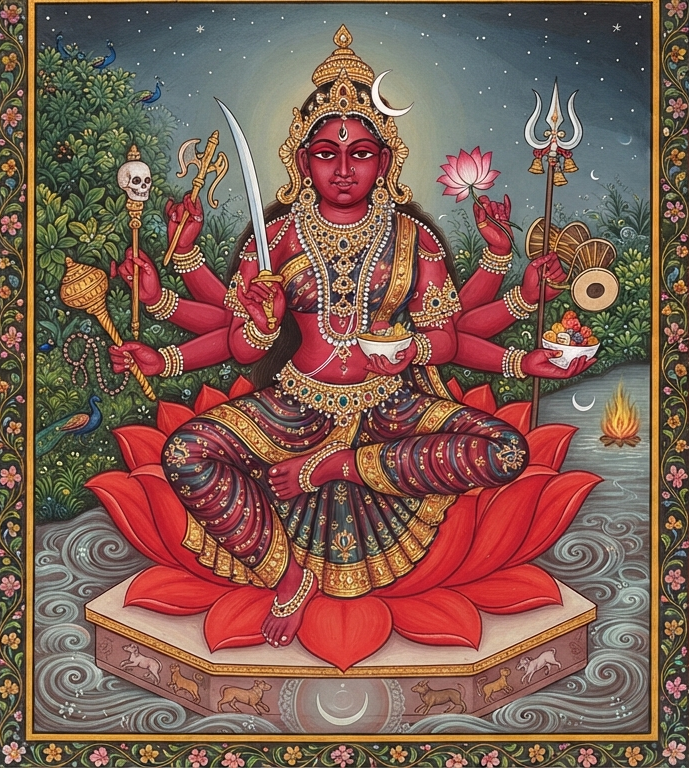
The Inspiring Shakti of the Sacral Realm
If Varuna is the ocean, Rakini is the current. She represents the vital energy (Shakti) that flows through the Svadhishthana, turning raw emotion into art and stagnant water into a rushing stream.
She is the Guardian of Nectar – Rakini is the protector of the divine nectar in our bodies. This is our vitality and life force. She ensures that our creative juices are preserved and used for growth, not wasted on distractions.
- The Celestial Beauty: Often depicted as exceptionally beautiful and dressed in red or blue, she represents the pull of beauty, art, and pleasure.
- Four or six arms: She carries tools of both creation and protection, showing that creativity requires strength.
- The Inspiring Force: Rakini is the one who grants “poetic vision.” When you feel a sudden “flow state” or a burst of inspiration, that is the energy of Rakini waking up within you.
The Flow of the Inner Sea: A Svadhishthana Meditation
Before moving forward, I invite you to pause. The teachings of the Svadhishthana are not meant to be grasped by the logic of the mind, but felt in the fluid pulse of your blood and the soft sway of your emotions.
Using the resonance of the VAM mantra and the cooling imagery of the water element, this practice is designed to help you let go of rigidity. Press play, soften your belly, and allow yourself to glide through the inner tides like the powerful Makara.
1. The Fluid Foundation
Find a comfortable seat, perhaps resting your hands just below your navel in Dhyana Mudra (right hand resting in the left, thumbs touching). Close your eyes and imagine your pelvis is a silver bowl, holding the pristine waters of an ancient, hidden lake.
2. Riding the Makara
Visualize the Makara, the legendary creature with the body of a fish and the head of a crocodile. Feel its strength and its ability to navigate the deepest, darkest parts of the ocean without fear.
- As you breathe in, imagine the Makara lifting you onto its back, carrying you through the waves of your emotions.
- As you breathe out, feel any “stuck” or stagnant energy dissolving into the cool, purifying water.
3. The Silver Crescent & The Sound
In the space of your sacrum, visualize a glowing Silver Crescent Moon. This is the symbol of the tides, the cycles of life, and your own creative potential. In the center of this moon, see the seed syllable VAM (वम).
- The Practice: Gently chant the sound VAM internally. Let the “V” sound start at your lips and the “M” resonance ripple down into your hips. Feel the vibration smoothing out the “whirlpools” of anger or pride, replacing them with a sense of pure, liquid grace.
4. The Realm of Varuna & Rakini
Now, visualize Lord Varuna, the King of the Waters, seated upon the Makara. He holds a noose made of water, symbolizing his power to bind and release. Beside him is the two-headed goddess Rakini Shakti, glowing with a soft, ethereal light.
- Visualize: See them as guardians of your subconscious. They are here to help you “digest” your feelings so they don’t become heavy.
- Affirmation: “I flow with the rhythms of life. I am a creative being, and I allow my emotions to move through me like water.”
5. Closing
Take a deep breath, feeling the “cooling nectar” of the moon filling your lower abdomen. When you are ready, gently open your eyes, carrying the serenity of the White Lotus and the adaptability of the Water Element into your day.