

Traditional Concepts
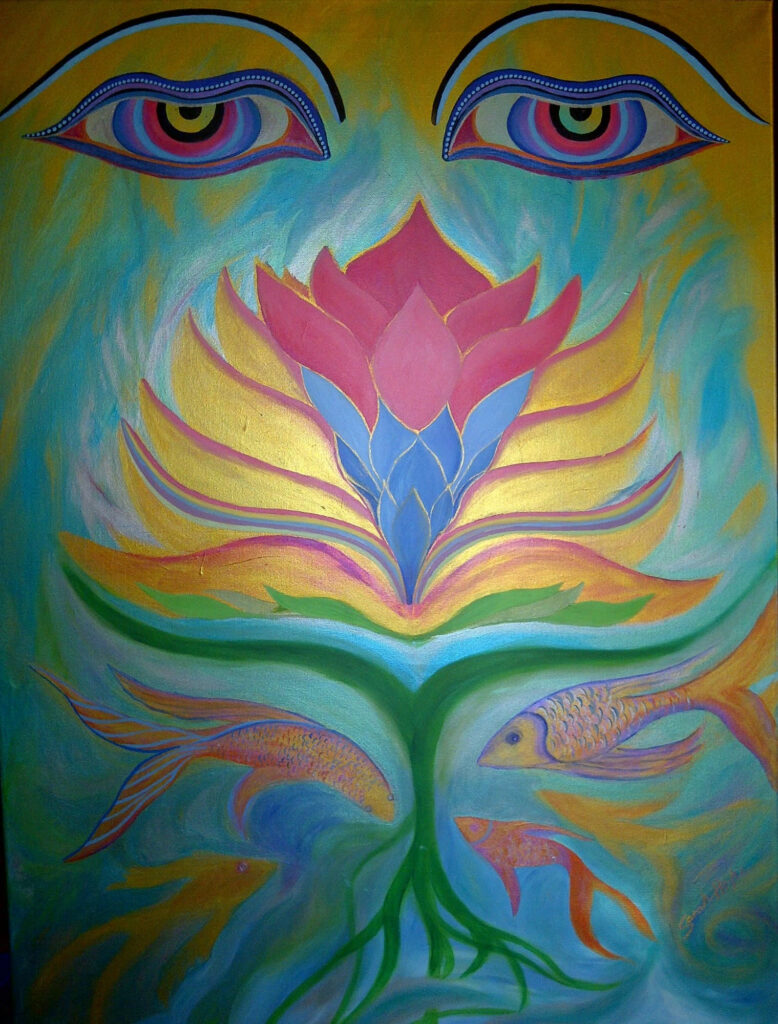
Traditional Sahasrara At a Glance
Introduction
Imagine yourself as a house. The lower six chakras are the infrastructure keeping it running: the electrical wiring (which sometimes goes haywire), the plumbing (which occasionally needs a deep clean-out) and the walls that support the roof. The kitchen is where you cook your daily sustenance and each room handles a specific, vital function of your daily life—from your primal sense of survival to your complex thoughts and emotions. Sahasrara, the Crown Chakra, is what happens when you step completely outside of that house and realize you aren’t just the structure inside the walls. You are actually the sky, the earth, the trees, and everything surrounding it.
Imagine coming home to this house. Inside is the space of pure, quiet awareness where the busy chatter of the mind finally falls silent. Instead of feeling like an isolated individual in life, entering the Crown is the experience of coming home to absolute peace, where the boundaries of the ego dissolve, and you realize you are deeply connected to everything that exists outside of you. It is the shift from being a single person inside a room to becoming the infinite space itself.
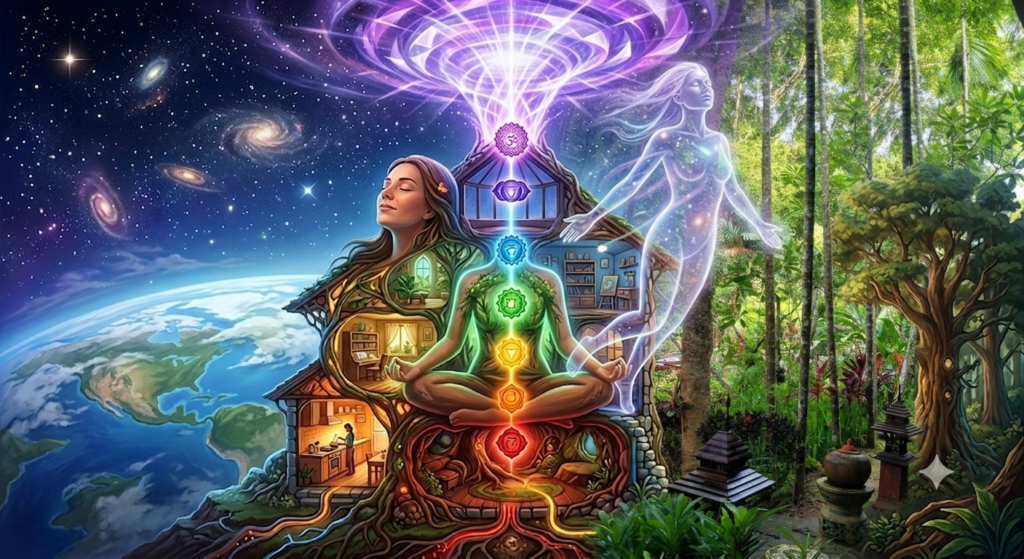
The thousand-petaled lotus of Sahasrara is the absolute summit of the subtle energy architecture. Situated at the crown of the head, it represents the plane of pure, unconditioned consciousness where individual awareness entirely dissolves into the cosmic whole. While modern New Age systems often describe it as an energy gateway for personal spirituality, the traditional Agama texts map Sahasrara as a vast, non-dual void—a sublime landscape that is simultaneously completely empty and perfectly full. It is full of the potential of emptiness
The Architecture of the Subtle Channels (Nādīs)
True realization of the Ātmā is not an isolated event at the crown; it requires a simultaneous awakening and resonance between the Anāhata Chakra (Heart) and the Sahasrāra Chakra.
During the rise of Kundalini, spiritual energy travels upward through the dual pathways of the Idā and Pingalā nadis. These currents meet and balance at the Ājñā (Third Eye) chakra, where they combine with the primary evolutionary force ascending directly through the central channel, the Sushumnā Nādī.
Traditional texts reveal that the Sushumnā is not a singular pathway, but rather a nested network of three progressively subtler, concentric channels that become active as consciousness refines:
- Vajra Nādī: The outer subtle layer running within the awakened Sushumna.
- Chitrā (or Chitrini) Nādī: Contained within the Vajra, conducting high-frequency creative light.
- Brahma Nādī: At the absolute center rests the subtlest flow of all. It is named after Brahman because the highest, transcendental levels of universal consciousness are directly activated via this channel. When the Kundalini Shakti passes unhindered through the Brahma Nadi, non-dual liberation is achieved.
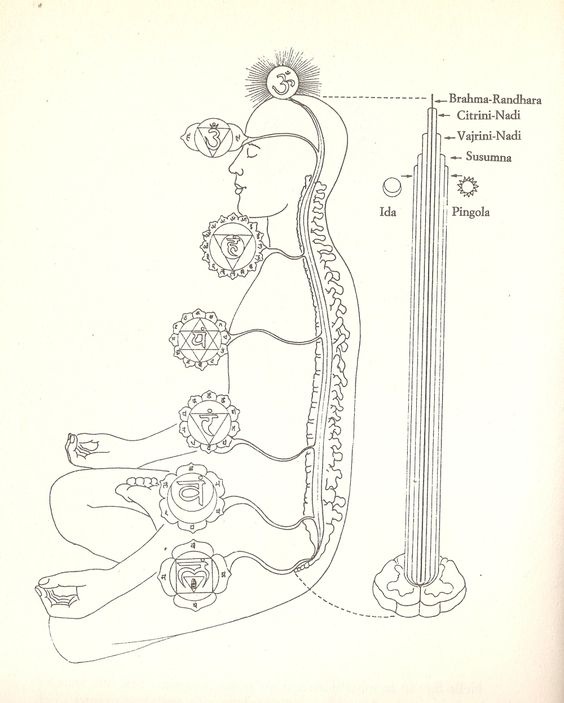
The Concentric Nesting: The telescope-like pillar represents how Vajrini (Vajra), Citrini (Chitrā), and Brahma-Randhara (Brahma Nadi) are layered inside the main Sushumna channel.
The Cosmic Markers: The diagram highlights Ida with a crescent moon symbol 🌙 and Pingalā with a sun symbol ☀️ at the top of the channels. This directly supports the cosmic, dualistic themes of your Shunya/Purna section.
The Pathway of Ascent: The dotted line at the base explicitly shows how the primary energy pathway originates right at the root before narrowing into those concentric central channels.
The nested concentric architecture of the Sushumna Nadi, illustrating the subtle layers leading to the Brahma-Randhara at the crown.
The Separation and Union of Shiva and Shakti

Our lifelong human striving for lasting happiness, security, and fulfillment is fundamentally an energetic urge toward cosmic unity. In the macrocosm of the subtle body, Shakti (nature, matter, and creative energy) is anchored at the base within the Mūlādhāra Chakra, while Shiva (pure, unmanifest consciousness) rests at the summit within the Sahasrāra.
Between these two cosmic poles exists an irresistible, magnetic attraction. When they are separated by our conditioned mind, we experience the vast distance between them as a dark zone of unclarity. This not-knowing is the fundamental ignorance of how the universe really is, it is the mistaken belief that we are separate individuals rather than an interconnected whole. The structural consequences of this perceived separation are the emotional currents of suffering that colour human life: loneliness, sadness, bitterness, fear, and doubt.
When energy ascends to the crown through the Brahma Nādī, the ultimate union is achieved. The restless chatter of the mind falls silent. Every busy thought, emotion, and desire simply dissolves back into the deep, quiet peace from which it came. The yogi becomes a realized being, aware of their true nature as absolute truth. As long as they remain in the physical body, they retain this non-dual consciousness.
However, when this illusion of division dissolves at the crown, the practitioner realizes that everything is ultimately one. Even while living daily life in a physical body, the liberated soul carries this realization everywhere. Existence transforms into a beautiful, joyful play (lila)—something to be witnessed and enjoyed fully, entirely free from the ups and downs of pleasure, pain, honors, or humiliations. The practitioner lives in a state of equanimity, they are indifferent to honors and humiliations, because the ego is gone, praise cannot inflate them, and criticism cannot wound them.
The Dissolution of the Antahkarana (The Inner Instruments of Mind)
To understand how states of non-duality and Samadhi are reached at the Crown, we must look at the operational mechanics of the mind. As explored deeply in The Antahkarana: The Four Functions of Mind , our daily human experience is governed by the shifting dynamics of Manas (sensory mind), Ahamkara (ego-identity), Chitta (memory storehouse), and Buddhi (intellect/discernment).
To dive deeper into how these functions govern our human experience prior to liberation:
Read: The Antahkarana: The Four Functions of Mind ✨Up to the level of the sixth chakra (Ajna), these four internal functions are still highly active, structuring our inner visions, thoughts, and even advanced meditative trances. However, upon entering the Sahasrara, a profound shift occurs: the Antahkarana completely dissolves back into its origin.
- Ahamkara (Ego) relinquishes its rigid boundaries, expanding infinitely into the Supreme Self.
- Manas (Sensory Processing) falls into absolute, quiet stillness.
- Chitta (Subconscious Impressions) clears out completely, transforming into pure space.
- Buddhi (Intellect) no longer needs to analyze or discern between “this and that,” because the knower, the knowledge, and the object of knowledge have merged into one.
The best way to begin to understand Sahasrara is to regularly practice deep meditation, where you intentionally let go of everything and all is peace. Samadhi is the pure bliss of total inactivity. While a yogi entering a trance state in the lower chakras still experiences residual form or mental activity, at the level of Sahasrara, even the meditator dissolves. The more often you can attain this state of bliss, the easier it becomes to rest in your real self.
The Seed of All Vrittis
Because Sahasrara is the final terminus where the energy of all Nādīs flows together, it contains the foundational seeds of every human expression. As we mapped out in A Map of the Vrittis: Navigating the Emotions of the Chakras, human nature experiences 50 primary vrittis (mental inclinations).
When these 50 primary tendencies are expressed through the 10 Indriyas (the ten senses and organs of action) in both an internal and external manner, they branch out into exactly 1,000 distinct permutations. This mathematical perfection is why the traditional texts depict the Sahasrara as a lotus of one thousand petals—one petal for every unique expression of human consciousness returned home to its source.
Navigating the Whirlpools of Mind
Before the final seed of individual mind returns to pure white light, it flows through a vibrant landscape of chakra-based emotions.
Explore the Vrittis