

2nd, Sacral Chakra

At the heart of this fluid emotional centre lies the bīja mantra Vaṁ (वं). Just as a drop of water holds the blueprint of the ocean, chanting or meditating upon Vaṁ (वं) anchors our awareness, helping us navigate the swirling currents of the subconscious.
The Svadhisthana (2nd chakra) has 6 petals: baṁ, bhaṁ, maṁ, yaṁ, raṁ, laṁ.
These sounds are the vibration of the vrittis that are mostly shadow qualities—the messy, complicated parts of being human. Swadhisthana is the center of emotion, sexuality, and creativity. Because it is a water element, its qualities (Vrittis) are more fluid, messy, and interpersonal. Human qualities like disdain, mistrust, and indulgence fit perfectly here. They are all about how we flow (or crash) into other people.
In the traditional Agamic view, these vrittis represent the expressions of consciousness as it operates through Svadhishthana. Rather than viewing them simply as moral failings to be suppressed, classical practice seeks to understand, master, and ultimately dissolve these currents back into the central seed vibration at the core: Vaṁ (वं).
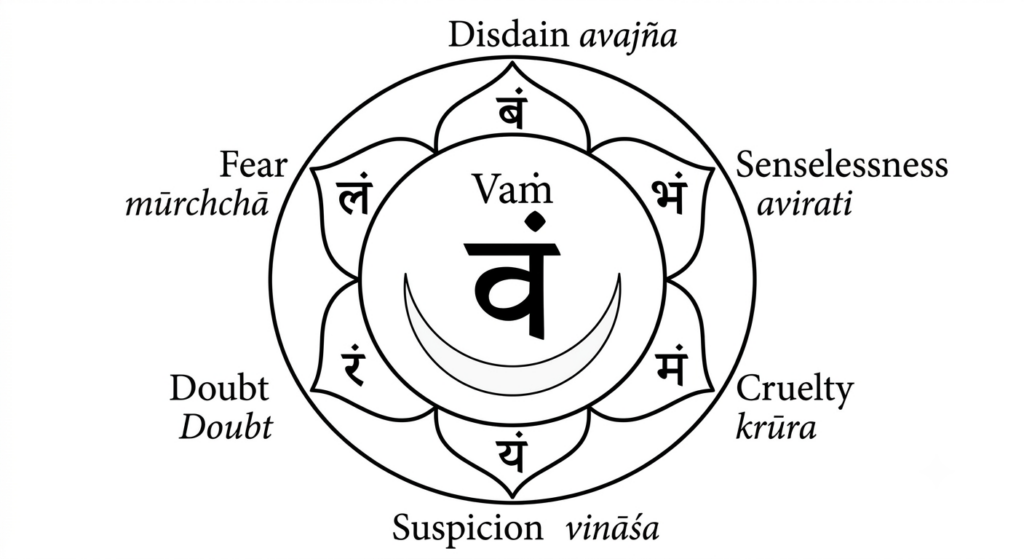
Overcoming Negative Emotions in Svadhishthana Through Acoustic Roots, Vibrations and Practice
The Svadhishthana chakra is a hub for various challenging emotions, but by chanting their “acoustic roots” out loud or internally, and applying targeted practices, we can transform these feelings and cultivate positive qualities.
1. Baṁ (बं) – Avajñā (Indifference, Disdain)
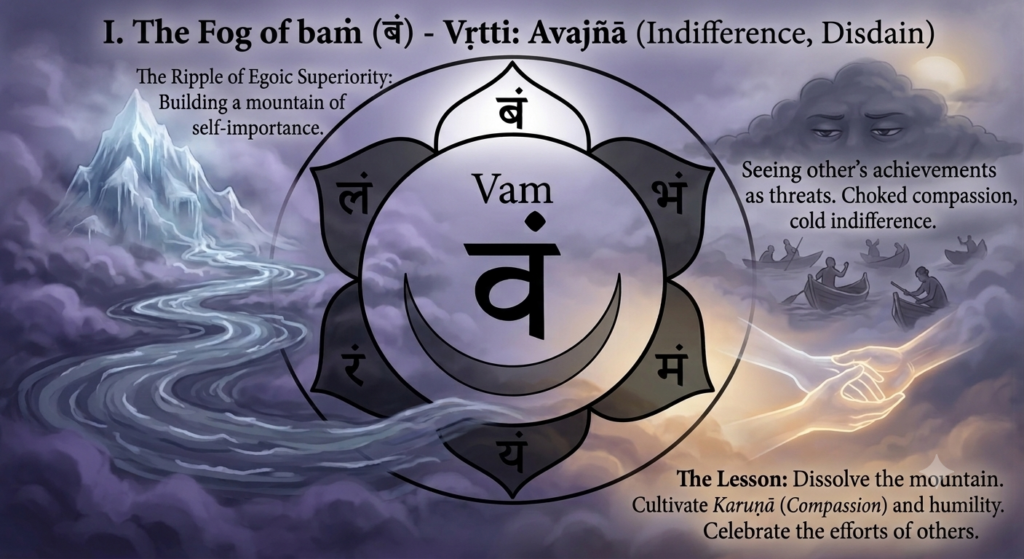
Challenge: Belittling others to build an ego-driven sense of superiority creates a cold, stagnant block in the sacral waters.
Solution: Cultivate empathy by celebrating others’ good fortune and recognizing their struggles with compassion instead of judgment.
2. Bhaṁ (भं) – Mūrcchā (Loss of Clarity / Delusion)
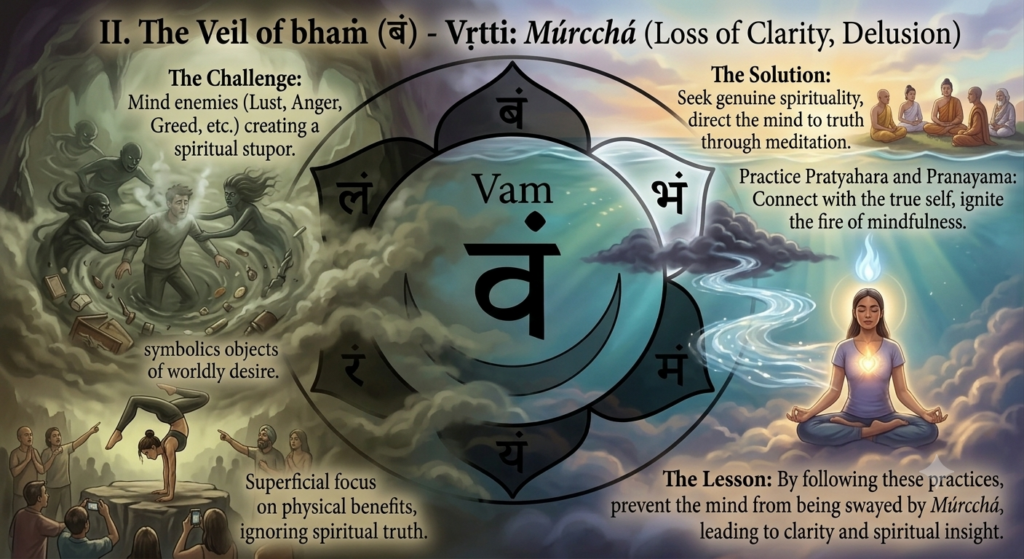
Challenge: Letting your good judgment become clouded by superficial understandings or mind enemies leaves you trapped in illusion.
Solution: Practice pratyahara to withdraw the senses and anchor your mind directly in truth through meditation and breathwork.
3. Maṁ (मं) – Prashraya (Over-Affection / Indulgence)
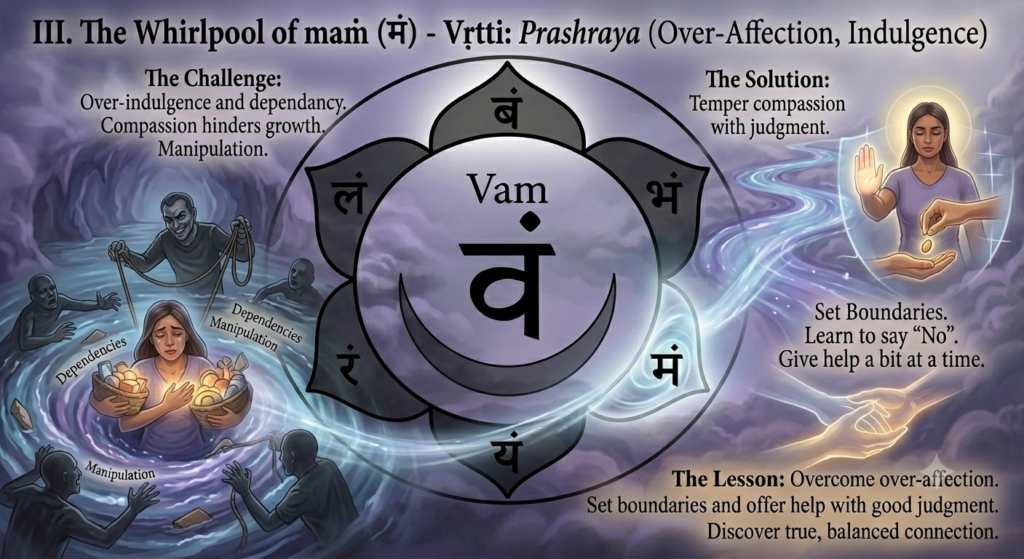
Challenge: Allowing kindness to turn into enabling encourages dependence and invites people to take advantage of your generosity.
Solution: Temper your compassion with discernment by setting firm boundaries and offering help in measured, balanced steps.
4. Yaṁ (यं) – Avishvāsa (Self-Doubt / Suspicion)
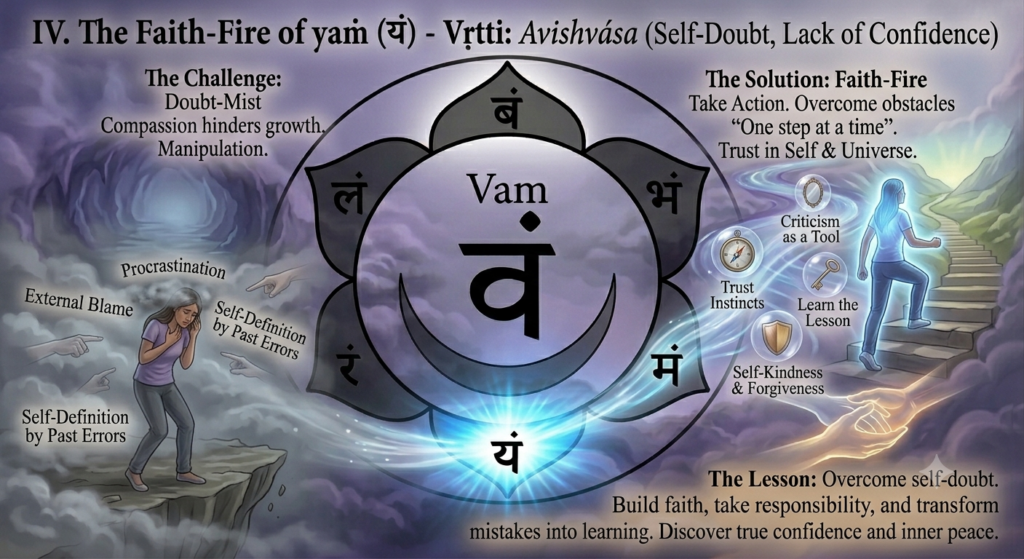
Challenge: Procrastination and uncertainty erode your confidence, blocking inner peace and fueling constant hesitation.
Solution: Build trust from within by taking structured, step-by-step action and treating past errors as lessons rather than limits.
5. Raṁ (रं) – Sarvanāsha (Fear of Annihilation / Defeatism)
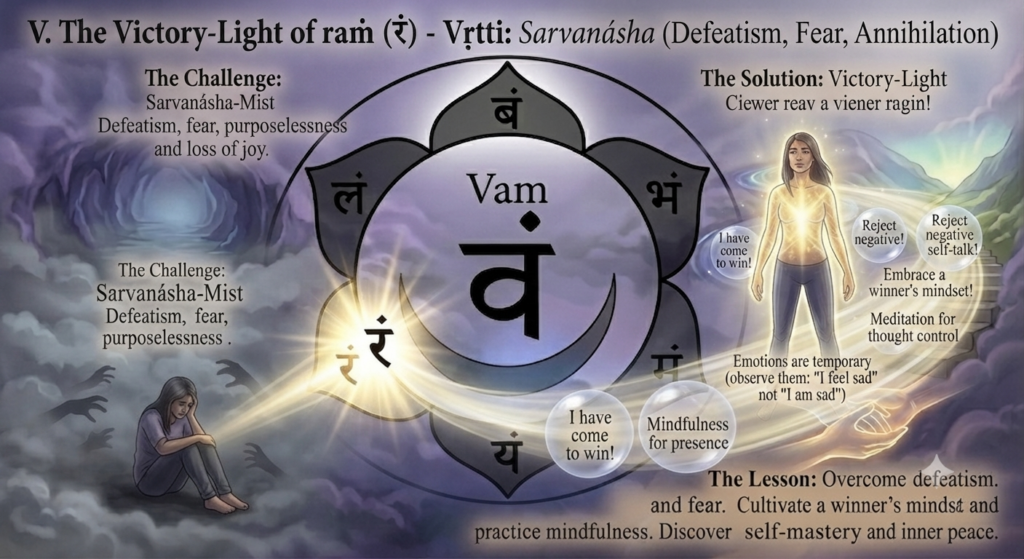
Challenge: Falling into profound hopelessness and fear makes you feel as though everything is inevitably lost.
Solution: Counteract defeatism by taking grounding action and using powerful mental shifts like “I have come to win.
6. Laṁ (लं) – Krūratā (Cruelty / Pitilessness)
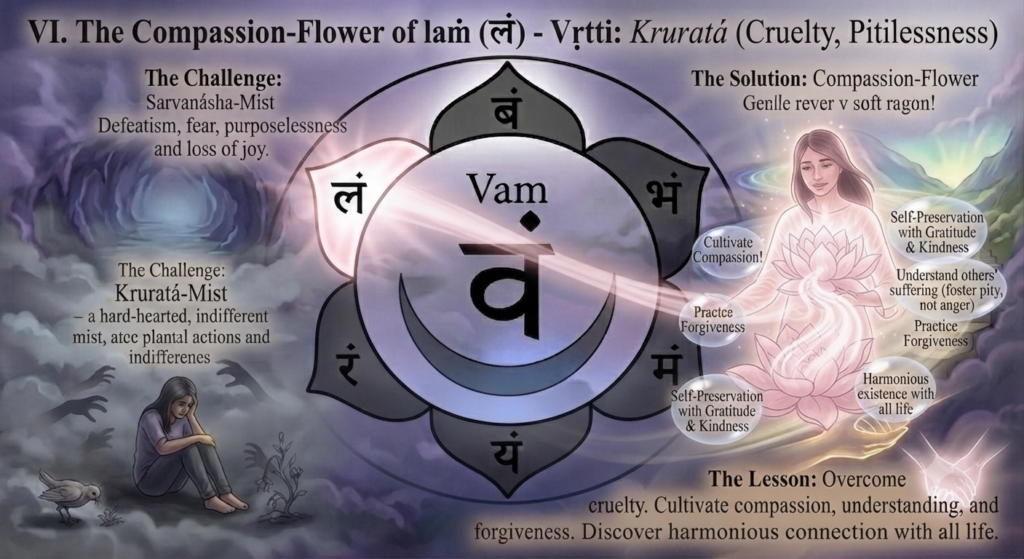
Challenge: Shutting down empathy leads to hard-heartedness and indifference toward the suffering of others or the environment.
Solution: Recognize that cruelty always stems from inner pain, replacing anger with grounded compassion and forgiveness.
The Universal Strategy: “Vairagya” (Non-Attachment)
In yoga, the ultimate way to deal with these qualities—whether in yourself or others—is Vairagya. You become the witness.
When someone acts out one of these qualities, try saying to yourself: “Ah, there is a human experiencing disdain (Baṁ) to help you depersonalize the behavior so you don’t have to carry their baggage.
Here are some ideas on how to deal with these qualities if you come across them in another person:
1. Baṁ: Disdain / Arrogance This is the “I’m better than you” energy.
The Approach: Use the Grey Rock method. Arrogance feeds on a reaction. By being as uninteresting and neutral as a grey rock, you starve the ego-play. Don’t argue your worth; your results will do that for you. If someone is disdainful, try asking them why they are being dismissive. Disdainful people often rely on the other person being too polite to mention their behaviour. By naming it, you pull the rug out from under their act.
2. Bhaṁ: Mistrust / Lack of Confidence This person might be suspicious of your motives or constantly doubt themselves.
The Approach: Practice radical consistency. Radical consistency is the practice of becoming so predictable that you effectively “starve” the other person’s suspicion. However, if their suspicion turns into accusations, don’t over-explain—sometimes “I’m sorry you feel that way” is a complete sentence. Use this method as a tool to see if the other person is capable of healing.
3. Maṁ: Affection / Infatuation This can manifest as over-attachment or “clinging” behavior.
The Approach: Set clear boundaries. If someone’s affection feels heavy or conditional, kindly define your space. Enjoy the warmth, but don’t let their need for validation become your full-time job.
4. Yaṁ: Delusion / Confusion Dealing with someone who isn’t seeing reality clearly or is easily “lost” in their own head
The Approach: Offer grounding clarity. Use “I” statements to share your reality without attacking theirs (e.g., “I see it differently…”). Avoid getting sucked into their whirlwind; stay anchored in what you know to be true.
5. Ram: Disregard / Destructiveness This manifests as a “don’t care” attitude toward people’s feelings or physical things
The Approach: Detach and Observe. When someone is in a destructive phase, getting too close often leads to collateral damage. Observe from a distance, offer help only if they are ready to change, and prioritize your own stability first.
6. Laṁ: Pitilessness / Ruthlessness. This is a person who lacks empathy or acts with a “scorched earth” policy
The Approach: Protect your peace. Ruthlessness isn’t something you “negotiate” with. Minimize your vulnerability, keep your interactions professional or brief, and don’t expect an apology that requires empathy they haven’t developed yet.
The Voyage of the Six Ripples
To reach the center of the Self, one must first navigate the waves that pull us off course.
I. The Fog of BAM and BHAM
The journey begins in the shallows. Here, the water is thick with Attachment (BAM). You feel the pull to cling to the shore, to the people and things you think define you. But as you push further out, the fog of Suspicion (BHAM) rolls in. You wonder: Can I trust the current? Can I trust myself? > The Lesson: To find the center, you must learn to swim without a life jacket, trusting the water to hold you.
II. The Crags of MAM and YAM
As the current picks up, you encounter the jagged rocks of Arrogance (MAM). The ego whispers that you are above the water, better than the tide. But pride makes you rigid, and rigidity leads to the whirlpool of Delusion (YAM). You lose sight of the horizon, spinning in circles of your own making.
The Lesson: Fluidity is your greatest strength. To pass the crags, you must become as humble and soft as the water itself.
III. The Storm of RAM and LAM
Finally, you reach the deep sea, where the red lightning of Destructiveness (RAM) strikes. This is the raw, burning desire to tear things down when life feels out of control—the frenzy of the soul. Beneath it lies the cold chill of Insensitivity (LAM), the temptation to go numb so you don’t have to feel the sting.
The Lesson: Do not fight the storm, and do not freeze against it. Channel that lightning into the “Seed of VAM”—transforming the heat of anger into the warmth of creation.
The Landing: The Still Point
Beyond the six ripples, the water becomes a perfect mirror. You have moved through attachment, doubt, ego, confusion, anger, and numbness. Now, you don’t just see the water—you are the water. You have reached the dwelling place of the self, where Varuna watches and Rakini creates.