
Behind the Blueprint: Read my personal story about visiting a temple in Cambodia and how a blistering hot walk revealed its connection to the heart centre.
Read My Story →The Sacred Heart
“Who we are today comes from our thoughts of yesterday, and our thoughts of today build our tomorrows: our lives are a creation of our mind. When the mind is impure, sorrow follows like the wheel of a cart pulled by a beast. When the mind is pure, joy follows like a shadow that never leaves. Those who think the unreal is, and think the Real is not, shall never reach the Truth, lost in the path of wrong thought. But those who know what the Real is, and know the unreal is not, shall indeed reach the Truth, safe on the path of right thought.” — The Buddha
The Hrit Chakra serves as the bridge between the personal ego and the universal spirit.
Within Your Heart
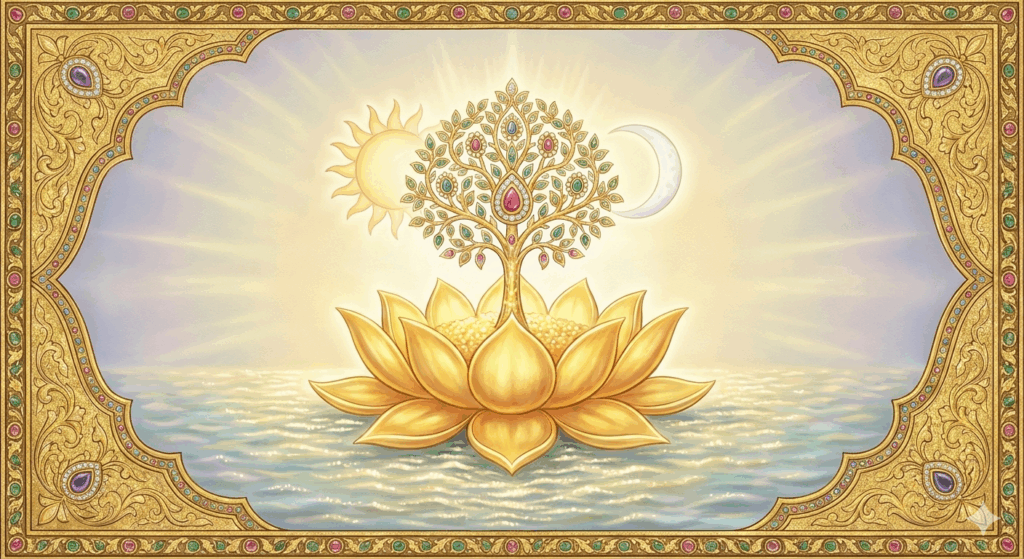
What if the entire night sky, the warmth of the sun, and the depth of the oceans were contained within a tiny space within the region of your heart? That is exactly what Hrit Chakra is: a microscopic gateway to a macroscopic universe.
Deep within the lotus of the heart lies an internal cosmic sanctuary. It holds all of space and time, witnessing the sun, the moon, and everything that has touched your individual soul. When you reach this center, an entirely new journey opens up, expanding your life in a profound spiritual direction.
(Adapted from the Chandogya Upanishad).
The Hrit Chakra — the “Abode of the Soul” — is a minor but profoundly significant energy centre, also known as the Hridaya Padma. It is our Sacred Heart. Hridaya Padma is a living, blooming sanctuary; it is the lotus that floats on a sea of pure nectar, holding the soul’s sacred flame—a flame that never wavers in a space that is eternally still.
The Essence of the Soul
Just below the Heart Chakra, where the air of our emotions is constantly moving, lies a deeper sanctuary: the realm of the individual soul (Jivatma). Here burns the flame of our innermost essence — a flame that never flickers in this motionless realm that remains untouched by the turbulence of thoughts and emotions. This essence remains pure. It is your divine self, like the blue sky, constant behind the clouds, free of hurt and suffering.
“In the centre of the Heart Lotus, there is a Golden Altar. Above it sits the Kalpa Taru. He who meditates here with a steady mind finds that his thoughts become reality. But beware—only the Pure Heart can handle the fruit of the tree.” — Adapted from the Gheranda Samhita.
Within the centre of your soul is Kalpa Taru, the wish-fulfilling tree. When you visualize sitting beneath this tree in the presence of the divine, you can manifest your highest spiritual intentions. However, be warned: the power of manifestation here is immense. A seeker must possess a pure heart before activating this centre, as misuse can be disastrous. If an impure heart and mind unlocks this gateway, it can become a destructive force. The true purpose of the Hrit Chakra is to achieve connection with the divine, not to manifest wealth, power, or petty desires. As the saying goes: “Be careful what you wish for”.
The Components of the Inner Sanctuary
Rather than a physical structure, the ancients mapped the Hrit region as a profound inner ecosystem comprised of four symbolic pillars:
- The Wish-Fulfilling Tree (Kalpa Vriksha): The ultimate axis of the soul’s deepest spiritual intent.
- The Radiant Lotus: A beautiful, multi-petaled foundation that houses our highest internal virtues.
- The Dual Radiance (Surya & Chandra): The perfect equilibrium between our dynamic, active drive and our quiet, receptive inner stillness.
- The Altar: The silent centre where individual awareness completely rests in the presence of the divine.
Together, these elements form a micro-cosmos within the chest—a protected space designed for ultimate spiritual refinement.
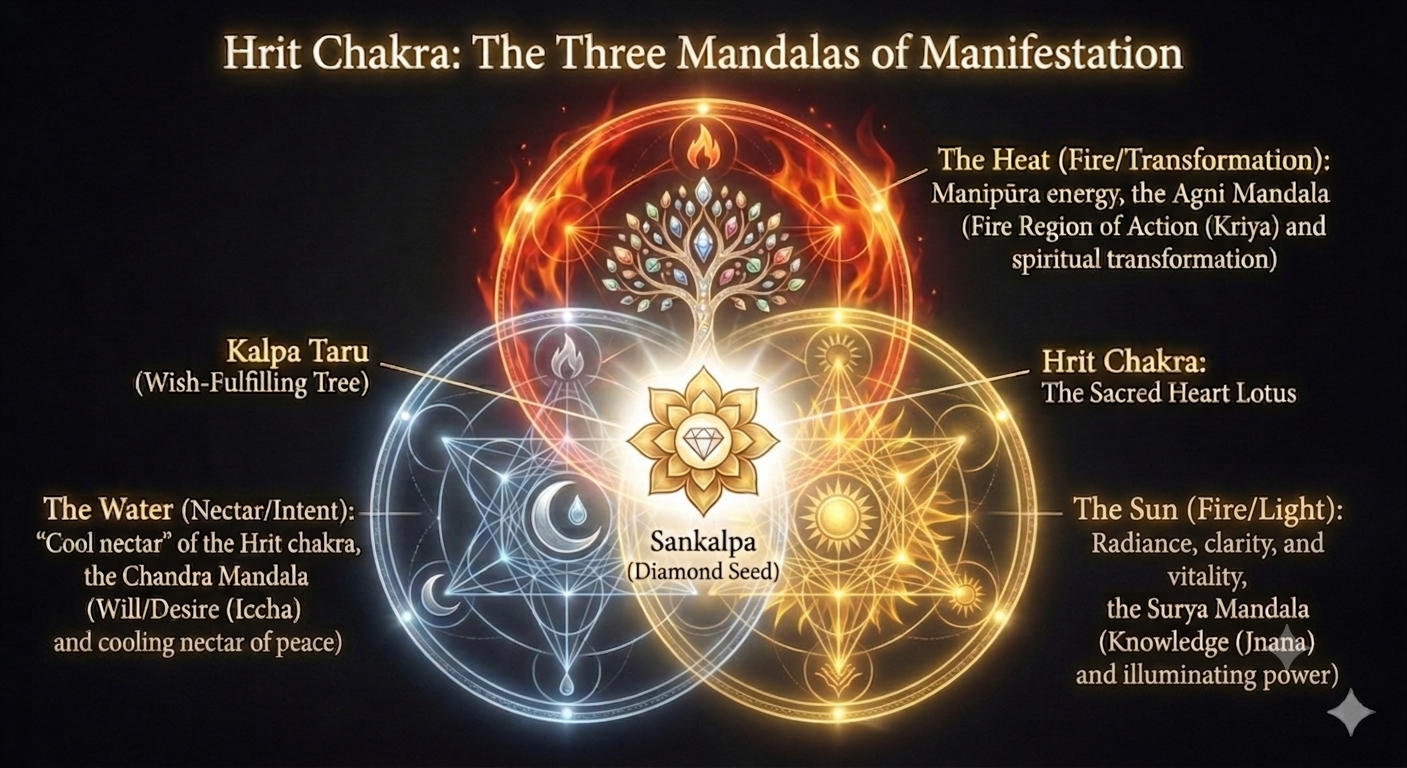
Where the Mandalas of Energy meet the Tree of Manifestation in the Hrit Chakra
Traditional yogic texts map the Hrit Chakra as a sacred convergence zone where three distinct universal spheres of energy meet. Modern applications often prioritize the functional requirement of grounding the wish with the earth, emphasizing practical manifestation, whereas the traditional emphasis is strictly on spiritual transformation.
In classical philosophy, these spheres are understood as the spiritual elements required for the soul’s deepest intentions to take root:
- The Receptive Stillness (Chandra Sphere): The cooling, fluid space of pure intent, where an aspiration is nurtured away from the friction of daily life.
- The Muted Radiance (Surya Sphere): The grounding presence of inner illumination and steady wisdom, providing the light needed to see one’s path clearly.
- The Light of Transformation (Agni Sphere): The internal fire that purifies our underlying drives, ensuring they are burned clean of personal ego.
When these three energies naturally balance within the chest, the internal environment shifts from a place of emotional distraction to one of deep, unshakeable tranquility.
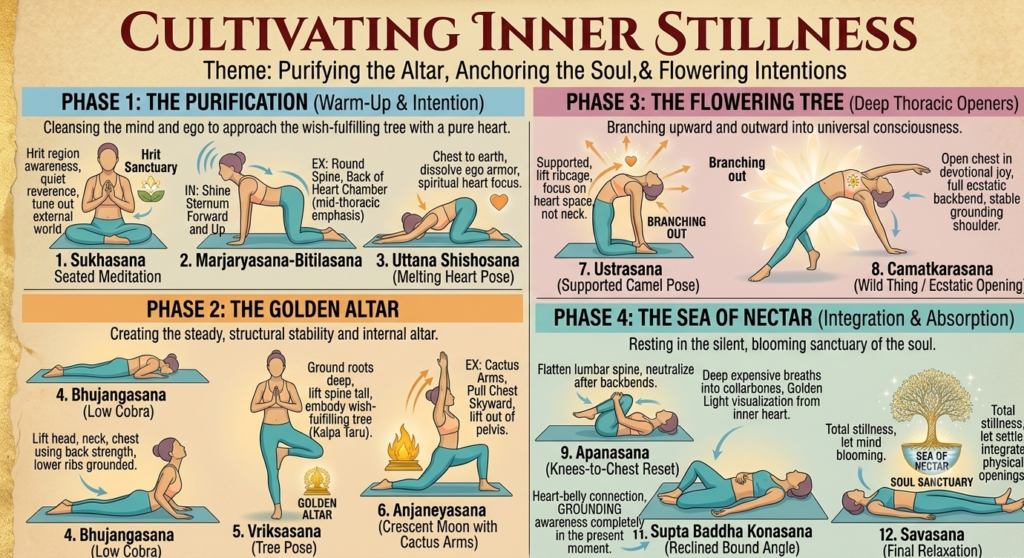
Cultivating Inner Stillness
Theme: Purifying the Altar, Anchoring the Soul, & Flowering Intentions
PHASE 1: THE PURIFICATION (Warm-Up & Intention)
Focus: Cleansing the mind and ego to approach the wish-fulfilling tree with a pure heart.
1. Sukhasana Seated Meditation: Sit comfortably. Place the back of your hands on your knees with the middle finger touching the tip of the thumb. Close your eyes and anchor your awareness directly into the Hrit region and tune out the external world. As you breathe naturally, feel this specific inner space begin to settle. Let your attention sink deeply into the innate stillness of the Hrit sanctuary, establishing a foundation of quiet reverence.
2. Marjaryasana-Bitilasana with breath awareness (Cat-Cow Variant): On all fours. Inhale, dip the belly, and pull the shoulder blades back to explicitly shine the sternum forward and up. Exhale, round the spine, tuck the chin, and feel the back of the heart chamber open. Emphasize moving from the mid-thoracic spine rather than the lower back.
3. Uttana Shishosana ( Melting Heart Pose): From hands and knees, walk your hands forward, melting your chest down toward the earth while keeping your hips stacked vertically over your knees. Rest your forehead or chin on the mat. Feel gravity gently pressing the spiritual heart downward, dissolving the armour of the ego.
PHASE 2: THE GOLDEN ALTAR (Stabilization & Rooting)
Focus: Creating the steady, structural stability and internal altar
4. Bhujangasana (Low Cobra): Gently slide your body forward to lie flat on your belly with the tops of your feet pressing into the floor. Place your palms on the mat directly under your shoulders, hugging your elbows close to your ribs. Inhale and gently peel your head, neck, and chest away from the floor using the strength of your back rather than pushing with your hands. Keep your lower ribs grounded, gaze neutral to protect the neck, and focus on broadening across the collarbones to expand the centre of the chest.
5. Vriksasana (Tree Pose – Embodying the Kalpa Taru): Stand tall in Mountain Pose. Shift your weight to the left foot, and place the sole of your right foot on your inner left calf or thigh. Bring your hands to prayer at your heart centre, or grow your “branches” by reaching your arms high. Ground your roots deep into the earth while lifting your spine tall. Focus your gaze (Drishti) to stabilize your mind. Repeat on the other side.
6. Anjaneyasana (Crescent Moon with Cactus Arms): Step the right foot forward into a low lunge, lowering the left knee to the floor. Inhale your arms up, then exhale to bend the elbows out to the sides into “cactus arms,” pulling the chest skyward. Lift out of the pelvis before pulling back, visualizing the front of the chest rising like a flame from a golden altar. Repeat on the left side.
PHASE 3: THE FLOWERING TREE (Deep Thoracic Openers)
Focus: Branching upward and outward into universal consciousness.
7. Ustrasana (Supported Camel Pose): Kneel with hips over your knees. Bring your hands to your lower back, fingers pointing down. Inhale, lift the ribcage away from the hips, and gently arch back. If accessible, drop your hands to your heels. Keep your chin tucked slightly if it feels safer, keeping the emphasis on the heart space rather than dropping into the neck.
8. Camatkarasana (Wild Thing / Ecstatic Opening): From Downward-Facing Dog, lift the right leg high and open the hip. Pivot on the ball of your left foot, shift weight into the left hand and shoulder, and land the right ball of the foot behind you. Extend the right arm out past your ear, lifting your hips and fully opening the chest in devotional joy. Maintain strong stability through the grounded shoulder. Repeat on the left side.
PHASE 4: THE SEA OF NECTAR (Integration & Absorption)
Focus: Resting in the silent, blooming sanctuary of the soul.
9. Apanasana (Knees-to-Chest Reset): Transition down onto your back. Draw both knees in toward your chest and wrap your arms gently around your shins. Rock slowly side to side, allowing your entire lumbar spine to flatten against the mat. Breathe deeply into the back body to neutralize the spine after the deep backbends before moving into integration.
10. Matsyasana (Supported or Active Fish Pose): Release your feet to the mat, then slide your hands palms-down underneath your glutes with legs extended long. Press firmly into your elbows, arch your upper back, and rest the crown of your head lightly on the floor. Take deep, expansive breaths into the collarbones, imagining a golden light radiating from the inner heart.
11. Supta Baddha Konasana (Reclined Bound Angle): Release from Fish Pose to lie flat. Bring the soles of your feet together and let your knees fall open to the sides. Place your left hand over your spiritual heart centre (middle chest) and your right hand on your lower belly. Feel the physical resonance of your breath, grounding your awareness completely into the present moment.
12. Savasana (Final Relaxation): Release the feet and extend the legs long, resting flat on your back. Release all effort, visualizations, and mental control. Let the mind settle into total stillness, allowing the body to integrate the physical openings of the practice in absolute quiet.
The Garden of the Soul – a Visualization
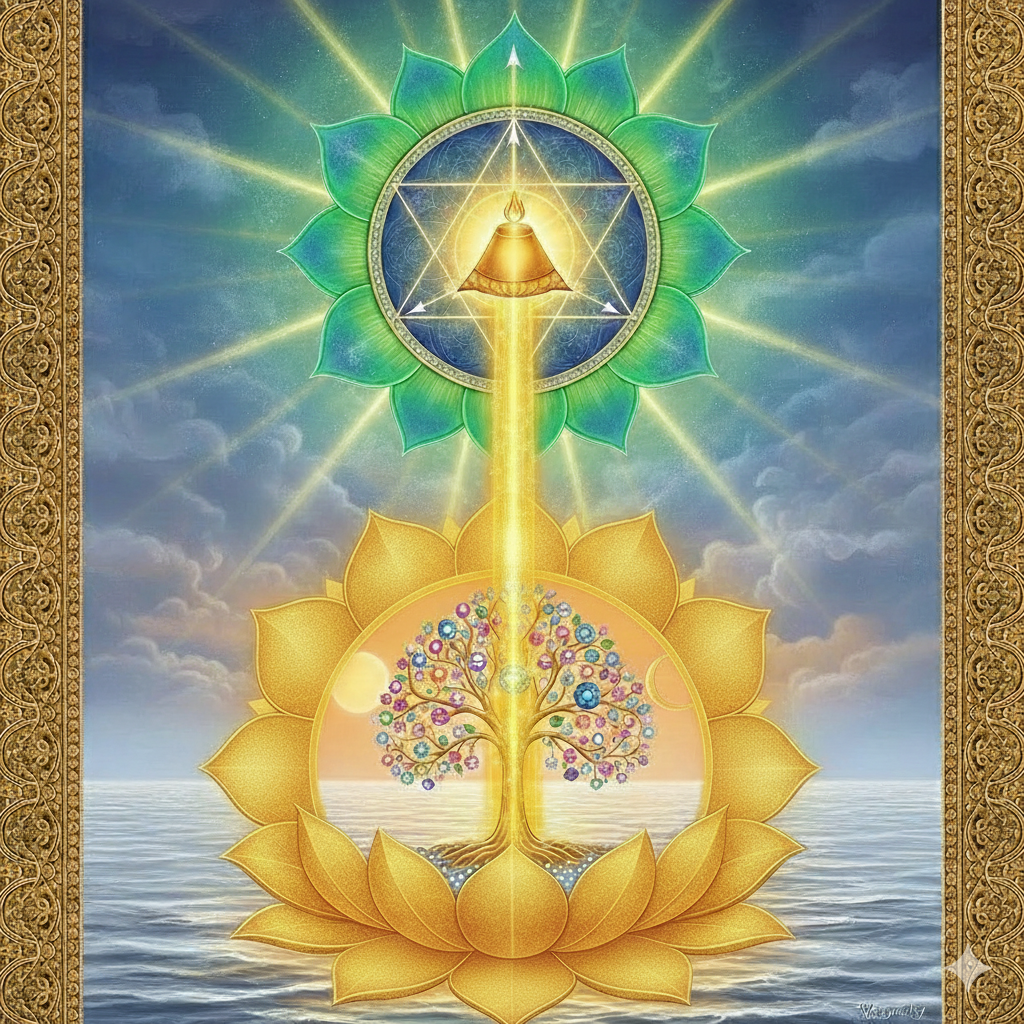
In your inner sanctuary, you can meditate on the Hrit Chakra in a state of bliss, independent of outside circumstances. Here, a golden lotus floats on a sea of pure nectar, providing a radiant altar for your personal deity. This golden hue is the Gold of the Alchemist — the transformation of base emotions into divine wisdom — illuminating your inner world with its own internal sun, moon, and fire.
At the heart of these mandalas is a clear, still lake surrounded by mountains. Called Lake Anavatapta, this lake is the settled awareness of the practitioner, purified by time and devotion. It is protected and held within the immovable mountains of detachment, ensuring the surface of the water remains undisturbed by the winds of the world. Gazing into the depths, one can see luminous gems scattered upon the lake floor, representing the refined virtues and strengths gathered across lifetimes of practice.
Rising from the centre of these still waters is an island of gold, encrusted with brilliant gems: the ruby of devotion, the sapphire of vastness, and the emerald of healing. Upon this golden ground, where the three mandalas intersect, the Kalpataru — the Celestial Wish-Fulfilling Tree — takes root. In this perfect silence, where the mountains meet the water and the gold meets the fire, the soul’s deepest intentions can be manifested into reality.
To understand how the ‘Mountains of Vairagya’ protect the still lake of the soul during life’s most painful storms, read my personal story: Redefining Vairagya or Non-attachment.
The Meaning of Sankalpa
Kalpa (कल्प) has two main meanings in Sanskrit:
- A Sacred Rule or Ritual: A vow, a method, or proper conduct.
- A Cosmic Aeon: A very long period of time. In Vedic cosmology, a Kalpa is one day in the life of Brahma (the Creator), equal to 4.32 billion years.
Sankalpa (सङ्कल्प) – The Spiritual Vow
What it means: A sacred vow, heartfelt intention, solemn resolve, or a determination to achieve a specific, usually spiritual, goal.
The Deeper Meaning: Unlike a fleeting “resolution” made by the surface mind (e.g., “I will go to the gym”), a Sankalpa is believed to arise from the deepest part of the heart (Hridaya). It is a sacred promise made to your higher self. It is most powerful when stated in the present tense as an affirmation (e.g., “I am peace”). In practice, especially in Yoga Nidra, a Sankalpa is sown like a seed into the relaxed subconscious mind to create profound, lasting change.
The images are the map. While the syllabus is open to all, the transmission of the Hrit frequency is passed only from heart to heart. Are you ready to climb the tree?