
Traditional Concepts
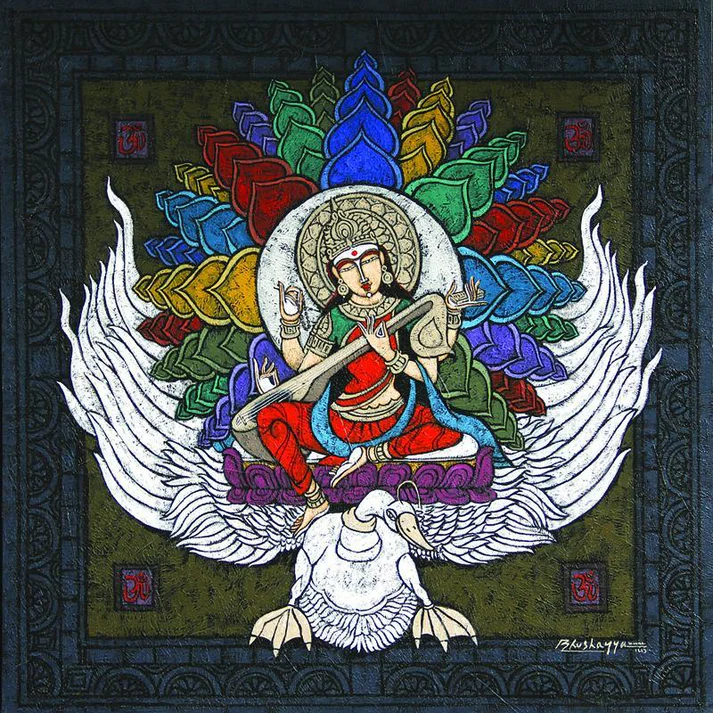
www.artzolo.com – Kunuku bhushayya
Introduction
- Within your crown is the supreme consciousness.
- Sahasrara means “thousand-fold”.
- The function of Sahasrara is enlightenment and spiritual union.
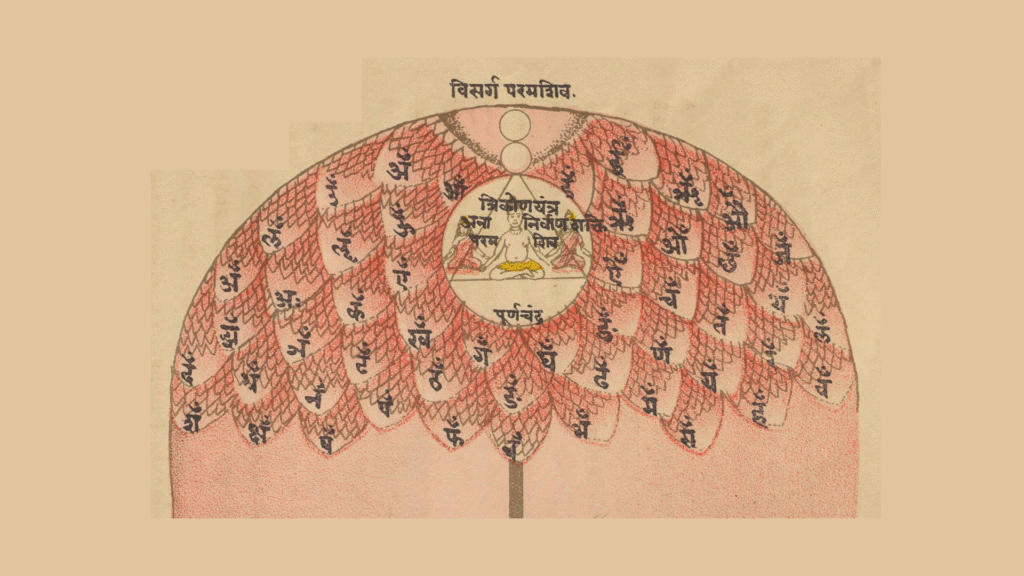
- It is represented as a lotus with one thousand, multi-colored petals.
- The Bija Mantra is Silence (or the resonance of the OM).
- The element is transcendental (beyond all elements).
- The sense is pure consciousness.
- There is no animal symbol, as it represents the final liberation from the animalistic nature.
Sahasrara is the place of pure consciousness. It represents infinite knowledge, enlightenment, and transcendence.
Sahasra means 1000 and ‘ara’ means spoke or petal. A thousand is symbolic of the infinite.
This thousand petaled lotus is down-turned, lustrous and whiter then the full moon, tinged with the color of the young sun. Within it is the full moon, perfectly white, resplendant as in a clear sky. Its rays shine, moist and cool as nectar. Within the moon, constantly shines like lightning, the triangle, and inside this again shines the Great Void. The Supreme Light is formless and the Bindu is imperishable.
The great void is the Bindu, or Shunya and can only be attained with great effort. It is well hidden and is the root of liberation. It is the seat of Shiva, the Brahman and Atman of all beings. It is the sun that destroys delusion. In this place is Nirvana Shakti, where there is neither time nor space, free from Maya.
At the beginning of spiritual awakening, the lotus in the chakras are turned downward. As Kundalini Shakti rises up the Susumna Nadi the lotuses turns upright and bloom, signifying the descent of divine grace.
The best way to begin to understand Sahasrara is to meditate on the Guru Shiva sitting in the centre of the white lotus. In the empty space of the moon within Sahasrara, the creative energy in proximity to the light shining from the triangle wishes to create. She becomes massive, becoming the bindu which divides into the letters Ham and Sa, adorned over the celestial gateway. The right is Ham, male, Purusha, the Bindu / and the left is Sah, female, Prakrti, Visargra. Meditate on Him who is pure like rock crystal and dressed in pure white, silken raimants. Hamsah is the union of Prakrti and Purusha who pervades the universe, all that is moving and motionless. If you find union of Prakrit-Purusha, you find imperishable and increasing happiness.
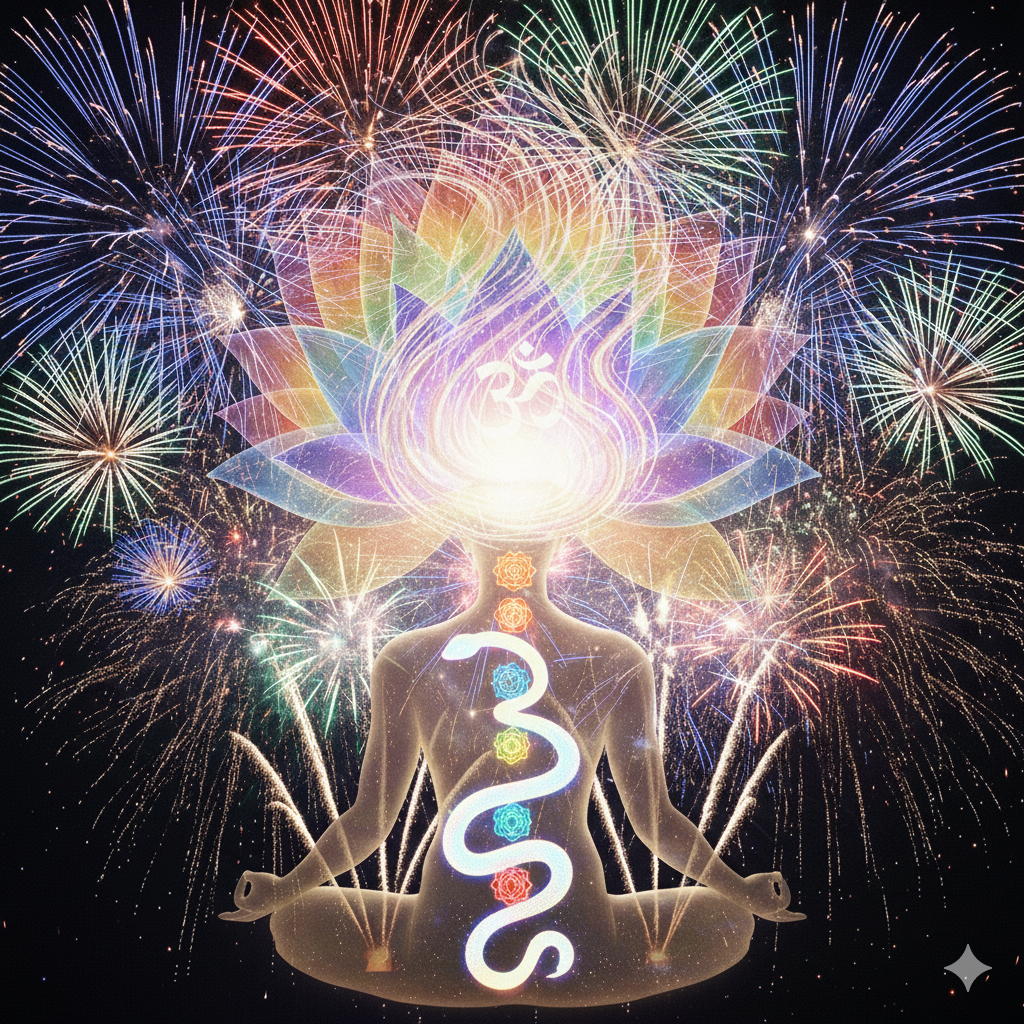
Purusha is the silent witness, the ultimate, unconditioned, pure consciousness it is eternal and outside of time. Prakrti is the creative potential, ultimate, unconditioned, undifferentiated substance or matter.
Let go of everything and rest in peace. The more often you can attain a state of bliss the easier it becomes. The traditional yogic path emphasizes that the goal is the gradual, safe ascent of the spiritual energy.
Samadhi is the pure bliss of total inactivity. Up to the sixth chakra the yogi may enter a trance in which activity or form still remains within the consciousness. Bringing the energy as far as Ajna and allowing it to remain there, will bring profound peace and joy. To take the energy beyond, to Sahasrara can literally blow your mind. Activation of Sahasrara should only be undertaken after many years of preparation and under guidance of an authentic teacher or spiritual guru, ensuring that the body and mind are prepared through specific asanas (postures), pranayama (breathwork), mudras (seals), and ethical living principles (Yamas and Niyamas). This preparation strengthens the entire system so it can handle the immense spiritual energy without adverse effects.
Our life-long striving for happiness and fulfilment is achieved with the union of Shiva and Shakti. Shakti is located in the Muladhara Chakra and Shiva in the Sahasrara Chakra. Between the two exists an irresistible attraction, and we experience the distance between them as a dark zone of unclarity and ignorance. The trench that separates Shiva and Shakti (otherwise known as Purusha and Prakrti – consciousness and nature) is “not-knowing”, and the consequence of “not-knowing” are emotions full of suffering, such as loneliness, sadness, bitterness, fear, doubt, etc., that accompany us through life.
In Sahasrara Chakra the prana moves upward and reaches the highest point. Then, it needs to be brought back down to the root chakra where it can rest again at the base of kundalini.
All feelings, emotions and desires, which are the activities of the mind, are dissolved into their primary cause. The union is achieved. The yogi is sat-chit-ananda, truth-being-bliss, becoming their own true self. While remaining in the physical body, nondual consciousness is retained, enjoying the play of lila without becoming troubled by pleasure and pain, honors and humiliations.
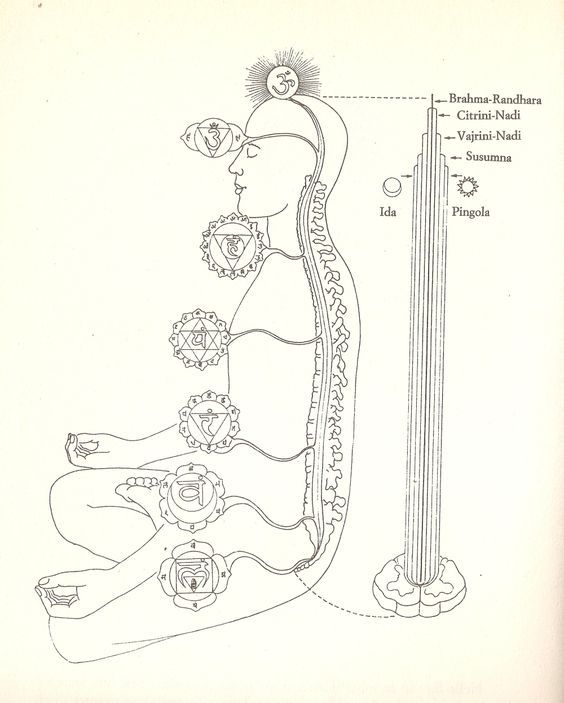
The union of Shiva and Shakti occurs when the stream of energy in the two main Nadis – Ida and Pingala, unite and rise through the Sushumna Nadi. During the rise of Kundalini, energy travels up the ida and pingala nadis and meets at Ajna chakra, where it combines with the energy rising up through the Shushumna Nadi and continues to the Sahasrara chakra. One reaches a state of non-duality, great bliss, or Samadhi. It is a state of balance, equilibirium, and the experience super-consciousness where the individual transcends the ego, or sense of self. The inner structure of Sushumna comprises of three subtler nadis, which become active when the Sushumna is awakened. Inside Sushumna is Vajra Nadi. This nadi contains Chitrini Nadi, and at the centre is Brahma Nadi, the subtlest flow. Brahma Nadi is so called because the higher levels of consciousness are directly activated via this nadi. When the kundalini shakti passes through this channel, transcendental experiences take place. But the realisation of the Atma takes place only when a simultaneous awakening of the Anahata Chakra and the Sahasrara Chakra occurs.
The mind establishes itself in the pure void of Shunya, complete emptiness, pure void, and this emptiness is full of everything. It is Shunya (empty) because it is Purna (full).
Shunya contains everything and nothing, everything exists and is non-existent. Our world is filled with complementing aspects from electrons and positrons, male and females, construction and destruction, whatever you consider, you will find its complementary other. So although from a partial point of view it seems something exists, from an absolute point of view nothing exists. Opposite natures inherently exist to maintain the state of Shunyata. So we see that Shunya has two complementary states, it is not empty but completely filled (purna).
When Shiva and Shakti unite, nothing remains, there is absolute silence. Different traditions have their own way of describing this experience. Some call it Nirvikalpa Samadhi, some Nirvana, others as Kaivalya, Moksha, Enlightenment, Self-realization, Heaven and so on. Swami Sivanand writes in “Kundalini Yoga”, that when Kundalini is united with God Shiva at the Sahasrara Chakra, the Yogi enjoys Parama Ananda (Supreme Bliss). When Kundalini is taken to this center, the Yogi attains the superconscious state and the Highest Knowledge. He becomes a Brahmavidvarishtha (full-blown Jnani).
Vrittis of Sahasrara
The energy of all Nadis flows together in Sahasrara. All the 50 letters of the Sanskrit alphabet from the other six Chakras are repeated here again and again. Sahasrara chakra, contains the seeds of all the vrittis, and all their means of expression.
There are 50 vritti’s in the human being. Samskaras are the various mental inclinations or natural tendencies to behave in a particular way that human beings experience and express. The samskaras of an individual will be expressed as a particular configuration of vrittis according to their personal experiences. On an energy level the vrittis are associated with the different chakras. With 50 vrittis, expressed through 10 indriyas (senses) in both an internal and external manor, there are 1000 expressions. Thus there are 1000 petals in the lotus for this chakra. When all the vrittis in the chakras have been assimilated, absorbed and transformed, the mind may become still.
There is another factor that is needed to attain spiritual bliss. Grace. The Grace of Shanakara, or God, or Shiva, is needed to enter this chakra, without it, it is impossible.
Brahma – Creator, Consciousness, and the Father of Knowledge
In the Root, Brahma was the spark of physical life. Here in the Sahasrara, he is the Grandfather of the Universe, the witness to the Truth. Accompanied by Saraswati, the grandmother of the universe, he represents the moment when our individual creativity returns to the Universal Source. The swan they ride is the symbol of Viveka (Discrimination)—the ability to see the One in the many.
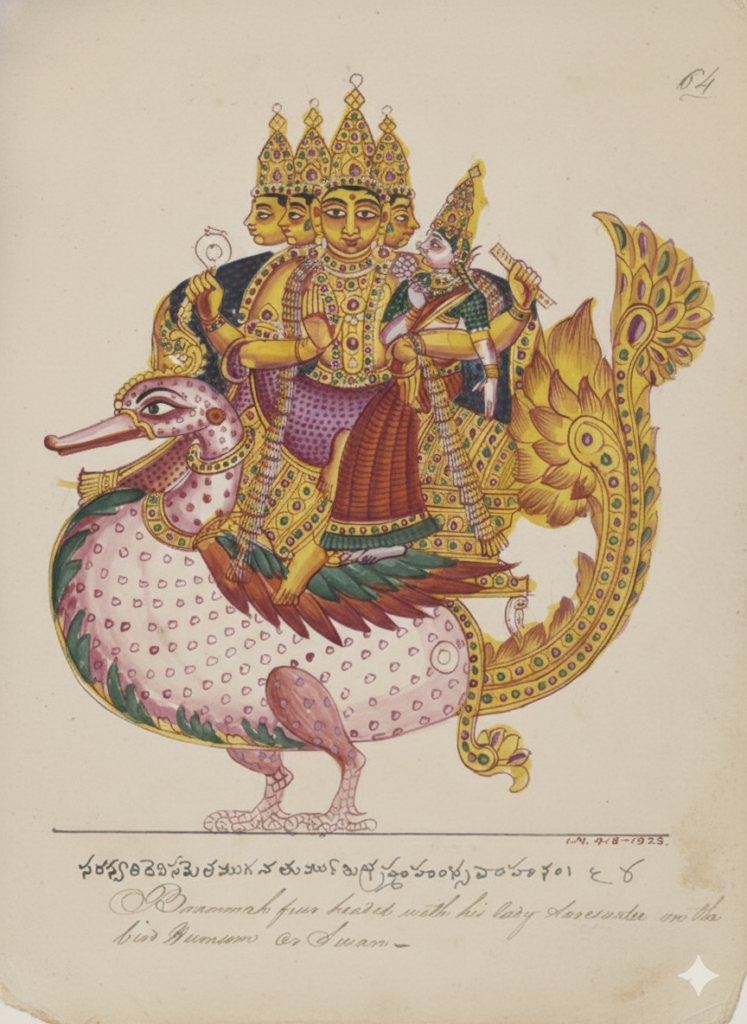
As the venerable ‘Grandfather’ of the cosmos, Brahma reminds us that true creation is not just a youthful impulse, but a product of deep, seasoned wisdom and focused intellect. In the realm of the Sacral chakra, Brahma represents the primordial drive to create. As the Creator deity, he is the embodiment of intellect and focused consciousness. However, his symbolism carries a profound warning: his four heads, eternally gazing upon his creation Saraswati, represent the egoistic attachment a creator can have for their work. In the Svadhishthana, Brahma teaches us the relationship between abstract consciousness and tangible action; he is the “vision,” while Saraswati is the “flow” that brings that vision to life. Together, they remind us that while creation requires intense focus, we must eventually learn to let our creations breathe on their own.
Deities of Sahasrara
- Paramashiva (Pure Consciousness): Often depicted as a silent, radiant light or a white Shiva in deep meditation, representing the state beyond all Vrittis.
- The Sadguru (Shrii Shrii Anandamurti): In your tradition, the Guru is the bridge between the human heart and this Crown energy.
Imagine climbing a steep, rocky mountain to reach the summit of Truth or Enlightenment. You must make all the effort to climb the mountain. You need to have devotion, study, meditate and live an honest, disciplined life, climbing the mountain step-by-step using your own energy. When you have almost reached the top it becomes impossible to climb further, it is covered in fog, ice and snow and no matter how you try, you are prevented from reaching the summit.
A mystical force comes down right at the final, impossible step. An act of pure, undeserved help from the ultimate spiritual master pulls you to a higher plane. It is the final push of wisdom that you can’t earn. It instantly removes the last bit of illusion and fog in your mind. It transforms you from a struggling climber into someone who is suddenly on top of the mountain with clear view.
Grace is the ultimate spiritual favor or blessing that is necessary to cross the final barrier to enlightenment, after you’ve done all the preparation work.
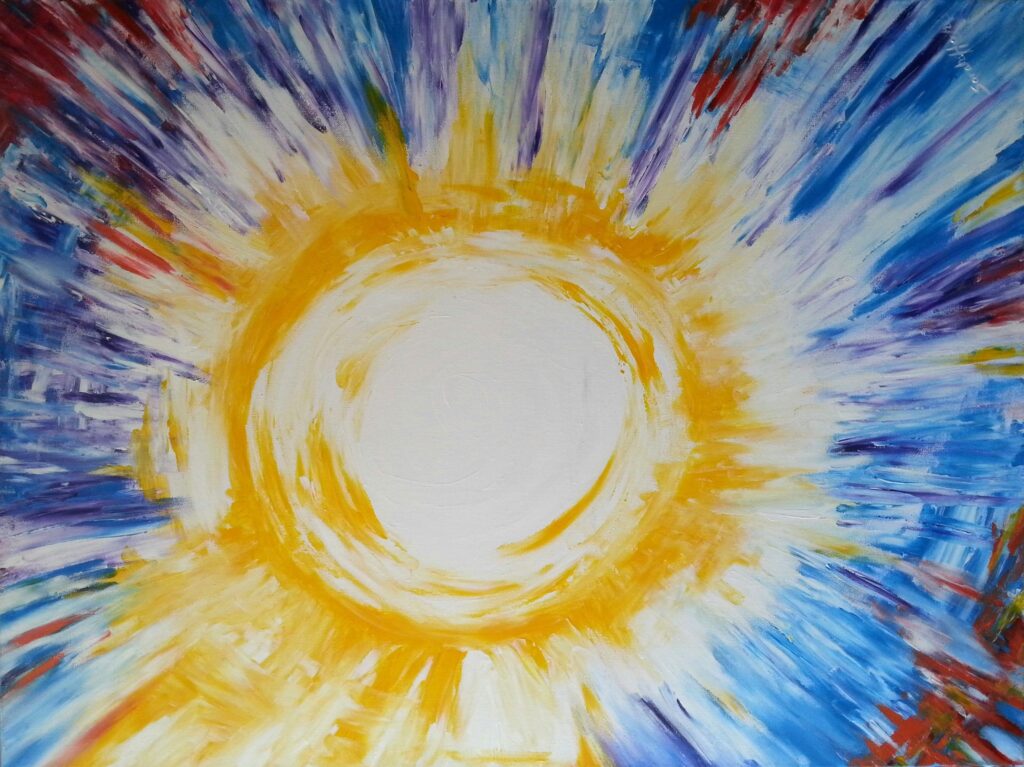
The Three-Breath Focus (Crown Application): This is a 1-minute practice you can do multiple times a day.
- Inhale (Clarity): Focus 100% on the sound of your in-breath. Think: “I am inhaling the perfect understanding of my unified self.”
- Exhale (Containment): Focus 100% on the sound of your out-breath. Visualize a clear, white light sealing your personal boundaries, protecting you from the noise.
- Repeat: Do this only three times. It’s so short, your mind won’t have time to register the chaos before you’ve completed the practice. This anchors the Crown’s energy (unity) instantly.