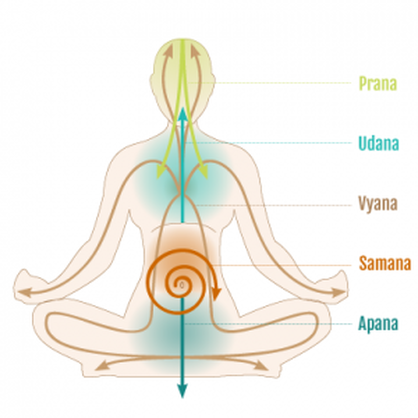

The pranamaya kosha is composed of the five pranas, also called vayus or “forces of the air.”
Apana Vayu
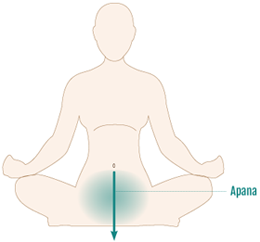
Muladhara chakra governs the vital breath Apana.
Apana vayu governs the movement of energy from the navel down to the pelvic floor or root chakra at the base of the spine. It is responsible for elimination. The energy moves down and out and also helps retain things in. It governs the elimination of urine and poop, semen, menstrual fluid, and child birth. It is activated by the outward breath and expels carbon dioxide. On a deeper level, it rules the elimination of negative sensory, emotional, and mental experiences.
Some techniques to keep Apan Vayu healthy are pelvic floor exercises and seated yoga postures.
Apana breathing focuses on exhalation and suspension of breath (holding after exhale)
Apana Breathing meditation:
- Draw vitality up from the earth as you inhale, pulling the energy into the belly.
- as you exhale let go of any difficult thoughts or memories. Direct the energy from the belly into the feet/ground.
- Hold the air out for a moment with attention at the root chakra. Visualize Prana moving down through the legs and out through the feet.
- Repeat for as long as you feel comfortable.
Prana Vayu
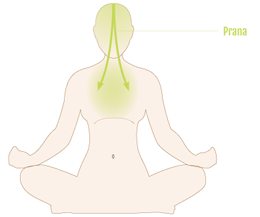
Prana vayu moves downwards and inwards. Some sources say it is centered in the heart region, some in the region of the third eye but its movement is in the thoracic region, maintaining the heart, lungs, breathing, swallowing and blood circulation. Prana-vayu concerns what we absorb through our senses, what we see and hear, what we eat and drink and what we breathe. It is activated by the inward breath.
Prana Vayu is weakened by sensory overload, like loud noise, angry or sad songs, violent T.V. shows & video games or bad news. An agitated mind can’t settle into meditation. A strong Prana Vayu allows you to cultivate peace and quiet and a meditation practice. Meditation is excellent for activating and balancing prana vayu.
Some asanas for Prana vayu are:
- heart opening backbends eg: bow pose, camel pose, cobra pose, dancer pose, and bridge pose.
- Virabhadrasana I (warrior I)
- Utkatasana (chair pose)
- Utthita hastasana (arms raised overhead)
- Anjaneyasana (crescent lunge)
- Savasana (corpse pose)
Connection between Prana vayu and Apana vayu
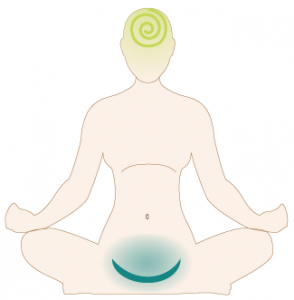
Disfunction of Prana and Apana Vayu. When the prana is disunited. Mind and body are disconected
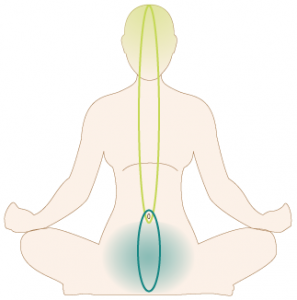
Here the breath is united at the navel. Connection between Prana vayu and Apana vayu allows the mind and body to work in harmony.
Yogic practices work to bring Apana vayu up to unite with Prana vayu and draw Prana vayu down to unite with Apana vayu, which occurs in the region of the navel – the pranic center of the body.
What we ingest through our eyes and ears is just as important for our well being as what we eat and drink.
Samana Vayu
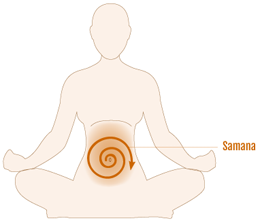
We can let go of negativity (via apana vayu)
Samana vayu unites the upward energy of prana and the downward energy of apana. Manipura is the place where Prana (upward flowing pranic energy) and Apana (downward flowing pranic energy) meet. This meeting creates heat, which when directed downwards can activate the kundalini in the Muladhara. The energy then reverses and travels upward.
It digests, absorbs and assimilaties. In the stomach, it aids in the digestion of food. In the lungs, it aids to digest air or absorb oxygen. In the mind it aids to digest experiences — sensory, emotional, and mental. It helps us connect to our gut, stoking our inner fire and confidence.
By breathing into the belly, we can effectively process difficulties, allowing them to evolve into constructive learning opportunities. As we discern the underlying lessons, challenges can be reframed as positive growth. Equipped with fresh insight, we can approach similar situations with greater wisdom. Then we can let go of negativity (via apana vayu)
It can sometimes be difficult to allow the breath into the belly as we have been taught to suck in our bellies, but it is good to relax the muscles of your tummy and explore the movement of Prana.
Some asanas for activating this life energy are:
- twists and
- abdominal work
- arm balances eg crow
- chair pose
- reclining abdominal twist
- boat pose.
Vyana Vayu
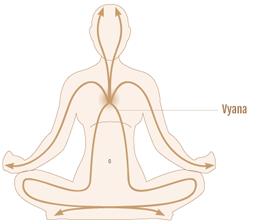
Vyana Vayu is centered in the heart and lungs. Vyana Vayu governs the movement of energy throughout the entire body and the energy that radiates out from our body. It moves food, water, and oxygen throughout the body, and keeps our emotions and thoughts circulating in the mind, imparting momentum and providing strength.
This vayu dictates the blood flow and the electrical impulses through our nervous system and the movement of fluid through the lymphatic system.
Vayana vayu is responsible for distribution. It moves outward in a circular, pulsating motion.
Practices that benefit Vyana vayu include:
۰Focus on Inhalation and expansion.
۰Retention of breath (hold after Inhale).
۰Activities that give you joy, or touch your heart.
A breathing practice:
Inhale: Let the breath draw from the nose to the heart, and even move to the back of the heart (into the deepest, darkest corners).
Exhale: Imagine the breath moving out through the arms and legs and through the length of the torso. Imagine the breath moving out through every pore in the body, expanding you beyond the boundary of your skin.
Asanas for balancing Vyana vayu are:
- Backbends
- lateral postures (side bends)
- Surya Namaskar (sun salutations)
- Savasana
Udana Vayu
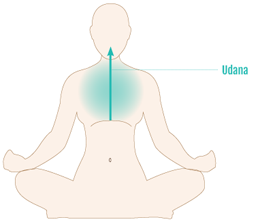
Udana vayu raises the energy from the navel up to the head. Udana Vayu works through the throat center. It affects the thyroid and parathyroid glands, which regulate metabolism, the intake of air and food, communication, and confidence in expressing ourselves. It governs the growth of the body, the ability to stand and speak; our effort, enthusiasm, and will. It is our positive energy and helps us to evolve in consciousness. it brings prana to the energy centers deep in our brain and the central axis of the subtle body.
Asanas for Udana Vayu:
Backbends, particularly belly backbends,
can activate udana vayu
- Setu Bandha Sarvangasana (Bridge Pose)
- Matsyasana (Fish Pose)
- Sarvangasana (Shoulderstand)
- Halasana (Plow Pose)
- Sirsasana (Headstand).
How to Direct Prana Through Udana Vayu:
In standing, lying and seated postures: Inhale: Imagine pranic energy moving up from the ground through the soles of the feet, moving up the legs, up the air channels of the back and up into the chest.
Exhale: Invite the energy to continue moving upward through the crown of your head. Inhale: Imagine pranic energy moving up from the ground through the soles of the feet, moving up the legs, up the air channels of the back and up into the chest.
Exhale: Let the breath release through the throat region as you exhale through the nose, releasing any tension in the throat, jaw, and teeth.
For inverted postures:
Inhale: Visualize that the pranic energy is beginning at the hands or arms, or whatever part of your body is in contact with the floor. Let it continue moving up the arms and torso as you lengthen your inhale.
Exhale: Move the breath through the legs and out through the soles of the feet. Using this breathing technique can be particularly helpful in asanas where you feel compressed in the neck, arms, and shoulders like Halasana and Sarvangasana.
Prana brings in the fuel, samana converts this fuel to energy, and vyana circulates the energy to various worksites. Apana disposes of the waste products produced by the conversion process. Udana manages the energy thus created, enabling the machine to function effectively.