

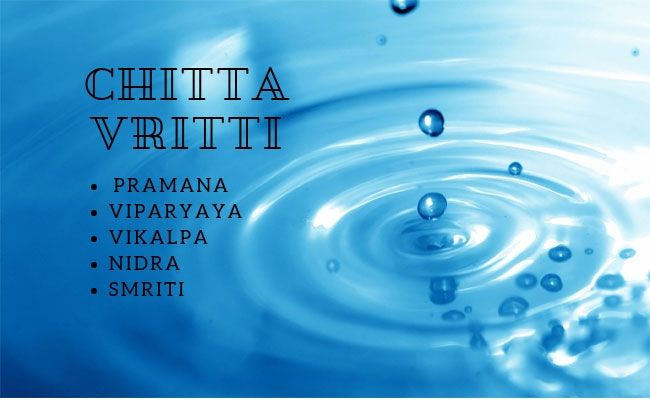
Vrit is a Sanskrit word meaning whirl.
Basically, a vritti is an emotion, good or bad that arises in our consciousness. Each emotion we are capabale of feeling settles at a level in our bdoy.
There are different chakras at different levels of the body that are the home of where the levels of emotion settle. The rawest, most inherent layers of emotions, or vrittis settle in the lower two chakras, svadhishthana and Muladhara. The higher chakras house higher emotions and lift us to higher levels of consciousness as we learn to govern them.
Energy is the expression of the dynamic flow of the cosmos. The mind is a vibration of energy. To express the flow of energy, the mind adopts vrittis, or mental tendencies.
Vrittis are the thoughts and emotions that whirl around in our minds. Vrittis express emotions but at the same time cloud our mind. Emotions are constantly changing. They disturb the natural peace and calm of our true nature and are the veil through which we are prevented from having clarity.
Vrittis are caused by attachments and desires and can be worked through by the practices of Yoga. When all the vrittis have been digested, the mind is free of the manipulations of thoughts and emotions.
This doesn’t mean we stop feeling emotions. As we practice, we learn to feel emotions fully, but they no longer overpower us. We can look at emotions, feel them, understand them and let them go, then there is space for it to be replaced by a different emotion. We don’t have attachment to emotions that make us feel good, or the emotions that drive us to repeat bad habits.
Yoga is the way to quiet the vrittis in the mind or chitta to reveal our true self.
Patanjali, the father of yoga grouped the vrittis into 5 groups.
Pramana (Correct Perception or right knowledge)
The information collected by our 5 senses. Knowledge that we believe to be true because it comes from experience or reliable source.
Viparyaya (Misconception or incorrect understanding)
When our senses misinterpret what is presented. An example is a coiled rope on a dark path that is mistaken for a snake until seen clearly. Our tricky minds distort perceptions, giving rise to false impressions and illusions, that eventually become correct knowledge.
Vikalpa (Imagination)
Imagination is a valuable tool of the mind for planning and ideas. But it can also create unrealistic fantasies complicating our perception and understanding. Fear and paranoia are also created in our imaginations.
Nidra (Sleep or Forgetfulness)
Nidra is the vritti of sleep or mental dullness. It can be a state of inertia where the mind lacks clarity, awareness, and alertness.
Smriti (Memory)
Smriti are the habits and patterns of memory. It is the way our minds weave threads of our past into the tapestry of our present. Modern research into memory recall has revealed that each time we remember something we are actually, remembering the last time we remembered it.
Vritti are modifications of the mind. They are the effect of Avidya.
Avidya is veiling or ignorance of our true nature.
Avidya is a misconception of our true reality and is described as our lack of awareness of our true nature which disconnects us from truth or not knowing the way things really are. It is attachment to our personality or ego which we mistake for our true identity.
Avidya can be destroyed by Jnana.
Jnana is spiritual knowledge or wisdom.
When one obtains the wisdom that the Self is inseparable from the oneness of the Universe, or the Divine, realization occurs that we are all a part of the same whole. An experience an inward awareness occurs. One becomes free from worldly and mental burdens and is inseparable from absolute reality.
Vrittis are absorbed in Brahman .
Brahman is truth, satya, “that which never changes,” “knowledge,” and “infinity.” It might also be known as The Tao, God, The universal Oneness. It is the omnipresent source of all that exists and is present in everything, every person, every molecule, every atom. the essence of oneness or emptiness.
Laya means dissolve, like water thrown in a heated pan.
When thoughts and emotions are traced backwards, they can be dissolved at the source of where they came from, into Brahman, the essence of oneness or emptiness. This leads to the state of samadhi, the highest unification with the Divine. It leads the mind from the state of manifestation and dissolution or the rising and falling of mental tendencies to union with the divine. Moola prakriti, meaning “original state,” is cosmic matter
Vrittis arise from the mind (Chitta). It arises because vritti is the essential nature or essence between the of two levels of mind: the mind of intellect and knowledge (buddhi), and the mind that perceives, (manas). The energy body related to consciousness, knowledge, intuition and experience or (buddhi) is Vijñānamayakośa. – related to manas – The part of mind related to the five senses or (manas) is, Manomayakośa, it craves for new and pleasant sensations and emotions and experiences.
The Koshas https://sahasras-hope.com/the-5-koshas/
“Mind gains great strength when the vritti are destroyed. It is not easy to destroy vritti (thought-waves) because they are innumerable. They should be taken up one by one and dealt with separately. Some vrittis are very strong. They demand strong efforts for their destruction. Most of the vrittis are very weak. Weak vritti melt away like clouds. Strong thoughts remain and frequently recur daily in the morning as soon as you rise from your bed.”
Enter silence. Silence is Atman. Silence is the heart-cave. When the mind is controlled fully, Vrittis cease. Close your eyes, by drawing in the senses (indriyas), and stilling the mind, by silencing the thoughts, by sharpening the intellect, by purifying the Chitta, by meditating and chanting om. When all the vrittis cease, Samskaras and the frame of the mind remain. Samskaras can only be fried up by Nirbija-Samadhi.
On an emotional level the vritti are associated with the different chakras. The chakras are depicted as lotuses with a specific number of petals, with one vritti per petal.
There are 50 vritti in the human being. These are the various mental thoughts and emotions that human beings experience and express. The samskaras of an individual will be expressed as a particular configuration of vrittis. With 50 vritti, expressed through 10 indriyas in both an internal and external manor, there are 1000 expressions.
The linga sharira is the subtle body. It is composed of the pranamaya kosha (vital life breath), manomaya kosha (mind) and the vijnanamaya kosha (intellect).
Indiya is the term for the 5 senses of a person’s direct perception, sight, sound, touch, taste, & smell. There are two kinds, motor and sensory. The motor faculties are those of speaking, grasping, walking, ejaculating, and evacuating. The sensory faculties or senses are hearing, touching, seeing, tasting and smelling. Both sets of faculties are correlated with the five elements, space, air, fire, water, and earth. Simultaneously, separate impressions of the senses are co-ordinated in the mind which is often called the 11th faculty.
The real Indriyas are in the astral body (Linga-Sarira). They are very subtle (Sukshma).
To do this we have to ingest goodness and health. Adopt a healthy, sattvic lifestyle that involves walking mindfully; eating fresh food and maintain a healthy gut; speak nicely to other people and kindly of other people. Be positive and encouraging.
When the outgoing tendencies of the mind are arrested, when the mind is retained within the heart, when all its attention is turned on itself alone, that condition is Antarmukha Vritti. The Antarmukha Vritti is the indrawing energy of the mind owing to increase in Sattva.
When we reach Samadhi, the senses are absorbed in the mind. They are no longer searching for stimuli.