
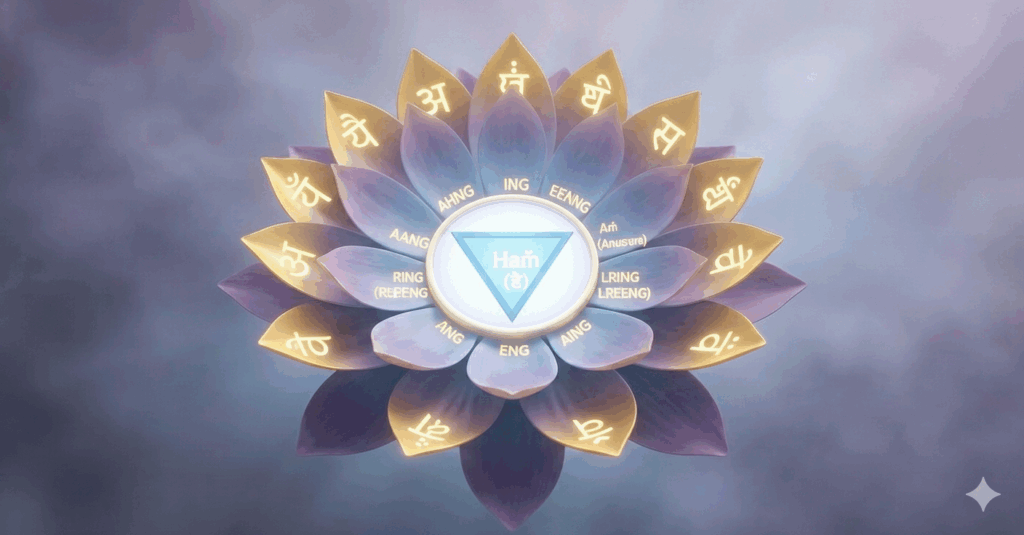
When the mind has become stable and peaceful one can begin with the throat chakra. It contains 16 petals, each with the vowels of the Sanskrit alphabet.
Each of the 16 petals of Vishuddha has a vermilion coloured Sanskrit letter.
- A अं – Represents the beginning of sound, purity. (Aṁ) – Pronounced like “ahng” or “uhng” (nasalized ‘a’).
- Ā आं – Extension of sound, clear expression. (Āṁ) – Pronounced like “aahng” (long nasalized ‘a’).
- I इं – Inner awareness, receptivity. (Iṁ) – Pronounced like “ing” (nasalized short ‘i’).
- Ī ईं– Deep inner wisdom, clarity of thought. (Īṁ) – Pronounced like “eeng” (nasalized long ‘i’).
- U उं – Upward movement of energy, creation. (Uṁ) – Pronounced like “ung” (nasalized short ‘u’).
- Ū ऊं – Fullness of expression, expansion. (Ūṁ) – Pronounced like “oong” (nasalized long ‘u’).
- Ṛ ऋं – Rhythm, order, balance. (Ṛṁ) – Pronounced like “ring” (nasalized vocalic ‘r’).
- Ṝ ॠं – Deep rhythm, cosmic order. (Ṝṁ) – Pronounced like “reeng” (nasalized long vocalic ‘r’).
- L̥ लृं – Lightness, subtlety. (Ḷṁ) – Pronounced like “lring” (nasalized vocalic ‘l’).
- L̥̄ लॄं – Deep subtlety. (Ḹṁ) – Pronounced like “lreeng” (nasalized long vocalic ‘l’).
- E एं – Union, merging of sounds. (Eṁ) – Pronounced like “eng” (nasalized ‘e’).
- Ai ऐं – Wisdom, knowledge, insight. (Aiṁ) – Pronounced like “aing” (nasalized ‘ai’).
- O ओं – Wholeness, completeness. (Oṁ) – Pronounced like “ong” (nasalized ‘o’).
- Au औं – Cosmic sound, universal vibration. (Auṁ) – Pronounced like “aung” (nasalized ‘au’).
- Aṃ अं – Nasal sound, resonance, connection to the subtle. (Aṁ) – This is often listed here as the last of the Anusvara vowels before the Visarga.
- Aḥ अः – Aspiration, exhalation, release. (Aḥ) – Pronounced like “ah-ha” (the ‘a’ followed by a slight aspiration like ‘h’).
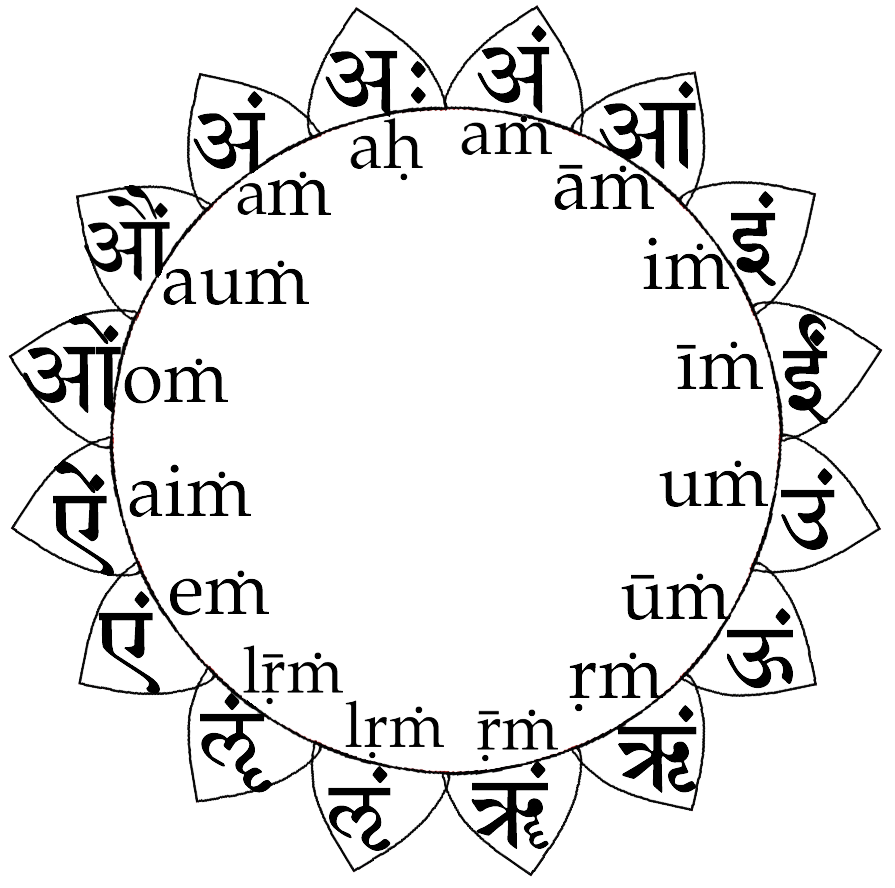
The 16 vowels on Vishuddha’s petals are not mental modifications or emotional tendencies that need to be overcome or purified. They are fundamental sound vibrations that enable all forms of verbal and creative expression. They represent:
- Fundamental Vibrations: The primal sound vibrations (Shabda Brahman) from which all articulated speech and cosmic manifestation arise. They are the raw phonetic potential of the throat center, embodying the purity and foundational nature of sound.
- Cosmic Sounds: The subtle sonic energies that resonate within the air element (Akasha Tattva) of Vishuddha. Meditating on these syllables is believed to activate the chakra and purify one’s voice and expression.
- Components of Speech: As the fundamental building blocks of the Sanskrit language (the language of mantras), their presence on the petals signifies Vishuddha’s role as the center for clear, pure, and effective communication and self-expression.
The 16 Sanskrit vowels of speach on the petals of the Vishuddha Chakra are primarily understood as divine syllables (Aksharas/Matrikas). They represent the elements of pure sound itself, residing in the chakra of purity and communication.
There is a different version of the meaning of the symbols on the petals of Vishuddha that includes the 7 musical tones and various mantras. The Vrittis on this chakra govern speech and expression. The first nine Vrittis are the mantras: Pranava (mantra om), udgitha (the Sama-mantras), and mantras hung, phat, vashat, svadha, svaha, namah, and the nectar of immortality (amrita). The remaining vrittis are seven musical notes: nishada, rishabha, gandhara, shadja, madhyama, dhaivata and panchama. As this is not the tradional version, I will include it in the New age version.