
Think of your heart’s emotions like the weather—some days bring heavy clouds of anxiety or doubt, while others bring bright sunshine and hope. This guide breaks down the 12 natural emotional waves of the heart so you can learn to observe them without letting them take over.
The Emotional Weather of the Heart
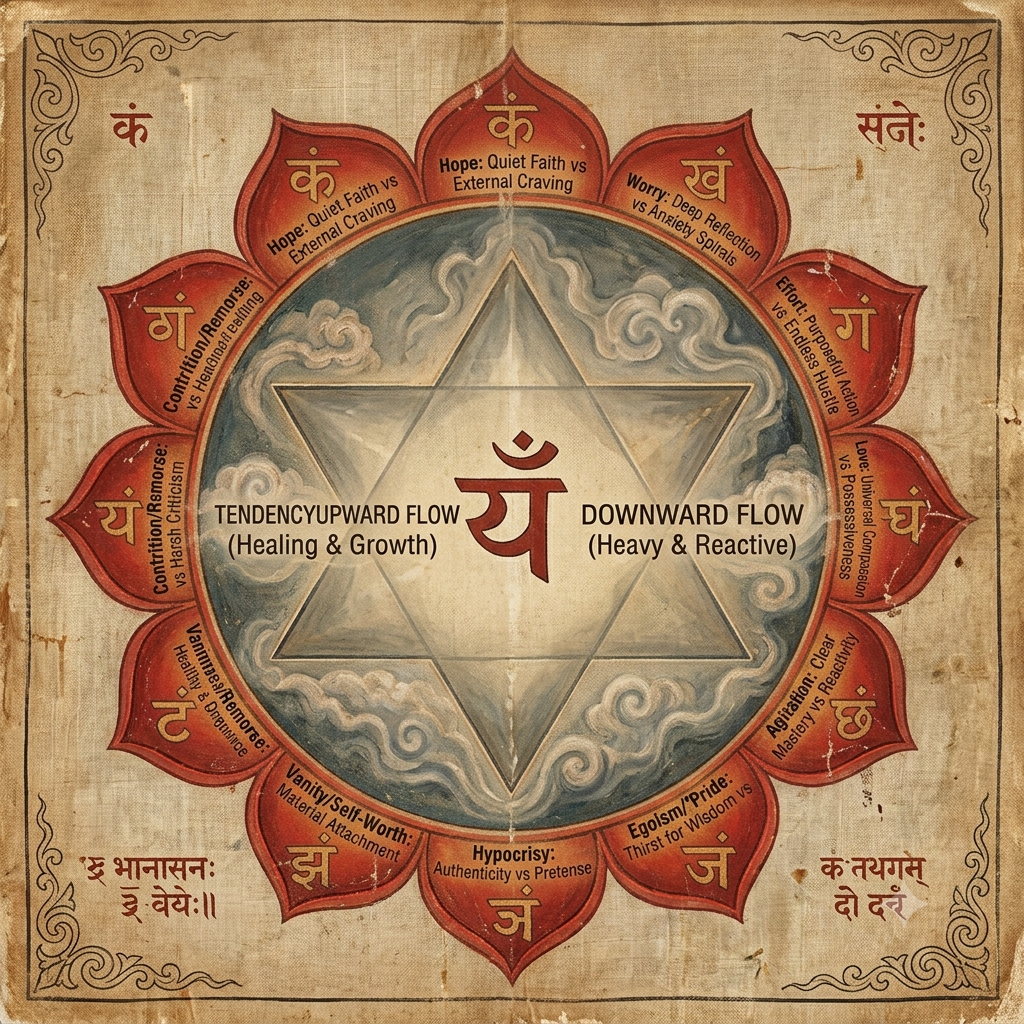
Our minds are a vibration of energy — a miniature expression of the cosmic flow. To manifest this energy, consciousness adopts Vrittis: the shifting moods, thoughts, and emotional waves we feel every day. In the Anahata Chakra, they are symbolized by 12 lotus petals, each representing an emotion of the heart: hope, worry, effort, universal love, self-worth, awareness, stress, ego, greed, hypocrisy, judgment, and regret.
When we treat emotions as who we are, we get stuck in them. Learning about the ancient map of the heart teaches us that our emotions are not our identity, and everything changes. Emotions are temporary waves passing through us. If we can change how we think from “I am angry” or “I am anxious” to “I feel angry” or “I feel anxious” — we stop identifying as the emotion and start observing how it feels. This subtle shift allows the wave to arise and dissolve naturally without becoming stuck.

Ripples on the Lake: Finding the Calm Beneath
At the deepest level of the Heart Chakra lies a place of quiet and intuitive guidance: the unstruck sound, the steady, peaceful silence beneath all the emotional noise. Think of your emotions as ripples on a lake. While the bubbles bubbling upward guide us toward the light, they are still movements on the surface.

When we feel the positive expressions of the heart — hope, effort, and universal love with their upward flow — observing them makes the emotion grow stronger, energizing us and guiding us toward the light. Yet, even these beautiful feelings are still movements on the surface. We must eventually learn to watch them arise and dissolve naturally without being swept away.
Bija Mantra Yaṁ
The vibration of Yaṁ is the bija mantra of the element of air. Air is invisible, yet it touches everything. Yaṁ captures how consciousness fills and touches everything within the heart.
The twelve mantras on the petals represent specific emotional frequencies or disturbances; Yaṁ is the core vibration that harmonizes them all. Just like a cyclone pulling swirling winds inward to the eye of the storm, Yaṁ draws external distraction and emotional turbulence back towards the centre. As the storm quiets, the vibration of the nasal “ṁ” creates a deep resonance, allowing the mind to step out of the chaos and hear the mystical Anahata Nada — the unstruck cosmic sound that reverberates in the heart, born in the stillness of the Hrit chakra.
Anahata — Unstruck and Unhurt
The unstruck sound originates deep in the secret cave (guha) Hrit chakra, which holds the eternal flame that is our soul. The heart chakra is where the primordial vibration rises into the air element (Vayu), manifesting as the dynamic, moving currents of human emotion. Blending the two is like confusing the deep, silent source of a subterranean spring with the rushing river on the surface. You cannot find stillness by trying to stop the winds of the emotions from blowing. Anahata is the windy, shifting weather of the emotional body where air moves and seeks balance among changing feelings.
Anahata also translates to “unhurt”. This does not mean anahata is a shield that prevents pain; it is the state that remains after every grief, betrayal, and sorrow has been fully felt, processed, and cleared. The emotional weather will always move across the outer petals, but when the storms are met and released, the spiritual heart returns to what it always was: completely unhurt, deep, and pure.

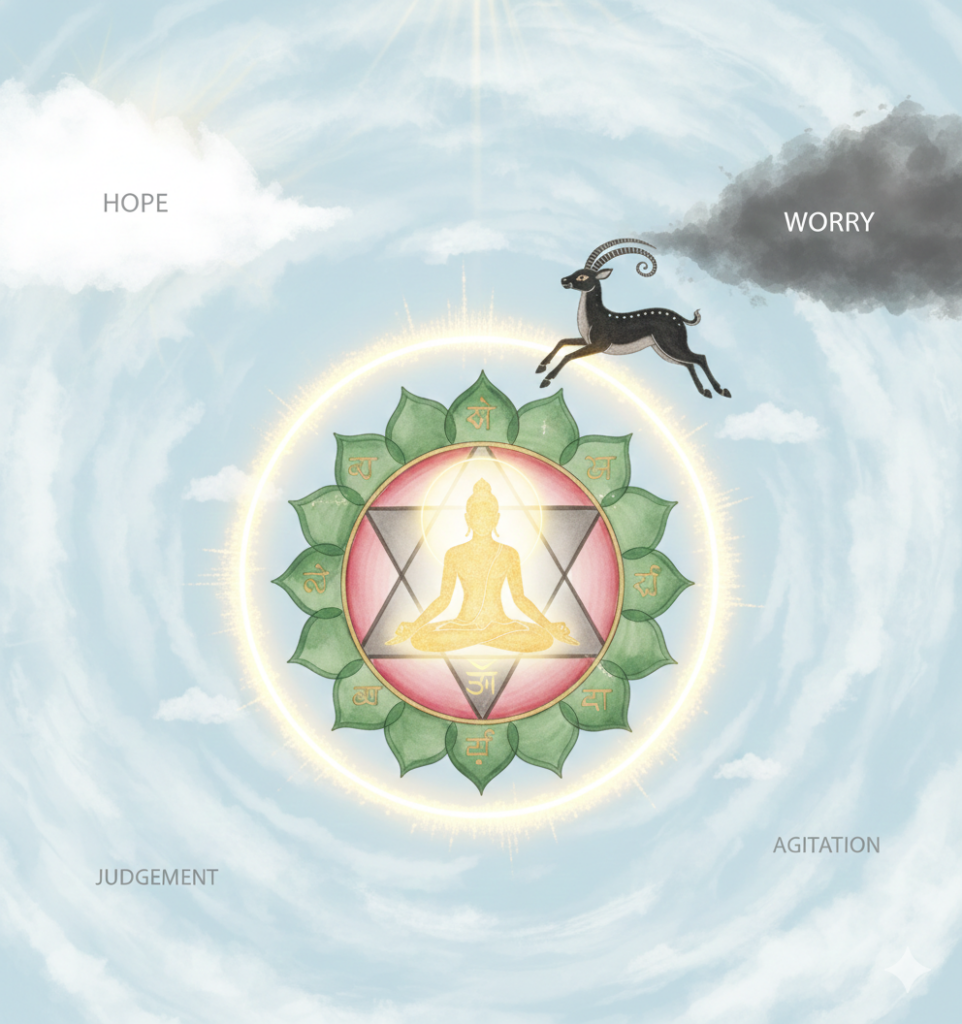
The heart is like weather — constantly shifting between heavy storms and clear skies. None of the clouds are actually who you are. Imagine the heart as a clear sky. Hope is a white cloud, and worry is a dark cloud. Both are disturbances to the clarity of the sky. When the wind of meditation blows all 12 clouds away, only the unstruck, unhurt heart remains
The Dual Flow of Energy
Anahata acts as the bridge between the lower chakras (physical and emotional) and the upper chakras (spiritual and communicative).

In the classical yoga tradition, these Vrittis are not judged as ‘good’ or ‘bad.’ They are simply directions of energy. How they are expressed depends upon where the frequency of your mind is flowing at that moment. To transcend these patterns doesn’t mean you stop feeling hope or making an effort. It means you become the neutral witness of the mind’s flow, resting in the equanimity of the inner chamber rather than getting tossed around by the weather.
- The Downward Flow (Reactive State): When energy gets stuck in fear or ego, these emotional states manifest as defensiveness, anxiety, and stress.
- The Upward Flow (Healing State): When energy rises with self-awareness, these same feelings are transformed into personal growth, compassion, and inner peace.
Within the geometry of the Shatkona — the six-pointed star at the centre of the Anahata Chakra — this dynamic balance is beautifully mapped out:
- The Downward-Pointing Triangle: Represents the descent of consciousness into the material world, the physical body, and the swirling waves of human emotion.
- The Upward-Pointing Triangle: Represents spiritual aspiration, self-awareness, and the upward ascent of energy toward liberation.
Where these two triangles intersect in the heart is the sacred space of balance, where we learn to hold our human experiences without getting trapped by them.
When ancient yoga philosophy speaks of transcending these patterns, it doesn’t mean you stop feeling hope or making an effort. It means you become the witness of these disturbances, finding that steady point of equanimity right where the two forces meet.

Balancing the Upward and Downward Flows of the Heart.
The 12 petals of the heart chakra represent 12 key emotional states. Depending on where your awareness rests, each emotion can either draw you into stress (downward flow) or lead you toward healing (upward flow).
| Bija | Emotional State | Upward Flow (Healing & Growth) | Downward Flow (Heavy & Reactive) |
|---|---|---|---|
| Ka | Hope | Quiet Faith: Trusting in your inner healing and growth. | External Craving: Expecting outside things or people to fix your happiness. |
| Kha | Worry | Deep Reflection: Pausing to gain genuine insight and clarity. | Anxiety Spirals: Overthinking and wasting mental energy on "what ifs." |
| Ga | Effort | Purposeful Action: Working steadily toward inner peace and wellbeing. | Endless Hustle: Straining and struggling without clear purpose. |
| Gha | Love | Universal Compassion: Loving without needing anything in return. | Possessiveness: Needing to control or own the people/things you care about. |
| Ṅa | Vanity / Self-Worth | Healthy Dignity: Feeling inherently worthy as you are. | Arrogance: Puffing yourself up to hide insecurities from others. |
| Ca | Awareness | Clear Discernment: Seeing situations objectively without emotional blur. | Over-Analysis: Getting trapped in your head and over-intellectualizing feelings. |
| Cha | Agitation | Emotional Mastery: Channeling restless energy into creative passion. | Reactivity: Feeling constantly triggered and easily upset by small things. |
| Ja | Egoism / Pride | Inner Strength: Standing firmly in your true values. | Defensiveness: Taking everything personally to protect your ego. |
| Jha | Greed / Desire | Thirst for Wisdom: An unquenchable desire to learn and grow. | Material Attachment: Always wanting more physical stuff or status to feel full. |
| Ña | Hypocrisy | Authenticity: Living honestly and aligning your actions with your values. | Pretense: Putting on a "fake mask" to impress or deceive others. |
| Ṭha | Judgmentalism | Healthy Boundaries: Distinguishing what is good for you from what isn't. | Harsh Criticism: Constant nitpicking and judging yourself or others. |
| Ḍa | Contrition / Remorse | Genuine Healing: Learning from past mistakes and letting them go. | Self-Guilt: Carrying heavy shame and punishing yourself repeatedly. |
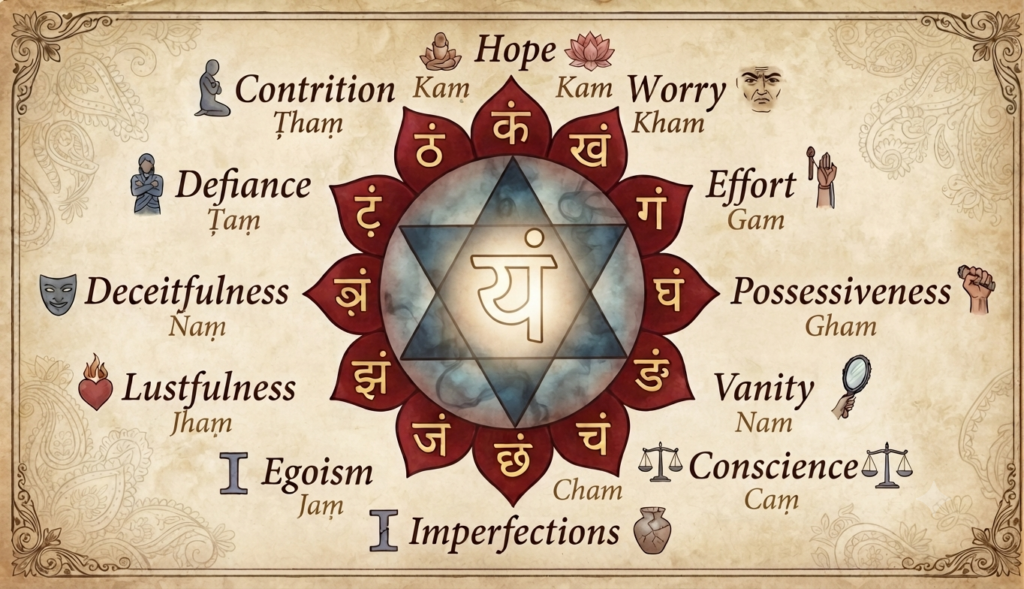
Click below for a deep dive into each Vritti: Click on any emotion below to explore how its energy flows—whether it is weighing you down into stress or lifting you toward growth.
When ancient yoga philosophy speaks of “transcending” these patterns, it doesn’t mean you stop feeling hope or making an effort. It means you become the witness of these disturbances.
1. क ka kaṁ Āśā – Hope, joy, optimism, happiness, pleasure.
- Upward Flow (Healing & Growth): Unshakable trust in life’s direction and a light, uplifted heart.
- Downward Flow (Heavy & Reactive): Naive expectation, clinging to outcomes, or deep disappointment when reality falls short.
- (Ka is the name of the soul in Ancient Egypt.)
2. ख kha, khaṁ: Cintā – Thoughtfulness, worry, concern, care, anxiety
- Upward Flow (Healing & Growth): Deep consideration, empathy, and mindful care for oneself and others.
- Downward Flow (Heavy & Reactive): Overthinking, chronic worry, anxiety, and mental exhaustion.
- Worrying is a waste of energy. If you have a problem and can do something about it then do it, then you will have no reason to worry. If you can’t do anything about it, then it is pointless worrying about it. Don’t worry about imaginary situations that are more than likely not to happen.
3. ग ga, gaṁ: Ceṣṭā – effort, Initiative
- Upward Flow (Healing & Growth): Dedicated perseverance, healthy enthusiasm, and inspired action.
- Downward Flow (Heavy & Reactive): Forcefulness, burnout, strain, and trying to control every result.
- Effort is a disturbance of simply ‘being’ by pushing to achieve. When you go with the flow, everything comes naturally.
4. घ gha, ghaṁ: Mamatā – Universal Love & Attachment
- Upward flow: Universal Love: Feeling complete in oneself; wanting the best for others. Unconditional love, open-hearted connection, and reverence for all life.
- Downward Flow (Heavy & Reactive): Possessiveness, jealousy, boundary issues, and conditional affection.
- If you love someone, you don’t need to own or possess them; you want the best for them, and you don’t need them to complete you, you need to be complete in yourself. You can add to their life experience, rather than wanting them to give to you, or compete with you. You may even need to set them free to complete their life’s purpose.
5. ङ ṅa, ṅaṁ: Dambha – Authenticity, Pretentiousness, hypocrisy, pride, vanity
- Upward Flow (Healing & Growth): Spiritual sincerity, humility, and gratitude in one’s practice.
- Downward Flow (Heavy & Reactive): Pursuing outward displays of virtue over inner transformation; arrogance and vanity of the ego.
- Arrogance is a disturbance of truth—a lack of genuine sincerity in spiritual practices. The higher path is humble gratitude.
6. च ca, caṁ: Viveka – Awareness, discrimination
- Upward Flow (Healing & Growth): Clear spiritual discernment, intuitive wisdom, and seeing truth beneath surface appearances.
- Downward Flow (Heavy & Reactive): Intellectual cynicism, cold detachment, or over-analyzing feelings.
- The ability to see the difference between what is real and what is temporary, choosing inner joy over passing distractions.
7. छ cha, chaṁ: Vikalatā – Agitation & Restlessness
- Upward Flow (Healing & Growth): Sensitivity that prompts gentle self-care, grounding, and nervous system regulation.
- Downward Flow (Heavy & Reactive): Feeling overwhelmed, restless, incompetent, or stuck in emotional inertia.
- Reframe negative thoughts into balanced truths—for example, replacing “I’m incompetent” with “I’m learning and developing my skills.”
8. ज ja, jaṁ: Ahaṃkāra – Egoism & Sense of Self
- Upward Flow (Healing & Growth): Healthy self-worth, solid boundaries, and honoring the divine spark within.
- Downward Flow (Heavy & Reactive): Defensiveness, self-centeredness, and feeling isolated from the world.
- Forgetting your true, spiritual nature and mistakenly believing you are just a physical body or a collection of temporary life experiences. It is the ego (“I-maker”) that creates a false sense of separation between you and the rest of the universe.
9. झ jha, jhaṁ: Lolatā – Greed & Longing
- Upward Flow (Healing & Growth): A deep spiritual yearning for truth, wisdom, and inner fulfillment.
- Downward Flow (Heavy & Reactive): Material craving, insatiable desire, and fear of scarcity.
- It is not having things that causes suffering, but being attached and fearful of losing them. Greed distorts the heart, but learning to appreciate what passes through your hands without grasping brings true peace.
10. ञ ña, ñaṁ: Kapaṭatā – Duplicity, Deceitfulness & Hypocrisy
- Upward Flow (Skilful Means): Using diplomacy and tact to act for the greater good.
- Downward Flow (Duplicity): Pretending to be what one is not or feigning feelings one doesn’t have to conceal ignorance or weakness.
- When your actions don’t match your true feelings, it creates a lack of integrity and trust. Live with genuine sincerity — don’t wear masks, pretend to feel things you don’t, or criticize others for mistakes you make yourself.
11. ट ṭa, ṭaṁ: Vitarka – Intellectual restlessness, argumentation, logic.
- Upward Flow (Healing & Growth): Sharp intellectual clarity, deep inquiry, and a curious, open mind.
- Downward Flow (Heavy & Reactive): Over-analyzing, endless mental debate, and using logic as a defense mechanism against feeling.
- The mind loves to argue and intellectualize to stay safe. Notice when reasoning turns into restlessness, and bring your awareness back down into the steady stillness of the heart.
12. ठ tha, thaṁ: Anutāpa – repentance, remorse, regret, sympathy.
- Upward Flow (Accountability & Growth): Healthy reflection, learning from past mistakes, and genuine inner healing.
- Downward Flow (Remorse): Chronic guilt, self-punishment, and getting trapped in past regrets.
- This quality describes a deep feeling of compassion and care for the suffering of others, paired with an active desire to help. It is also a healthy remorse for past mistakes and a firm resolve to change for the better—allowing the emotional disturbance to dissolve back into the stillness of grace.
3-Step Daily Life Practice
- Step 1 — Pause, Soften & Permission: When a heavy state like depression arises, soften the label and give yourself permission to feel it. Say to yourself: “I feel sad right now, and that is okay,” instead of “I am depressed.” Changing the label removes the heavy burden of identity and allows the feeling to just be.
- If worry arises, rename it as concern, and silently say to yourself: “I am feeling concerned about something at the moment,” instead of “I’m worried about that.” Changing the word removes the panic, and naming it creates instant distance.
- Step 2 — Breathe into the Heart: Inhale deeply through your nose, imagining wide space opening up all around the heart center (Anahata).
- Step 3 — Let the Wave Pass: Remind yourself that emotions are just temporary weather patterns rolling through the sky—they are experiences passing through you, not who you are.
The Breath of the Antelope: Anahata Meditation
The Seat of the Heart
To practice this meditation, Sit comfortably. Imagine your spine as a hollow reed through which air flows effortlessly. Soften your shoulders and place your hands in Anjali Mudra (prayer position) at the centre of your chest. Feel the warmth where your thumbs touch your sternum
The Inner Sky
- Close your eyes and visualize your chest expanding into a vast, pale blue sky. At the centre sits a twelve-petaled lotus of deep crimson red. Within its heart lies a smoke-coloured six-pointed star – the space of air and movement – radiating a smoky golden light.
- Focus on the central heart space (Anahata) and open your awareness to the Anahata Nada – the continuous, unstruck cosmic vibration that hums naturally within this energy centre. Imagine your heart space as a singing bowl holding a gentle, continuous vibration that never truly fades.
- Imagine a protective golden ring that keeps the unhurt essence of your being safe from the external world as you sit with and notice your feelings.
- Give yourself permission to feel whatever emotion arises. Don’t follow the story of what is causing the emotion. Just allow it to exist.
- As you feel the emotion focus on the protective golden ring. Let that smoky golden light fill the room or your space, keeping you safe.
The Grace of the Antelope
- Visualize the Black Antelope standing serene within this space.
- As you inhale, feel the lightness of the antelope. Imagine you are breathing in the expansive Vyana Vayu, the air that moves through every corner of your being.
- As you exhale, release heavy feelings of the day. If a cloud of worry or judgement appears in your sky, watch the antelope leap gracefully over it. Do not chase the cloud; let it drift by.
The Protective Ring
- See the shimmering golden ring around your heart. This ring is made of pure vibration. It allows the breath and universal love to flow through, but it keeps the noises of the outside world — the opinions, the chaos, the stress — from disturbing the peace in your heart.
- Begin to hum the sound Yaṁ softly, out loud or your in your mind.
- Feel the vibration starting in the centre of the lotus.
- Let the sound ripple out until it hits the golden ring and bounces back into the centre.
Glossary
Bija Mantra: A single-syllable “seed” sound carrying the core vibration of an element or energy center (e.g., Yaṁ).
Jivatma: The individual soul or true inner consciousness dwelling within the heart space.
Shatkona: The interlocking six-pointed star representing the balance and union of masculine (upward triangle) and feminine (downward triangle) energies.
Vritti: Literally “whirlpool” or mental modification; the shifting emotional waves, moods, and tendencies of the mind.