
Introduction – The Mātṛkās of Vishuddha
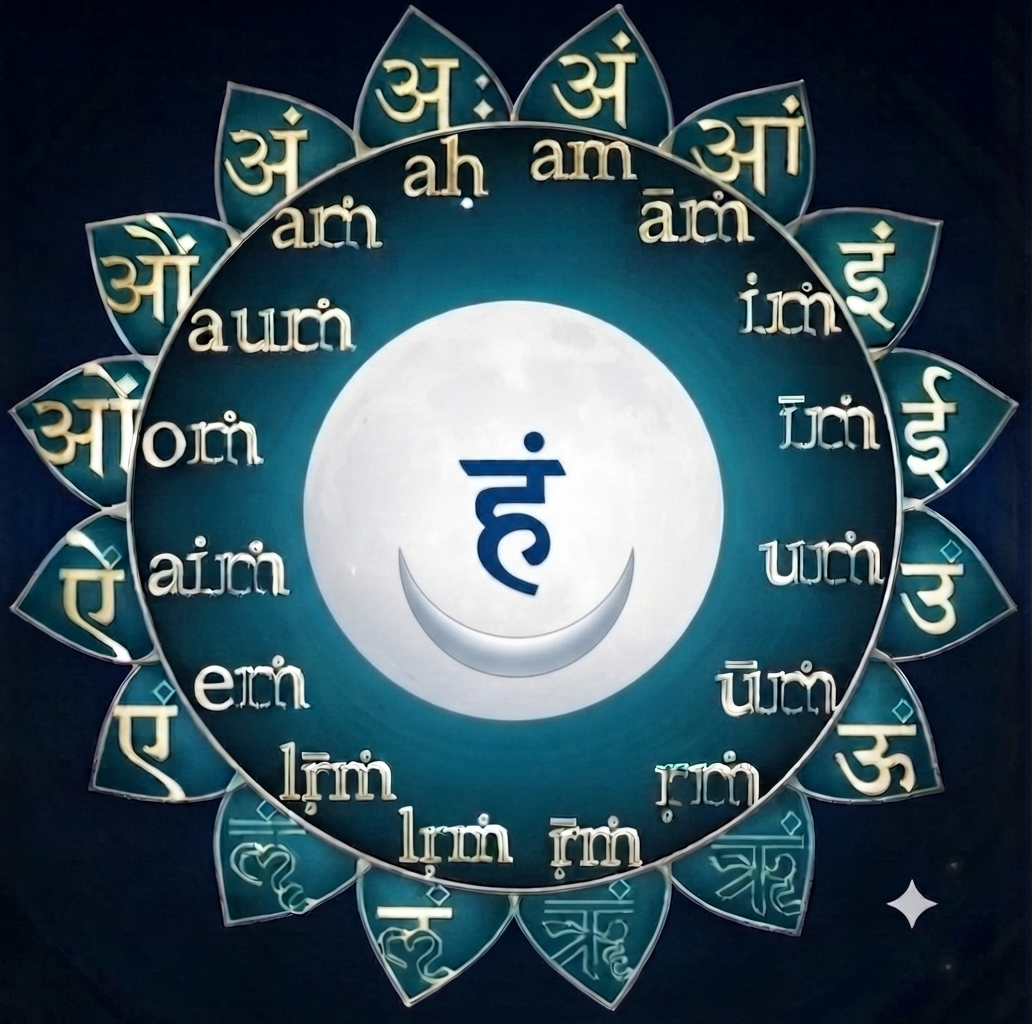
In authentic Agama, Tantra, and Kundalini texts, the Vishuddha Chakra is represented as a 16-petaled lotus with a white crescent moon within a down-turned triangle inside the throat centre. Its smoky colour of rain clouds symbolizes the subtle nature of space,
The 16 vowels on Vishuddha’s petals are not vrittis that need to be overcome or purified. They are fundamental sound vibrations that enable all forms of verbal and creative expression called Mātṛkās. In the lower Chakras (Muladhara to Anahata), the petals govern psychological vrittis — fluctuations of the mind and ego that obscure pure awareness and need to be refined or purified.
Once energy reaches Vishuddha Chakra, the mind rises above individual emotional programming into the realm of pure space. Here, the 16 vowels are Mātṛkās (“Little Mothers”) or Akṣaras (imperishable divine syllables).
They represent:
- Fundamental Vibrations: The primal sound vibrations from which all articulated speech and cosmic manifestation arise. They are the raw phonetic potential of the throat centre, embodying the purity and foundational nature of sound.
- Cosmic Sounds: The subtle, sonic energies that resonate within the Ether/Space element of Vishuddha. Meditating on these syllables is believed to activate the chakra and purify one’s voice and expression.
- Components of Speech: As the fundamental building blocks of the Sanskrit language (the language of mantras), their presence on the petals signifies Vishuddha’s role as the center for clear, pure, and effective communication and self-expression.
The 16 sounds inscribed upon the petals of Vishuddha are the 16 Sanskrit vowels and are primarily understood as divine syllables. They represent the elements of pure sound itself, residing in the chakra of purity and communication.
Known collectively as the primary Divine Mother sounds, they embody the subtle element of Space/Ether and form the acoustic foundation for all speech and manifestation. The 16 seed letters or bija mantras are inscribed on the petals in brilliant gold or white
The bija mantra at the centre of Vishuddha is हं (HAṂ), which governs the element of Space.
The 16 Sounds (Mātṛkās) of Vishuddha
In traditional Agamic practice, these letters are recited in a clockwise sequence across the 16 petals, combined with the nasal sound ṃ representing Bindu / consciousness.
Human vocal expression at Vishuddha Chakra encompasses both artistic and sacred sound: the 7 musical notes are the melodic, artistic, and emotional vocal sounds: Sa, Re, Ga, Ma, Pa, Dha, Ni — which originated from the melodic chanting of the Sama Veda; combined with the 9 sacred mantras that represent transformative, ritualistic, and spiritual intention, they make up the complete power of the human throat and vocal expression of the throat centre’s 16 petals.
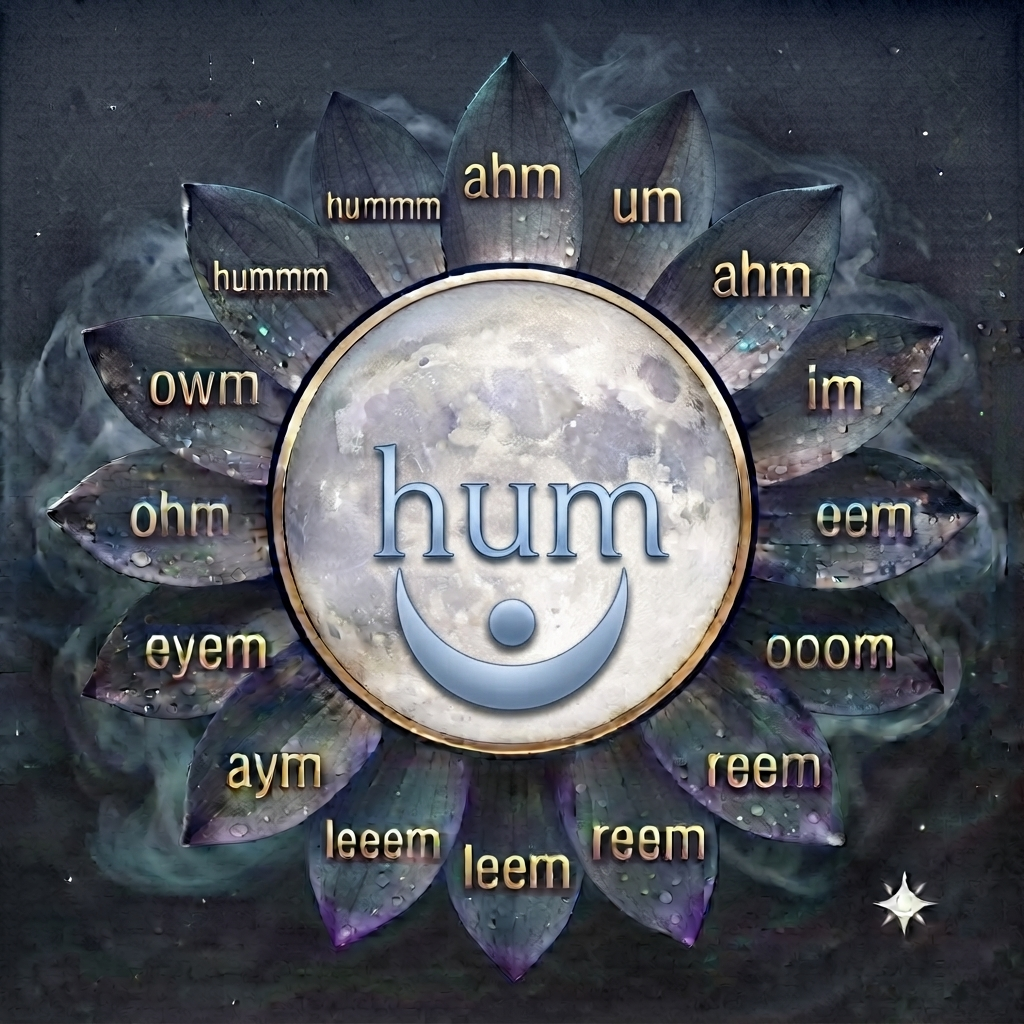
The 4 Phases of Sacred Sound
The 9 Esoteric Utterances
These 9 sounds represent spiritual, ritualistic, and transformative power used across Tantric and Vedic rites.
1. The 2 Primary Sacred Chants
The Silence & Source (The Unmanifest) Before a song or word exists, there is just space and potential.
- Oṃ – The primordial root sound (Praṇava).
- Udgītha – The primary chanting sound of the Sāma Veda (the Veda of sacred song and knowledge).
Oṃ and Udgītha are the foundation, unmanifest sounds from which all other mantras arise. This is the open, quiet breath in the throat before sound takes shape—the acoustic foundation for everything else.
2. The 6 Sacred Sounds
The Intentional Sparks (The 6 Bīja Mantras) Once sound begins to move, it takes on specific dynamic jobs—sharp energy, focused direction, soft surrender. They align with the active, dynamic vowels.
- Huṃ – The protective/energizing seed mantra.
- Phaṭ – The weapon / barrier-shattering sound.
- Vaṣaṭ – The sacred sound for focus and clarity.
- Svāhā – Offering to fire and divine consciousness.
- Svadhā – The offering of ancestral gratitude.
- Namaḥ – The sound of reverence and surrender.
3. The Secret 9th Element
The Turning Point (The Secret Nectar)
- Amṛta – The nectar of vocal mastery and divine immortality completes the 9 sacred sound elements.
Amṛta represents the moment speech stops being rigid and becomes the sweet, effortless, and fluid nectar of pure expression.
4. The 7 Musical Notes
The Song of Expression These 7 notes (Saptasvara) are the universal acoustic foundation of melody. They represent creative and emotional expression and correspond directly to the 7 notes of the Western major scale, bridging Eastern and Western musical mysticism. The 7 notes flow through the musical scale, climbing upward, moving from the grounded, flexible root note (Sa) to the highest soaring pitch (Ni), before dissolving back into silence.
- Sa (Ṣaḍja) – Root / Tonic (Do) — The foundational pitch; the origin from which all other notes arise.
- Re (Ṛṣabha) – Major 2nd (Re) — The ascending movement of breath and energy.
- Ga (Gāndhāra) – Major 3rd (Mi) — The harmonious, sweet expression of emotion.
- Ma (Madhyama) – Perfect 4th (Fa) — The central pivot note bridging the lower and higher tones.
- Pa (Pañcama) – Perfect 5th (Sol) — The resonant, stabilizing anchor note.
- Dha (Dhaivata) – Major 6th (La) — The expansive, uplifting tone of expression.
- Ni (Niṣāda) – Major 7th (Ti) — The leading note that reaches upward toward pure completion.
The Descent of Sound
The throat chakra (Vishuddha) holds the 16 vowels—which represent pure space, ether, and unmanifest sound. The remaining 34 consonants descend downward through the lower four chakras starting from Anāhata (Heart) down to Mūlādhāra (Root), as sound gradually becomes more dense, structured, and material in physical manifestation.
Beyond their acoustic resonance, each petal of Vishuddha is also animated by a presiding Devi (goddess/shakti). These divine feminine energies govern the subtle vibrations of sound, transforming each vowel into a living vessel of sacred consciousness rather than a mere phonetic element.
16 Mātṛkās & Presiding Devis
Sanskrit Syllables, Pronunciation Guide & Inner Esoteric Functions
The Vocal Qualities of the 6 Sacred Sounds
If you are musically minded, here is an interpretation of how the 6 sacred mantra sounds might be intonated. Western music uses Italian terms for dynamics to define how a piece is expressed. In Sanskrit, the word bīja literally translates to ‘seed’—because just as a plant’s physical seed encloses its entire unmanifest blueprint, a bīja acts as a condensed acoustic origin, holding the complete potential of a sound within a single syllable.
1. Huṃ (The Protective / Energizing bija)
- Western Musical Equivalent:
Sforzando (sfz) / Marcato (marc. ∧)/ Emphasized Resonance - How it sounds: A sharp, heavily accented attack that instantly builds internal resonance and protective energy. In Western vocal music, this is the deep chest-voice resonance or a dramatic, grounded impulse.
2. Phaṭ (The Barrier-Shattering / Weapon Sound)
- Western Musical Equivalent:
Staccatissimo (staccatiss. ▲) / Explosive Articulation - How it sounds: A sharp, sudden, popping burst of sound that immediately cuts off cleanly. It functions like a striking percussion hit or a sudden brass accent that cuts through a texture to release tension.
3. Vaṣaṭ (The Sound for Focus and Clarity)
- Western Musical Equivalent:
Tenuto (ten. -)/ Directed Focus - How it sounds: Sustaining a note with absolute clarity, precision, and unwavering pitch. In Western singing, this represents clean intonation and focused vocal projection that draws the listener’s attention directly into the center of the tone.
4. Svāhā (Offering to Divine Consciousness / Fire)
- Western Musical Equivalent:
Crescendo (cresc <)/ Ascending Release - How it sounds: An expansive, soaring sound that climbs upward and opens up freely—like a vocal line reaching a majestic climax or an offering lifting up into the room.
5. Svadhā (Offering of Ancestral Gratitude)
- Western Musical Equivalent:
Legato⌒ / Deep Resonant Warmth - How it sounds: Smooth, connected, and deeply grounded tone quality (cantabile). It reflects rich, warm lower formants in the voice that evoke memory, grounding, and reverence.
6. Namaḥ (The Sound of Reverence and Surrender)
- Western Musical Equivalent:
Decrescendo (dim. > ) / Morendo(Dying away) - How it sounds: Gently softening into quiet reverence, tapering off into pure silence (nada). It is the gentle release at the end of a musical phrase where the ego surrenders to the surrounding space.
Vishuddha Sacred Glossary
Essential terminology, elemental principles, and sonic metaphysics
🌌 Explore Vishuddha & Beyond
Return to the main Throat Chakra hub or continue ascending through the energetic system.