
Different Types of Meditation
There are many different ways to meditate, you need to find the one that works for you at the time.
- Focused attention meditation: The attention is focused on an object for the whole meditation session, such as the breath (Pranayama), repeating a mantra, an external object eg a candle flame or a sensation in the body. The mind learns to become less easily distracted.
- Open monitoring: Watching internal and external perceptions without judgement. Thoughts, feelings, memories; whatever arises, are allowed to flow naturally through the mind, trying not to alter or react to what arises. External sounds and smells etc are recognized and are allowed to be what they are, not as they are perceived to be. Examples are Mindfulness & Vipassana. Vipassana is not making your mind blank, it is being aware of what flows naturally through your mind
- Focus on the Body (Somatic & Moving Meditation): Moving meditation where we focus the mind on slow movements of the body. As your mind scans your body – noticing feelings, sensations and energy, the body relaxes completely, while retaining its presence in the moment. Examples are: Yoga Nidra and walking meditation.
- Effortless Presence is when the attention is not focused on anything in particular. It reposes in itself – quiet, empty, steady and introverted. Choiceless awareness or pure being is the deepest purpose of meditation, resting in effortless inner silence and a deeper state of consciousness, where the object of focus and the process of meditatation is left behind. There remains only the true self as pure presence. Examples are Dzogchen.
Homework – Setting up your Meditation Environment
Prepare for regular practice by choosing a time and quiet spot where you are unlikely to be disturbed — a corner of a room or a quiet nook in your home, away from distractions like the television or a computer desk. Start with short 5- to 10-minute sessions and gradually build your stamina over time. (With steady practice, you can meditate through physical discomfort and even ease pain.)
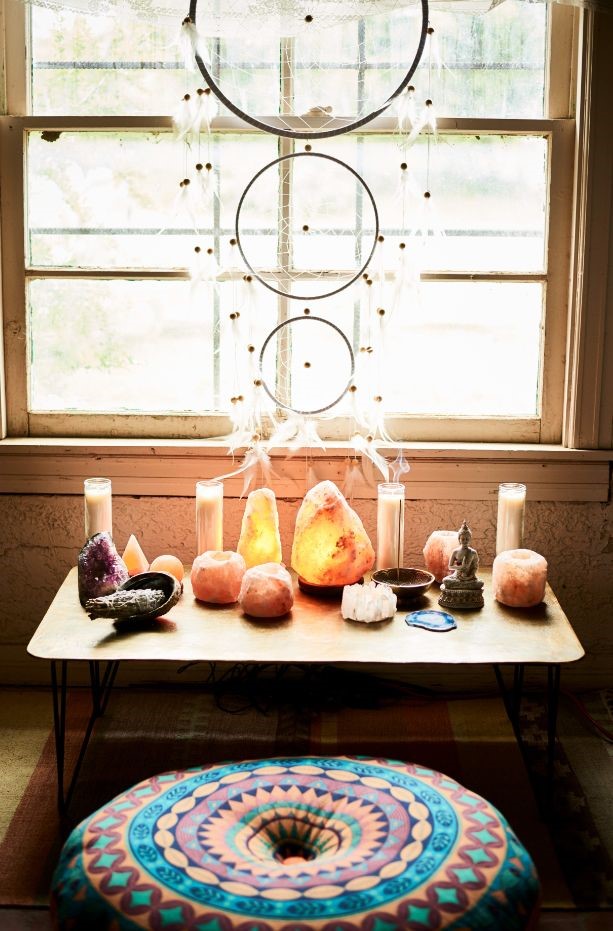
You can sit facing a plain wall, or set up your space with sacred objects that resonate with you. An object offers a visual anchor to help your mind settle. You could even make an altar on a little table in a cupboard to sit in front of for your practice. Your space might have crystals or a flower, maybe light candles, burn incense or essential oils. Essential oils affect your mood so choose the scent carefully; earthy smells like sandalwood, frankincense and cedarwood help settle restless energy; rose and geranium will help heal sadness; citrus scents will lift your mind and spirits. Preparing your space could be part of your ritual to signal your mind that it is time to slow down.
Posture, Seat & Gaze
It is important to be comfortable as discomfort becomes a distraction. Your back needs to be strong. One of the purposes of yoga is to make the body strong for meditation. If your back tires, sit against a wall or use a supportive chair. Sit cross-legged on a meditation cushion or folded blanket on the floor, or sit upright in a chair with your feet flat on the floor (uncrossed at the ankles). Aim to keep your hips slightly higher than your knees — if you are tall, sit on a thicker cushion so your lower back stays supported; if your feet do not reach the floor in a chair, rest them on a folded blanket or block. Monks just sit on a mat on the floor, but that is really hard and uncomfortable.
Keep your back straight, but not stiff, with a natural curve in your lower back. Lengthen through the crown of the head, chin tucked slightly towards your chest, but not looking down; shoulders relaxed, arms spread slightly, like the wings of an eagle. Place your hands on your knees or folded in your lap. Traditionally, the right hand rests palm-up inside the left hand, or if sitting in half-lotus, the right foot rests on the left thigh.
The eyes are somewhat open and the gaze looks down at a 45º past the nose. Your gaze needs to be light, don’t stare or do anything special, just let your gaze rest. Having your eyes slightly open will help you stay awake as meditation can make you sleepy, especially if you are new to the practice. Even the monks fall asleep. Alternatively, gently close down the eyes and take your focus to the third eye point (Ajna chakra) between the eyebrows but don’t strain your inner gaze.
Settling Into Stillness
Begin each session simply by sitting quietly in your space for a few minutes. If your attention wanders away, just gently bring it back to your body, the moment and your space. The key word here is “gently.” Your body is your gateway to the present moment. Slowly scan your body from your feet to your head, taking time to consciously relax every muscle. Settle your awareness on the natural rhythm of your breath, as your chest gently rises and falls. Allow your mind to quietly observe your thoughts as they arise and pass through your mind. Exist as the quiet present space around the thoughts – the silent witness to experience.
Your mind will wander — noticing that it has wandered is mindfulness in action. When you notice that yours has wandered, gently come back again to your body, your breath and your space.
Moving Meditation
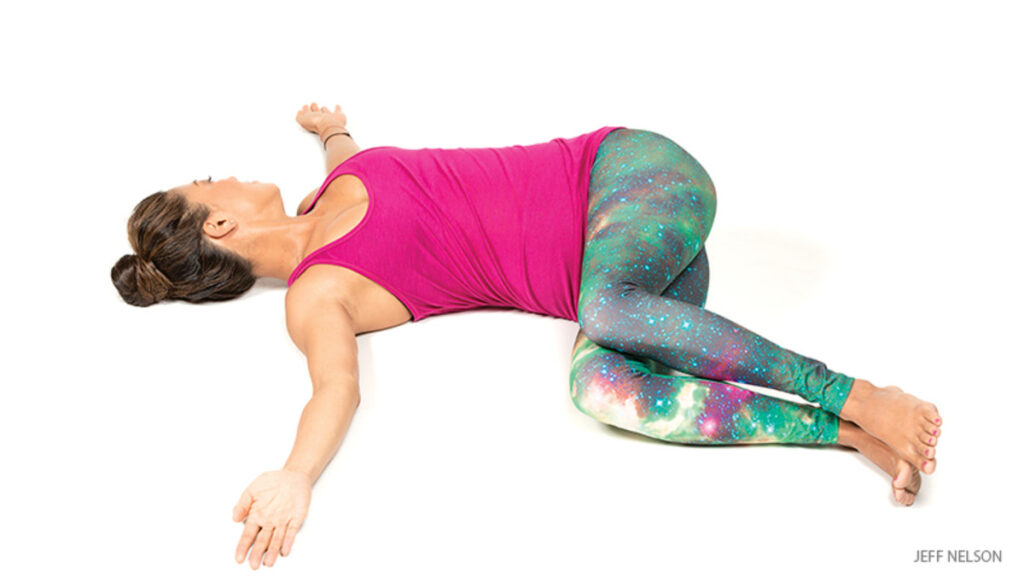
Practice lying on your back with knees bent, dropping your knees from side to side. Inhale as you bring your knees up, exhale as you lower your knees.
Count your breath making it even, the same number of counts to lower the knees to the floor and bring them back up. Inhale 3 counts as your knees come up, exhale 3 counts as they lower down. Do about 5 sets to get in the rhythm.
Then introduce turning your head to look in the opposite direction in time with your knees. Still keep mentally counting 3 as you move the knees from side to side, with the head also moving from side to side.
Next, start to Increase the count of your exhalation by one count. 4 counts in as your knees come up, 3 counts as they lower back down. Keep moving your head in time.
Continue for 5 sets, then increase the exhalation by another count. 5 counts as your knees come up, 3 counts as they lower down. Keep your head moving in time.
After another 5 sets increase your exhalations to 6 counts as your knees come up, 3 counts as you exhale as they lower. while you continue moving your head in time with your breath and the movement of your knees.
Don’t let the inhalations become more than twice the count of the inhalations.
You can continue as long as your like.
Increasing your exhalations calms the mind and by focusing your mind on the movements and your breath, it won’t be thinking of other thoughts.
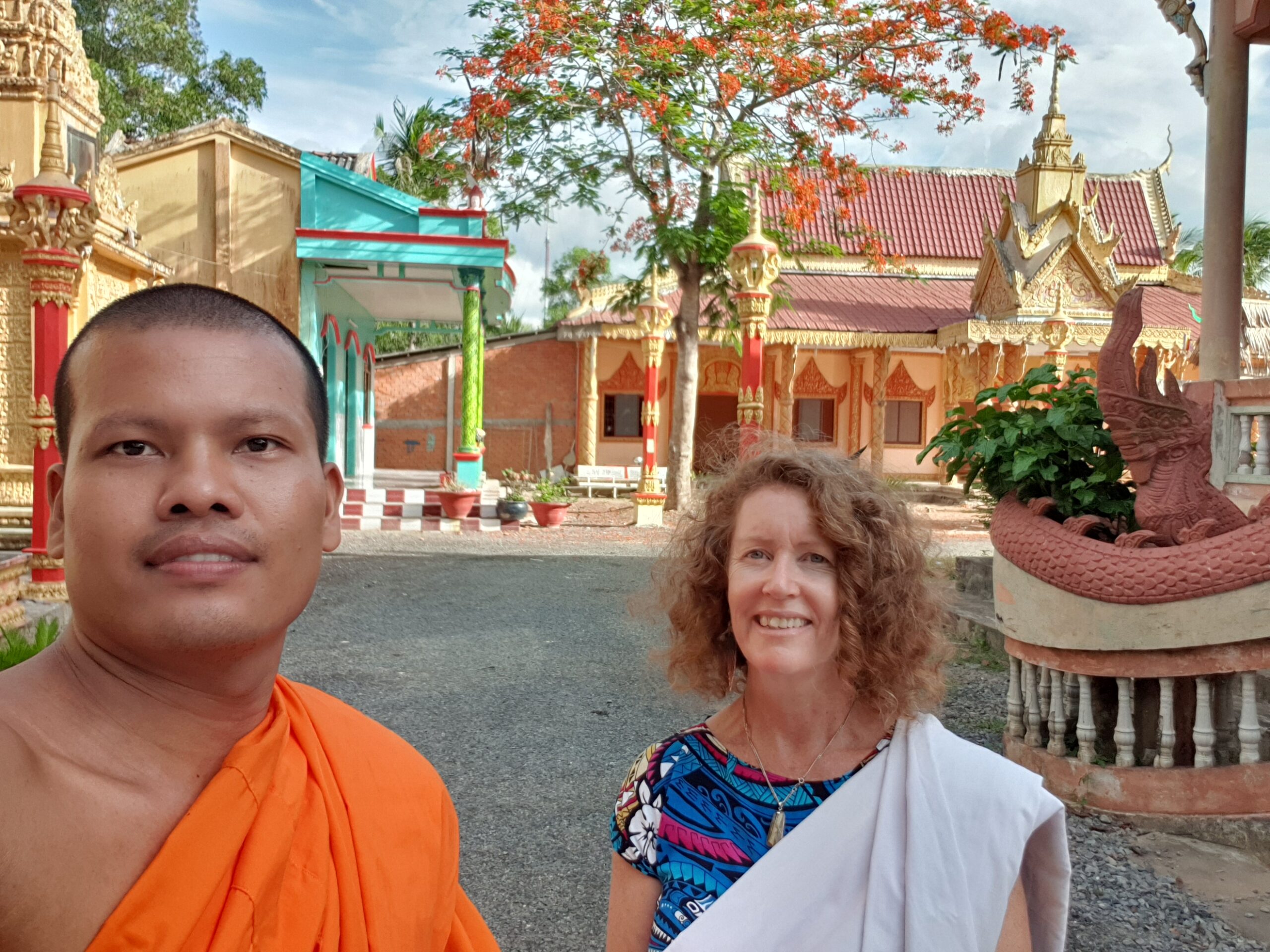
I learnt walking meditation when I was in a monastery in Vietnam.
We walked in single file in two lines, women and men in different lines.
Slowly and mindfully walked forward with our hands folded on our belly.
- For walking meditation, the words are:
- 1 – standing, standing, standing
- 2 – Intending to walk (said 3 times)
- 3 – right go touch (right foot lifts, moves forward and comes back to the ground)
- 4 – left go touch (left foot lifts, moves forward and comes back to the ground)
- 5 – when you reach the end of your walk, stop, stand and say the word ‘turning’ on the right side,
slowly, slowly, slowly - Repeat coming back the other way.