
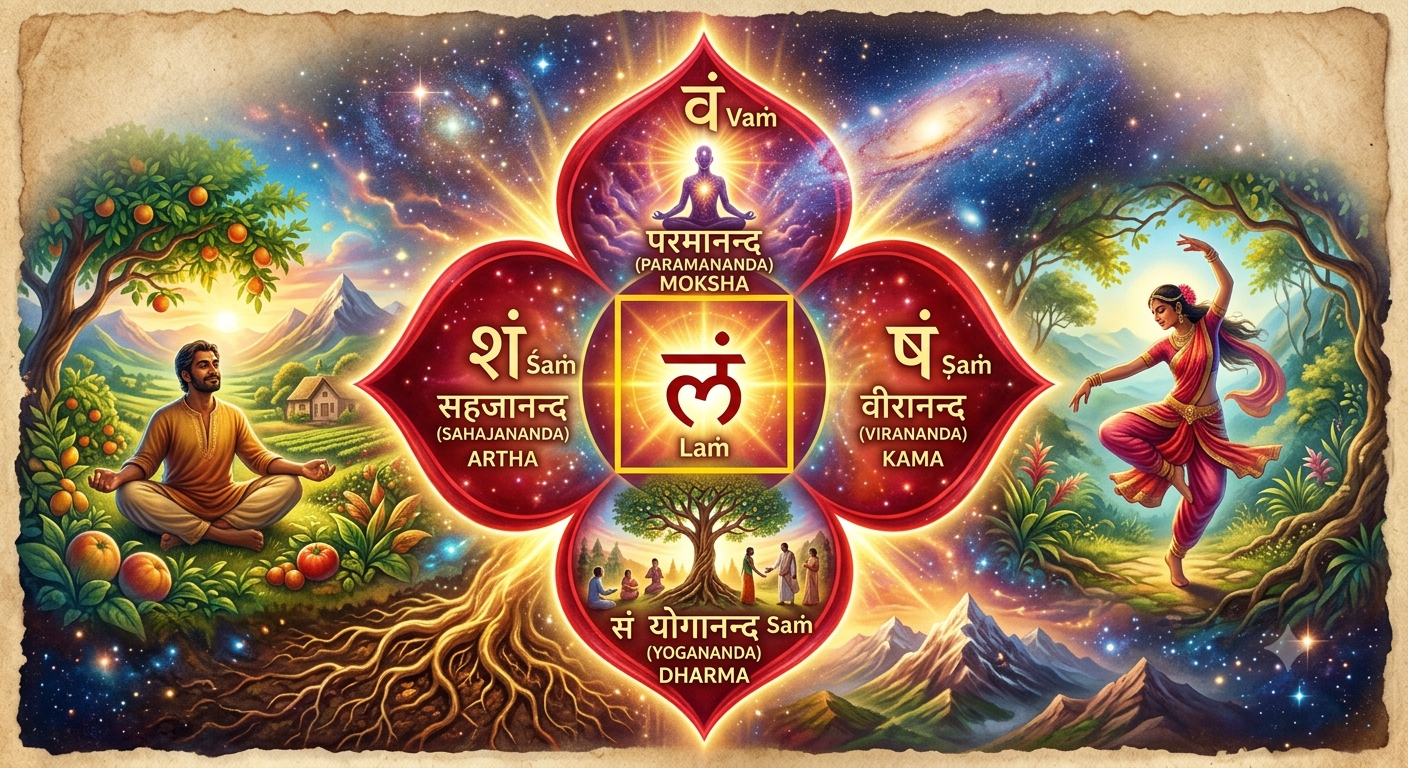
The Four Petals: Mapping the journey from union and duty to heroic bliss and final liberation.
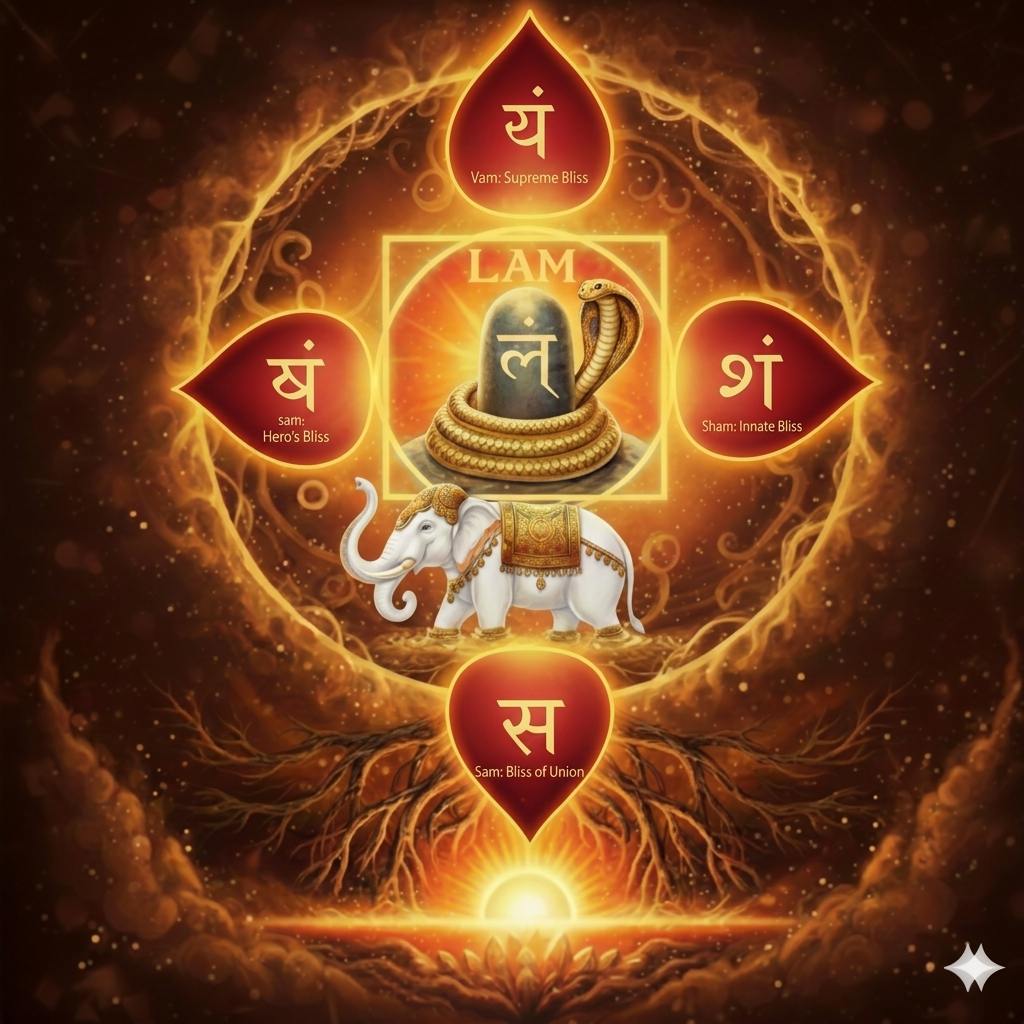
The Four Petals: Mapping Your Inner Evolution
The Muladhara chakra is traditionally described as a vermillion-red lotus with four distinct petals. In yoga philosophy, these petals are far more than just decoration—they are a map of human consciousness.
Each petal represents two things: one of the four great goals of life and one of the four types of joy we can experience. Together, they act as a bridge—taking the deep psychological states of our root energy centre and weaving them directly into how we survive, love, work, and visualize our purpose in the physical world.
Vrittis
Vritti means “whirlpool.” The mind is a vibration of energy. Vrittis are methods of expression that cause ripples on the surface of this energy—disturbances caused by our emotions, thoughts, desires, and survival instincts. To reach Samadhi, or bliss, a yogi needs to make his mind become still by bringing the vrittis to a state of calm. The goal is not to destroy these thought-waves, but to transform them into stillness so that we can observe our true inner nature. This is not an easy task.
Vrittis of Muladhara
The Grounding Power of Sound
The core symbol at the centre of this centre is the bija mantra Laṁ (लं) (pronounced luṁ). It belongs to the Earth element and serves as the anchor for the entire chakra system.
This vibration is the most solid seed sound, producing a deep, grounding vibration in the pelvic floor to release blockages related to survival, fear, and insecurity. It synchronizes your physical body with the stabilizing energy of the Earth and establishes the structural ‘root’ foundation necessary for the Kundalini energy to eventually rise. Without the stability of Laṁ, the pursuit of Bliss becomes ungrounded and unstable.
Bija mantras are sounds endowed with great spiritual powers. They work in the unseen planes of the universe and work profound miracles. The four petals of Muladhara each have a bija mantra and one specific quality or vritti. They represent the four directions of the soul’s outward movement.
🔴 Laṁ (लं):
- The Earth element bija mantra.
- The anchor that stabilizes our nervous system.
🤝The vibration: वं Vaṁ
- The Vritti: Supreme Bliss (Paramananda)
- The Life Goal: Spiritual liberation (Moksha)
- The Internal Meaning: Highest joy: The highest, purest joy of absolute spiritual liberation, enlightenment, and ultimate release from the limitations of the material world.
🌿 The vibration: शं Śaṁ
- The Bliss (Vritti): Innate Bliss (sahajananda)
- The Life Goal: Purpose & security/wealth (Artha)
- The Internal Meaning: Natural Joy: The grounded joy of finding natural abundance. The meaning, sense, goal, purpose and essence of life, including financial and emotional security.
🔥The vibration: षं Ṣaṁ
- The Bliss (Vritti): Heroic Bliss (virananda)
- The Life Goal: Sensory & aesthetic Pleasure (Kama)
- The Internal Meaning: Joy in control: The delight found in healthy passion, artistic expression (such as music, dance, and nature), and achieving mastery and control over our physical senses.
✨ The vibration: सं Saṁ
- The Bliss (Vritti): Bliss of Union (Yogananda)
- The Life Goal: Duty, virtues, and right ways of living. (Dharma)
- The Internal Meaning: Joy of Right Living: The deep, steady joy that arises when your life is in perfect alignment with cosmic duty, virtues, and responsibilities to the collective world.
🐦 A Living Experience of the Vrittis:These ancient sounds aren’t just characters on a page; they are living descriptions of our survival instincts and life-force energy. You can read my personal account of a profound, life-and-death synchronicity involving a stunning local bird at the exact moment of chanting the root vibrations here: The Story of the Sacred Kingfisher.
Meditation – A Grounding Reflection: Shaping the Mind
This practice uses the traditional sounds (Bija Mantras) of the Root Chakra to help calm the daily whirlpools (vrittis) of stress and survival anxiety. Instead of fighting your thoughts, you are going to use your imagination to shape that restless energy into a solid foundation.
- Feel the Raw Material: Sit comfortably and close your eyes. Rest your hands loosely in your lap, palms facing up. Imagine that the restless energy of your mind—all the chaotic thoughts, worries, and survival instincts of the day—is a warm, unformed lump of raw clay resting right in your hands.
- It feels heavy, but right now it is chaotic and shapeless. This represents the raw material of your vrittis.
- Squeezing the Four Petals: We are going to take this raw energy and, using our breath and the traditional sounds, consciously shape it into four steady, protective petals, transforming chaos into structure:
- The First Squeeze — Chant VAṀ: Take a deep breath. As you exhale, imagine your fingers gently pressing into the front of the clay, shaping the first petal. Feel this sound anchoring your sense of duty and right living, bringing stability to your daily responsibilities.
- The Second Squeeze — Chant ŚAṀ: Breathe in. As you exhale and chant, press into the right side of the clay to shape the second petal. Feel this sound calming your physical senses and restless desires, turning craving into peaceful contentment.
- The Third Squeeze — Chant ṢAṀ: Breathe in. Exhale and chant, pressing into the back of the clay to shape the third petal. Let all anxiety about money, security, and survival be squeezed directly into the supportive clay.
- The Fourth Squeeze — Chant SAṀ: Breathe in. Exhale and chant, shaping the final petal on the left side. Feel the light, quiet joy of pure spiritual freedom, letting go of the burdens of the material world.
- Placing the Foundation Stone: Look down in your mind’s eye at the beautiful, four-petaled emblem you have just shaped with your own focus.
- Now, imagine taking this perfectly formed piece of earth and placing it down at the very base of your spine—your root energy centre.
- Locking it into Bedrock with LAṀ: Take a final, deep breath. As you exhale, vibrate the primary Earth mantra: LAṀ (pronounced luṁ).
📖 Dive Deeper into the Subtle Body Map: In my upcoming course, we will map out the complete technical framework behind the Vrittis—including the exact pronunciation secrets for each petal, how the energy channels (Nadis) branch from the central hub, and how to work with the downward energy of the Apana Vayu.