

In the ancient texts, the ruling deities of Muladhara are Indra, the king of the gods, Brahma, the lord of creation, and the female energy is Dakini.
Indra – The Presiding god
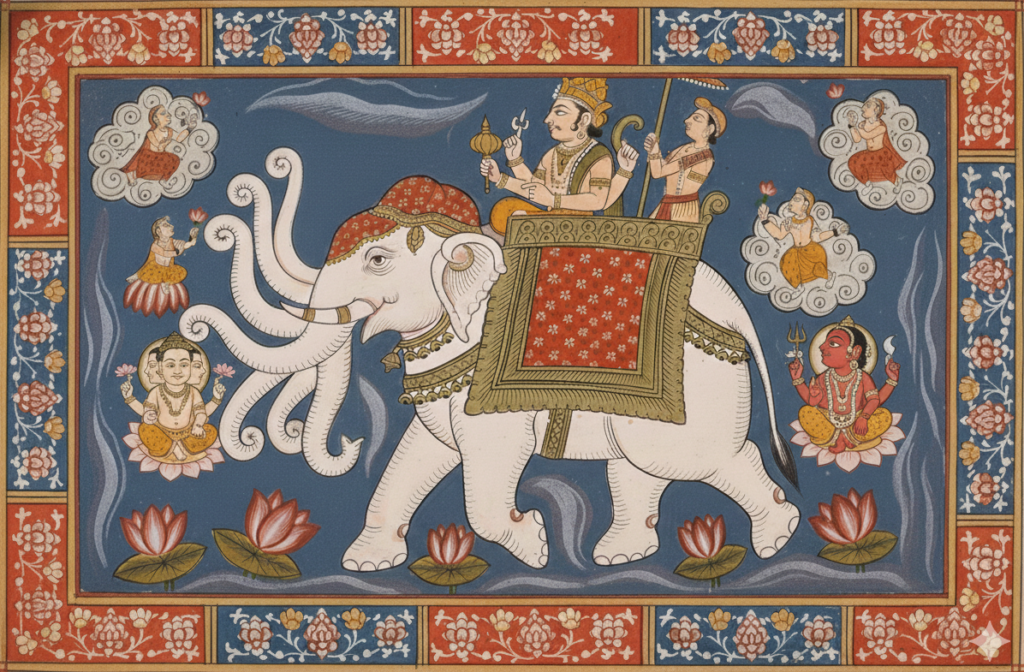
Indra is associated with strength and control over the physical realm, relating to the grounding nature of Muladhara. He is the colour of the Earth’s core’s golden glow, matching the golden square that represents the Earth element. He has four arms, carrying a thunderbolt, a divine bow, a spear & hook and the net of Illusions. He rides mounted on the white elephant Airawata. He is the Hindu god of lightning, thunder, rain, and river flows, and the king of the gods and heaven. Indra represents the aspect of our mind that indulges in the five senses and also attains mastery over them. He is at the root, the king of the physical experience.
Airavata – The Vehicle
Airavata is one of the most magnificent and symbolic figures in Eastern mythology. He is the king of all elephants and serves as Lord Indra’s loyal companion and sacred mount. He represents the immense, grounding strength of the Earth element and the weight of our ancestral memory.
When Airavata emerged from the Ocean of Milk, he was so magnificent that Indra immediately chose him as his mount. The milk white elephant of the clouds sucks up water with his seven trunks and sprays it into the sky. Indra strikes the clouds with his thunderbolt, and it rains on Earth.
Airavata’s seven trunks represent the seven physical tissues that build your body. Because the Muladhara is the Root chakra, it is the foundation for your entire physical existence. In Ayurveda and Tantra, these tissues represent the heavy, grounding Earth element within you. When you meditate on Airavata, you are symbolically strengthening your bones and anchoring your physical structure.
On a cosmic level, those same seven trunks act like a ladder—a beautiful hierarchy of the universe that connects you from the solid ground all the way up to the divine.
Seven Tissues of the Body
- Plasma
- Blood
- Muscle
- Fat
- Bone
- Marrow/Nerve
- Reproductive tissue
Seven Planes of Existence
- The physical earth plane.
- The astral or atmospheric plane.
- The celestial plane (Indra’s heaven).
- The plane of spiritual balance.
- The plane of creative generation.
- The plane of deep meditation.
- The plane of absolute Truth (Moksha).
Brahma
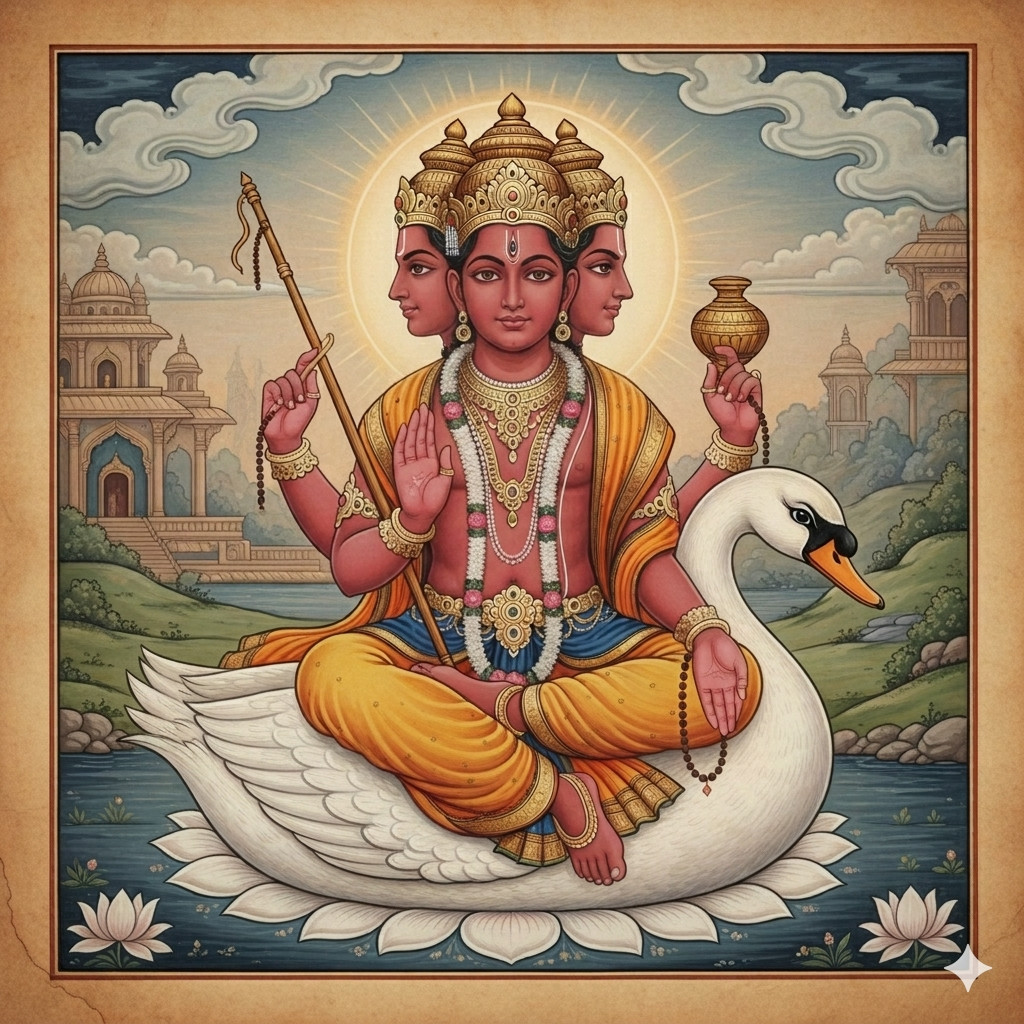
Brahma is the Hindu god of creation. He is young, deep red, with four faces, three eyes in each, and four arms, holding a staff, a sacred water-pot, and a rosary of sacred seeds. The fourth hand makes the gesture of dispelling fear. He is seated on a swan. Looking out in all directions, his four faces symbolize the physical, rational, emotional, and intuitive aspects of the self. Yet, wrapped within this creative power is a subtle lesson on pride. His four faces, looking outward in every direction to admire what he has made, symbolize how easily a creator can become trapped by ego, pride and possessiveness over their own achievements.
Dakini – Shakti
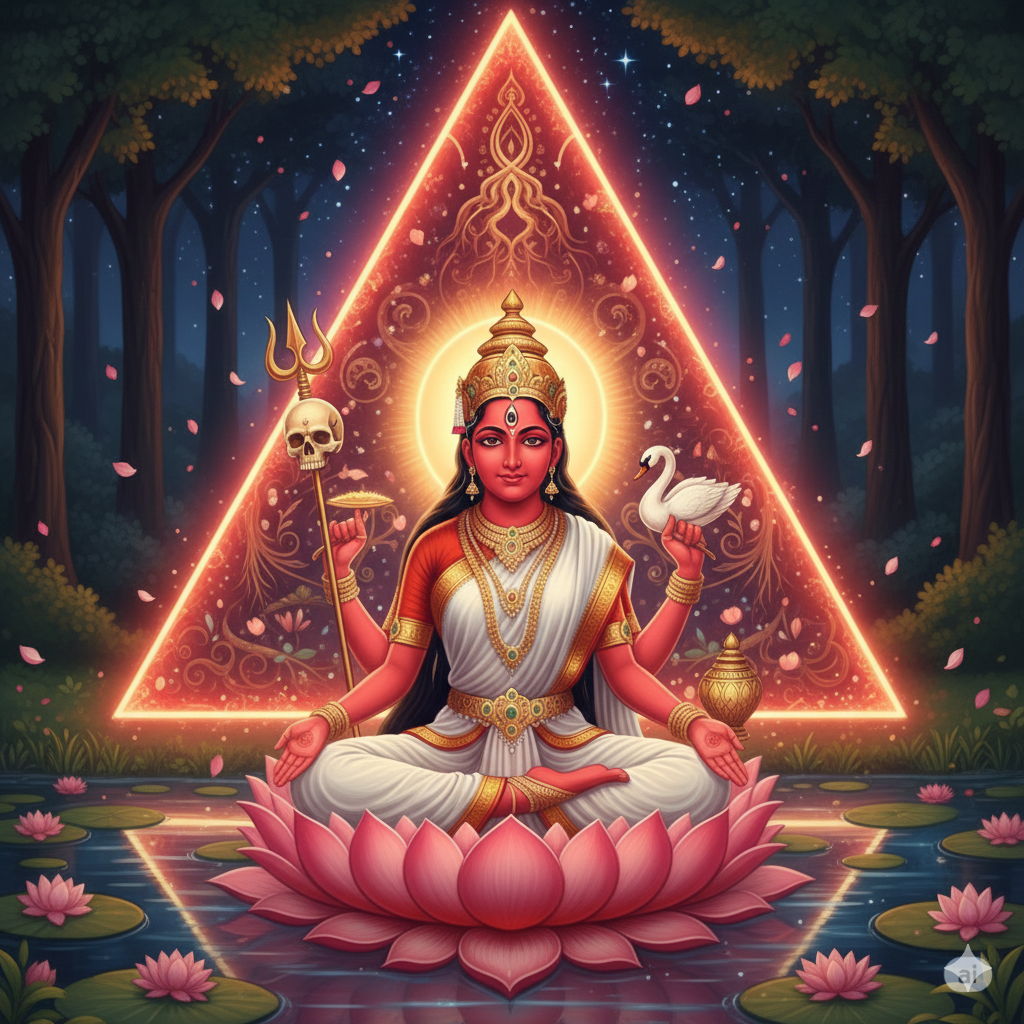
Dakini is the feminine principle or activating power and energy. The Dakini shines like a glowing red sun, with a beautiful face and three eyes, one eye is the eye of wisdom. Her four arms hold a trident, a skulled staff, a swan and a drinking vessel. She is seated on a red lotus. Her drinking vessel contains nectar, representing the intoxication of being alive in a body.
Yama – The Guardian
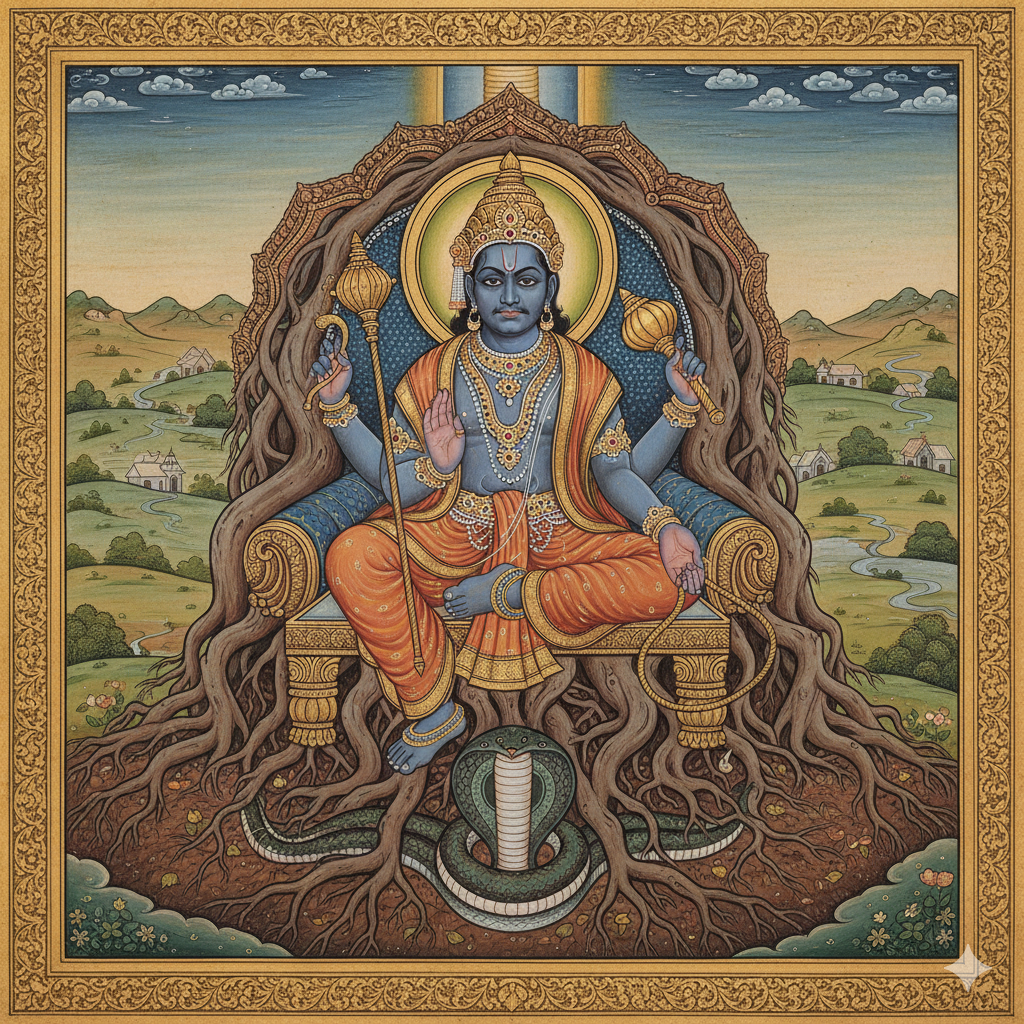
Yama is the Deity of the underworld, and the judge of good and evil deeds. Carrying the staff of punishment, a noose for capturing souls, and a mace to shatter mental, physical, and spiritual obstacles, he guides vital energy back into the primordial earth element upon death. His function in Muladhara is the guardian of our central energy channel. Meditating on Yama helps one overcome the fear of death and the Kundalini energy to rise upward. Yama is the guardian of the South; the exit point is Muladhara. Yama is the ultimate root that pulls the spirit back to the earth at the end of its time.
The Ashta-Dikpalas: Guardians of the Eight Directions
In traditional Vedic cosmology, the Muladhara is not just a point, but the center of your Spiritual Compass. The square inside the Muladhara symbol represents the Earth element, and its four corners and four sides are protected by the Ashta-Dikpalas—the Eight Guardians who rule the directions of space. These are the divine beings represented by the Eight Spears of Light — the guardians who secure our spiritual foundation from every direction.
We explore their deep energetic alignment and how they support your spiritual foundation in the core course modules.
Meditation: The Pillar of the Earth (Muladhara)
The Experience of the Root
Using the resonance of the LAM mantra and the grounding imagery of the earth element, this meditation is designed to help you anchor your awareness. Settle your weight into the ground, and allow yourself to become as steady and immovable as the great white elephant, Airavata.
1. The Physical Foundation: Find a comfortable seat. If you are outdoors in nature, feel the connection of your body to the ground. Imagine your spine is like the Swayambhu Lingam, solid, timeless, and centred.
2. Anchoring with Airavata: Visualize the great white elephant, Airavata. Feel his immense weight and stability. As you breathe in, imagine you are drawing strength through his seven trunks, nourishing the seven minerals of your body. With every exhale, feel yourself becoming as immovable as a mountain.
3. The Golden Square & The Sound: In the space at the base of your spine, visualize a glowing Yellow Square. This is your territory; it is safe and fertile. In the centre of this square, see the seed syllable LAM (लं). The Practice: Gently chant the sound LAM internally. Feel the vibration in the base of your seat, clearing away the snake of fear and replacing it with the ladder of security.
The Inverted Triangle & The Serpent: Now visualize the Inverted Red Triangle. See it as a funnel, pulling cosmic energy down from the crown of your head, through the centre of your body, and into the earth. Inside this triangle, notice the Serpent Kundalini coiled three and a half times around the Lingam. She is peaceful and radiant.
Affirmation: “I am supported by the Earth. My roots are deep, and my spirit is ready to rise.”
5. Closing: Take a deep breath, feeling the magnetic force of the earth element holding you. When you are ready, gently open your eyes, carrying that sense of Indra’s mastery and Yama’s fearlessness through your day