
Traditional Concepts
Introduction
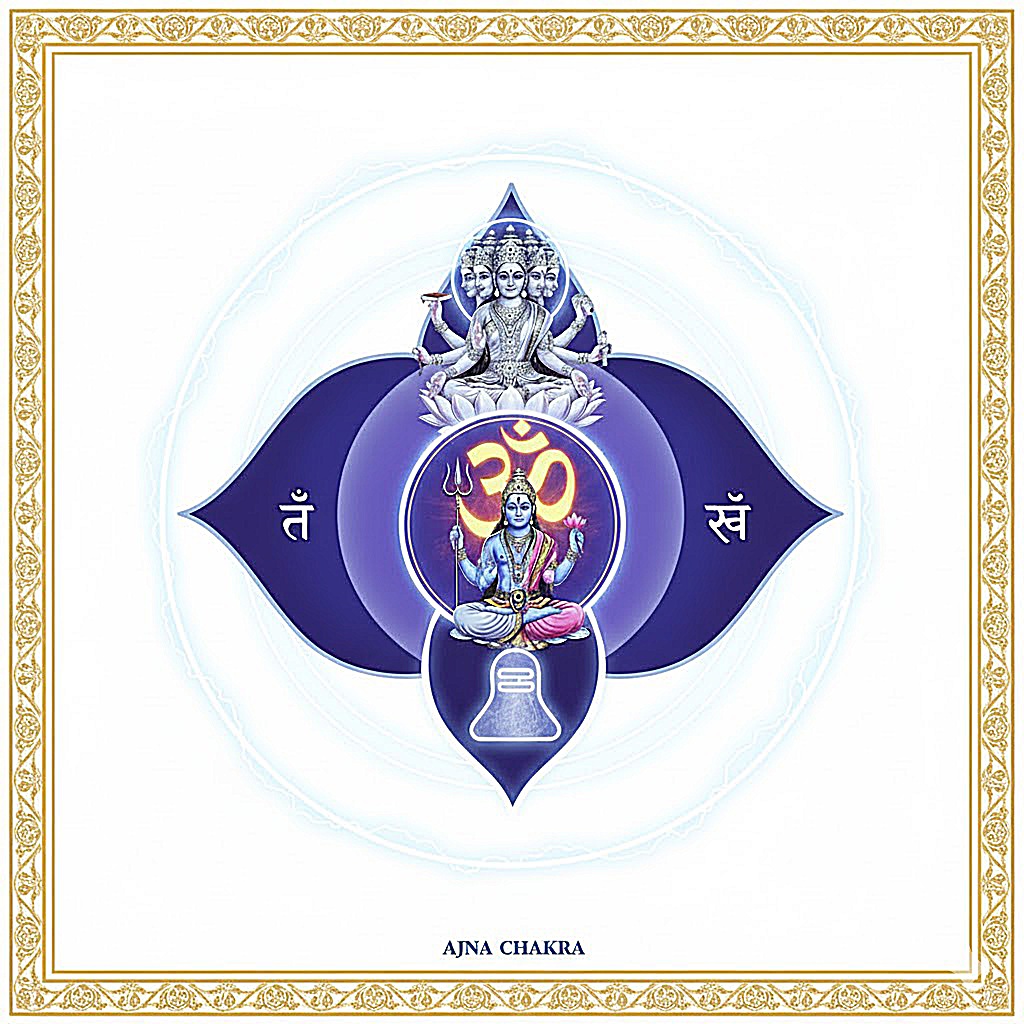
The lotus of Ajna is pure white like the moon.
Ajna means ‘command’. It governs the energy dynamics of the subtle body,
Once Kundalini reaches this point, the spiritual consciousness is fully activated, allowing the practitioner to “command” or govern the energy dynamics of their subtle body.
When you gain command of Ajna chakra you reach beyond indecision and time. As you rise beyond worldly desires and motivation you come to know intuitively what you need to do to fulfill your life’s purpose, bringing spiritual fulfillment and happiness. There is the big voice of ego bellowing at you what you ‘should’ do and there is the little voice of your true self, whispering what will lead you to happiness. When you learn to listen to the little voice, it becomes stronger and will tell you truly what path you need to follow. Then you need to find the strength and willpower to do it.
To truly master this inner command and hear that quiet whisper of the true self, we must first understand how to still the loud, chaotic waves of the mind. In classical yoga, these mental fluctuations and habits of the ego are known as the Vrittis.
To understand how these energy tracks influence your thought-waves and mental habits, explore The Vrittis of Ajna Chakra.
Go to the Vrittis of Ajna page.
Ida and Pingala Nadi
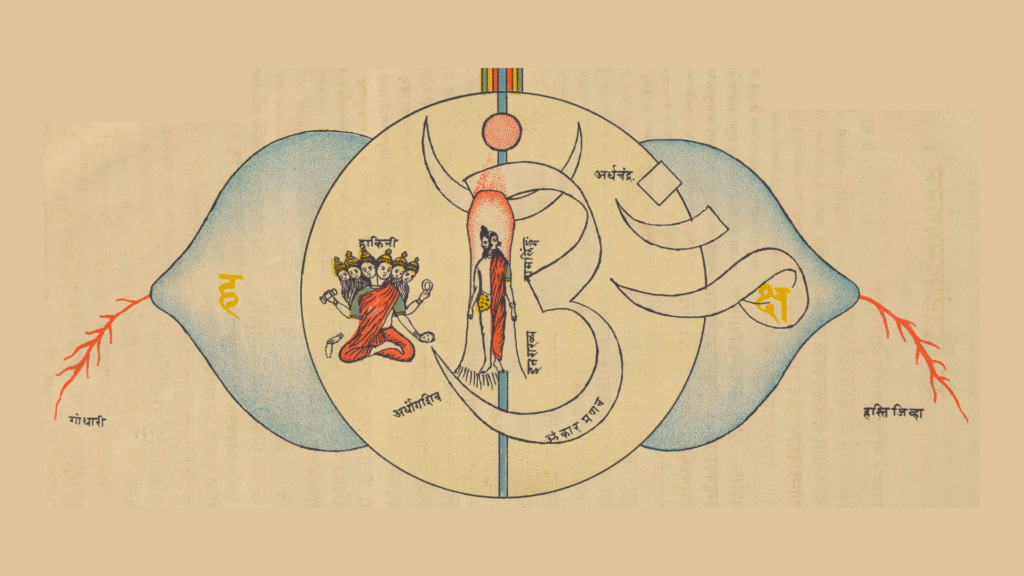
Nadi means “stream”.
Nadi Shodhana (alternate nostril breath) is a harmonizing breathing technique.
Ajna chakra represents many dual principles, and the need to transcend duality to reach enlightenment. Here the two principles of awareness must unite, Apara, worldly knowledge and para, spiritual wisdom, then one gains the blessings of bliss and impermanence.
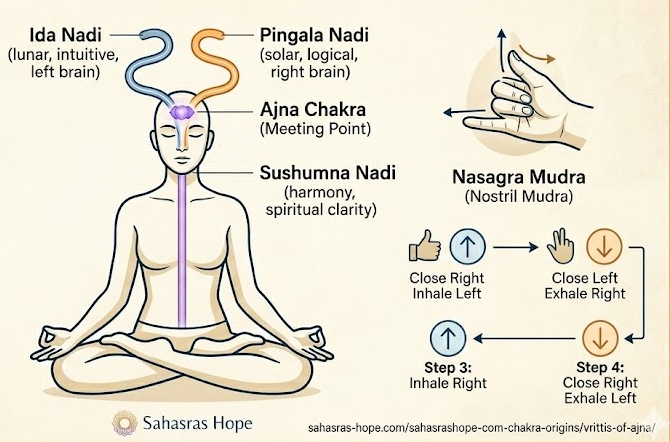
Ida, Pingala, and Susumna Nadis all originate at the Muladhara Chakra (Root Chakra), where Kundalini Sakti lies coiled, illustrating the concept of duality with Ida and Pingala operating around the core of oneness (Susumna), which is the path to spiritual awakening. The three main channels begin at the base, and while the Susumna runs straight up the spine, Ida and Pingala run parallel to the central channel, Susumna Nadi. They all cross each other at the location of every chakra, forming a double helix pattern, or a caduceus. The crisscrossing stops at the Ajna Chakra (Third Eye), where all three channels merge before Ida and Pingala continue to their respective nostrils, and Susumna proceeds to the Sahasrara Chakra (Crown).
This spiralling path around the central column is what creates the dynamic interplay of dualistic energy (male/female, sun/moon) that defines our human experience until that duality is resolved at the Ajna, where male and female energies become neutral, bringing balance, equilibrium and a sense of oneness and unity with the cosmic laws. Duality becomes equalized.
Ha means the sound of sun, Ta means the sound of moon, making Hata. Following hatha yoga, with its focus on the breath, brings happiness and pleasure known only to practitioners. It can only be achieved by those who do good deeds.
Ida and Pingala are time-bound. Up to the fifth chakra, Vishuddha, the yogi also is time bound, but as Ida and Pingala end in Ajna, the yogi moves beyond time into Sushumna, a state of non-dual consciousness. Shiva represents the ultimate reality, beyond all dualities, time, and space. The Ajna Chakra is precisely the point where individual consciousness begins to merge with and directly experience this cosmic consciousness. It’s the “third eye” that sees beyond illusion into truth.
As Ajna expands, it leads to the ability perceive the thoughts and emotions of people and all living beings, as well as energies of surroundings and other manifestations, and the ability to affect (command) these energies, to wield, weave, and direct them with intention.
| Symbol | Transliteration | English Phonetics | Pronunciation Secret |
|---|---|---|---|
| हं | haṁ | Hum | Like “Humming.” Represents the “Shiva” or masculine energy aspect. |
| क्षं | kṣaṁ | Kshum | “Ksh” as in baksheish. Represents the “Shakti” or feminine energy aspect. |
Bringing Balance to Ajna: Nadi Shodhana Prasada
To move beyond the dualities of the analytical left brain and the creative right brain, we must balance the energetic currents that feed them. Nadi Shodhana (Alternate Nostril Breathing) is the precise yogic tool to harmonize Ida (the cooling, lunar, intuitive current) and Pingala (the heating, solar, logical current), clearing the pathway for Sushumna—the central channel—to awaken clarity at the brow center.
The Practice
- Find Your Center: Sit in a comfortable, upright position. Relax your shoulders, soften your face, and let your left hand rest gently on your knee.
- The Mudra: Bring your right hand into Nasagra Mudra (resting the index and middle fingers gently between your eyebrows at the Ajna chakra), using your thumb to control the right nostril and your ring finger to control the left.
- The Breath Sequence:
- Close the right nostril with your thumb and exhale completely through the left nostril.
- Inhale deeply and smoothly through the left nostril.
- Close the left nostril with your ring finger, open the right, and exhale smoothly through the right nostril.
- Inhale deeply through the right nostril.
- Close the right nostril, open the left, and exhale through the left nostril.
This completes one full round.
Commitment & Integration
Begin by practicing this for 5 to 10 rounds. As you breathe, keep your awareness gently resting at the point between your eyebrows, feeling the dual currents of the body meeting and dissolving into a singular, peaceful focus.