
Third Eye Chakra
Introduction
“Where the individual mind dissolves into the light of unconditional truth.”
Meaning: Authority, command, or supreme perception.
The lotus of Ajna is pure white like the moon.
Ajna means ‘command’. It governs the energy dynamics of the subtle body.
Ajna provides the screen of the mind where all sensory information and thoughts are witnessed by the Silent Observer.
The screen of the mind where all sensory information and thoughts are witnessed by the Silent Observer.”
Once Kundalini reaches this point, the spiritual consciousness is fully activated, allowing the practitioner to “command” or govern the energy dynamics of their subtle body.
When you gain command of Ajna Chakra you reach beyond indecision and time. As you rise beyond worldly desires and motivation you come to know intuitively what you need to do to fulfill your life’s purpose, bringing spiritual fulfillment and happiness. There is the big voice of ego bellowing at you what you ‘should’ do and there is the little voice of your true self, whispering what will lead you to happiness. When you learn to listen to the little voice, it becomes stronger and will tell you truly what path you need to follow. Then you need to find the strength and willpower to do it.
To truly master this inner command and hear that quiet whisper of the true self, we must first understand how to still the loud, chaotic waves of the mind. In classical yoga, these mental fluctuations and habits of the ego are known as the Vrittis.
Many people strain their brow center when they try to focus and in mediation, which causes intense tension and headaches. In traditional yoga, that point is called the bhrumadhya (the eyebrow center). The trap many of us fall into is that we try to focus with our eyes instead of just our awareness. We inadvertently cross our eyes slightly, strain the optic nerves, and tighten the tiny muscles in the forehead. Because the Ajna Chakra is connected to the mind and pure light, it’s supposed to be a space of fluid, spacious awareness—but when we force it, it creates what the Daoists call “stagnant fire” in the head. A much more grounded, traditional approach is to drop the awareness just slightly lower—to the root of the nose—and draw that focus inward toward the center of the head. This cools the mind and removes the physical strain.
Ida and Pingala Nadi
Nadi means “stream”.
Nadi Shodhana (alternate nostril breath) is a harmonizing breathing technique.
Ajna chakra represents many dual principles, and the need to transcend duality to reach enlightenment. Here the two principles of awareness must unite, Apara, worldly knowledge and para, spiritual wisdom, then one gains the blessings of bliss and impermanence.
Ida, Pingala, and Susumna Nadis all originate at the Muladhara Chakra (Root Chakra), where Kundalini Sakti lies coiled, illustrating the concept of duality with Ida and Pingala operating around the core of oneness (Susumna), which is the path to spiritual awakening. The three main channels begin at the base, and while the Susumna runs straight up the spine, Ida and Pingala run parallel to the central channel, Susumna Nadi. They all cross each other at the location of every chakra, forming a double helix pattern, or a caduceus. The crisscrossing stops at the Ajna Chakra (Third Eye), where all three channels merge before Ida and Pingala continue to their respective nostrils, and Susumna proceeds to the Sahasrara Chakra (Crown).
This spiralling path around the central column is what creates the dynamic interplay of dualistic energy (male/female, sun/moon) that defines our human experience until that duality is resolved at the Ajna, where male and female energies become neutral, bringing balance, equilibrium and a sense of oneness and unity with the cosmic laws. Duality becomes equalized.
The Two Tracks of Human Consciousness
Relying heavily on gut feelings, instantly “knowing” the answer to a problem, or reading the energy of a room without needing facts to prove it.
A mind that naturally gravitates toward abstract thinking, big-picture vision, and deep creative or artistic pursuits.
Ida is the cool, feminine, lunar energy. It is beautifully restorative, yin, and deeply reflective.
Relying heavily on concrete facts, structured logic, and evidence. Instantly investigating a problem step-by-step with absolute systematic clarity.
A mind that naturally gravitates toward real-world application, clear physical boundaries, and courageous execution. The seat of inner valour.
Pingala is the hot, masculine, solar energy. It is active, yang, fiercely protective, and deeply dynamic.
Ha means the sound of sun, Ta means the sound of moon, making Hata. Following hatha yoga, with its focus on the breath, brings happiness and pleasure known only to practitioners. It can only be achieved by those who do good deeds.
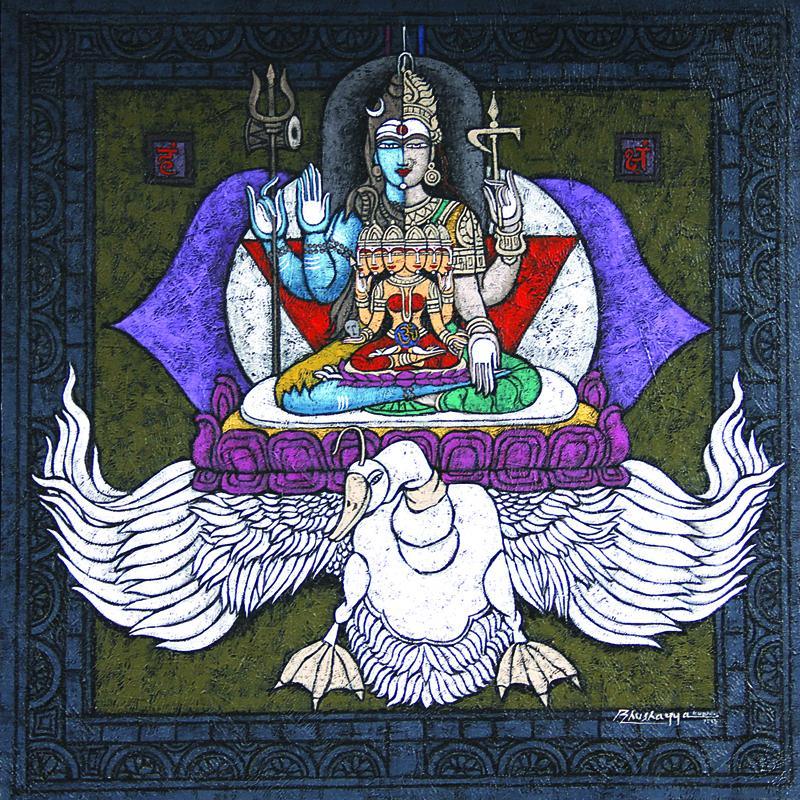
Ida and Pingala are time-bound. Up to the fifth chakra, Vishuddha, the yogi also is time bound, but as Ida and Pingala end in Ajna, the yogi moves beyond time into Sushumna, a state of non-dual consciousness. Shiva represents the ultimate reality, beyond all dualities, time, and space. The Ajna Chakra is precisely the point where individual consciousness begins to merge with and directly experience this cosmic consciousness. It’s the “third eye” that sees beyond illusion into truth.
As Ajna expands, it leads to the ability perceive the thoughts and emotions of people and all living beings, as well as energies of surroundings and other manifestations, and the ability to affect (command) these energies, to wield, weave, and direct them with intention.
The Secret Function of Manas in the Ājñā
In the universal architecture of the mind, Manas is our basic sensory processor. But when Manas is witnessed at the level of the Ājñā, its spiritual meaning shifts beautifully:
- The Cosmic Screen: It becomes the inner projector screen where all images, thoughts, and psychic insights are displayed for the Silent Observer to witness.
- The Internal Sixth Sense: It does not judge, rationalize, or analyze (that is Buddhi’s job). It simply acts as the internal mirror reflecting your reality.
- The Sacred Duality: This is precisely why the Ājñā chakra has only two petals. They represent the ultimate duality of the Manas processing system: Iḍā (the cool, lunar, intuitive current) and Piṅgalā (the warm, solar, dynamic current) meeting at the center command bridge.
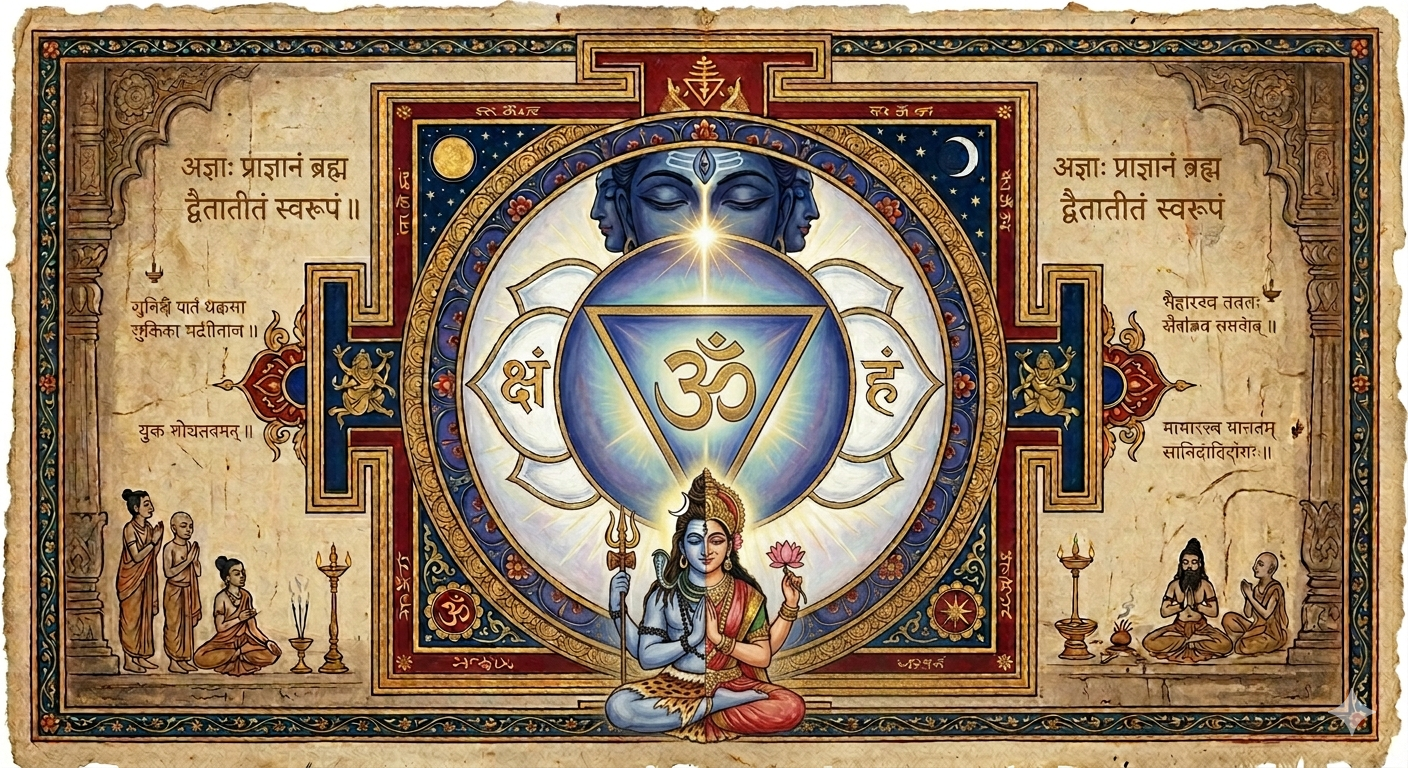
The Symbol
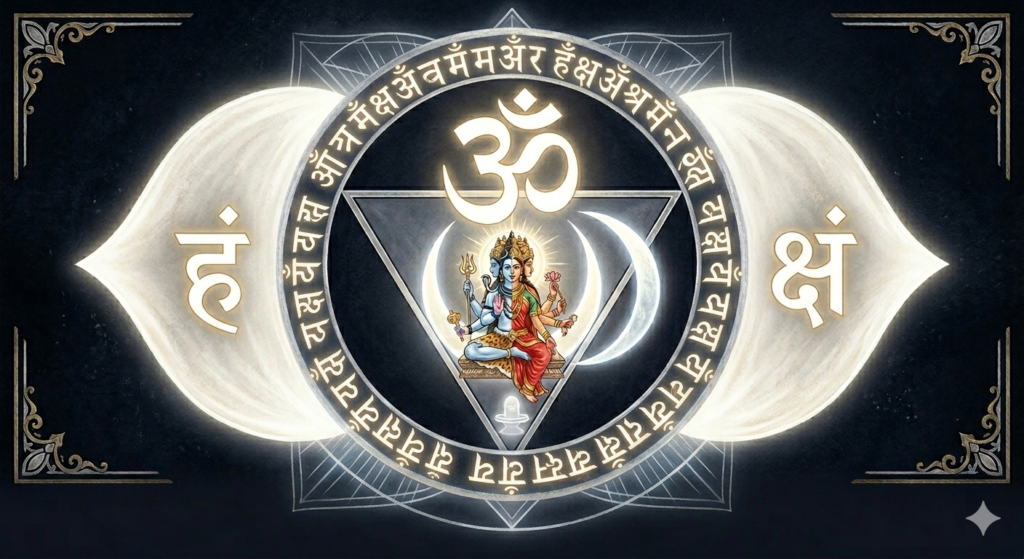
In traditional tantric and Vedic symbolism, an inner ring serves as a Mantra Chakra or a protective geometric ring of sacred sound syllables (Aksharas).
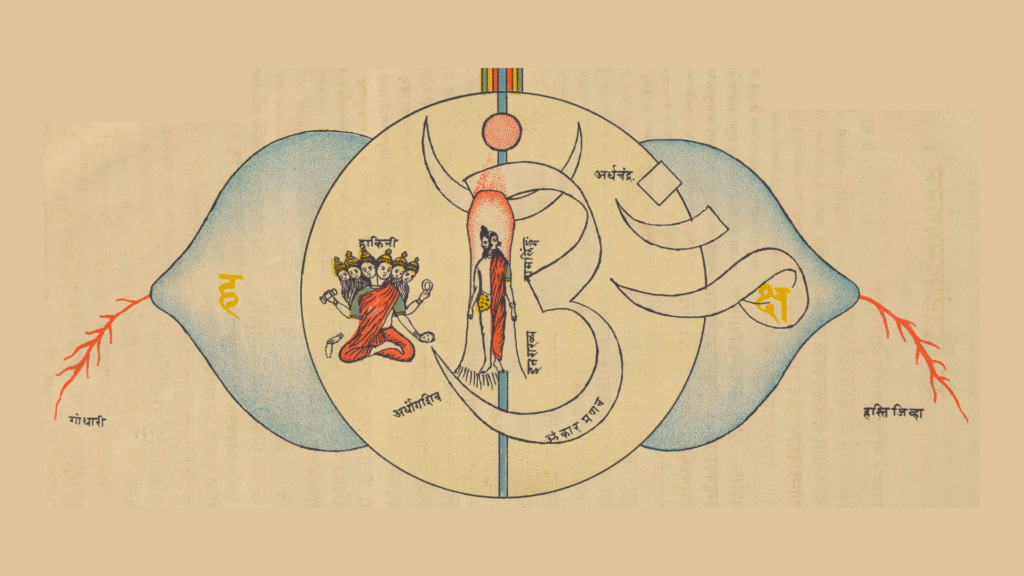
The two large main petals on the outside, have the two specific root seed syllables assigned to Ajna in the ancient texts: Left Petal (हं – Ham): Represents the solar energy channel (Pingala), the masculine principle, and objective reality. Right Petal (क्षं – Ksham): Represents the lunar energy channel (Ida), the feminine principle, and subjective reality. Together, they represent the supreme command of Ajna balancing and transcending all dualities
2. The Inner Ring Characters (The Protective Circle) The Sanskrit characters forming a ring around the central triangle are the letters of the Sanskrit Alphabet (Varnamala), often written out as a continuous mantra circle. In the authentic Sat-Chakra-Nirupana tradition, the human body’s energy system is mapped to the sounds of creation. The Blueprint of Sound: All the letters of the Sanskrit alphabet are distributed across the petals of the lower five chakras (totaling 50 letters from Muladhara up to Vishuddha). The Resolution at Ajna: When you reach Ajna, the mind closes the loop. The inner ring depicts these letters resetting or dissolving back into the central source—the AUM (ॐ) at the top. It visually demonstrates the mind gathering all the fragmented sounds, words, and thoughts of the world and pulling them inward into one single point of absolute silence.
3. The Subtle Geometry Underneath Beneath the sacred character ring lies a faint, layered Yantra grid. This geometric matrix represents the complex network of subtle energy lines (Nadis) intersecting at the brow center, illustrating that beneath the surface of fragmented thoughts lies a perfect, orderly traditional structure. By replacing generic modern lotus petals with this classical sound ring, the imagery moves away from contemporary interpretations. It functions as an authentic, advanced meditation mandala designed to help the practitioner study and understand the mechanics of the mind.
Bringing Balance to Ajna: Nadi Shodhana
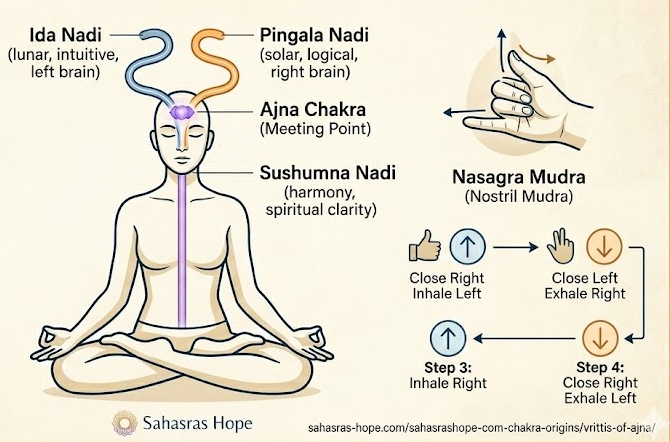
To move beyond the dualities of the analytical left brain and the creative right brain, we must balance the energetic currents that feed them. Nadi Shodhana (Alternate Nostril Breathing) is the precise yogic tool to harmonize Ida (the cooling, lunar, intuitive current) and Pingala (the heating, solar, logical current), clearing the pathway for Sushumna—the central channel—to awaken clarity at the brow center.
The Practice
- Find Your Center: Sit in a comfortable, upright position. Relax your shoulders, soften your face, and let your left hand rest gently on your knee.
- The Mudra: Bring your right hand into Nasagra Mudra (resting the index and middle fingers gently between your eyebrows at the Ajna chakra), using your thumb to control the right nostril and your ring finger to control the left.
- The Breath Sequence:
- Close the right nostril with your thumb and exhale completely through the left nostril.
- Inhale deeply and smoothly through the left nostril.
- Close the left nostril with your ring finger, open the right, and exhale smoothly through the right nostril.
- Inhale deeply through the right nostril.
- Close the right nostril, open the left, and exhale through the left nostril.
This completes one full round.
Commitment & Integration
Begin by practicing this for 5 to 10 rounds. As you breathe, keep your awareness gently resting at the point between your eyebrows, feeling the dual currents of the body meeting and dissolving into a singular, peaceful focus.