

The Great Confluence and Cosmic Grace
At the level of the Crown, the language of mythology shifts entirely into the language of absolute reality. Here, the deities are no longer external figures to be worshiped; they are the ultimate operational principles of your own illuminated mind and the final dissolution of the ego.
Brahma and Saraswati: The Return to the Source
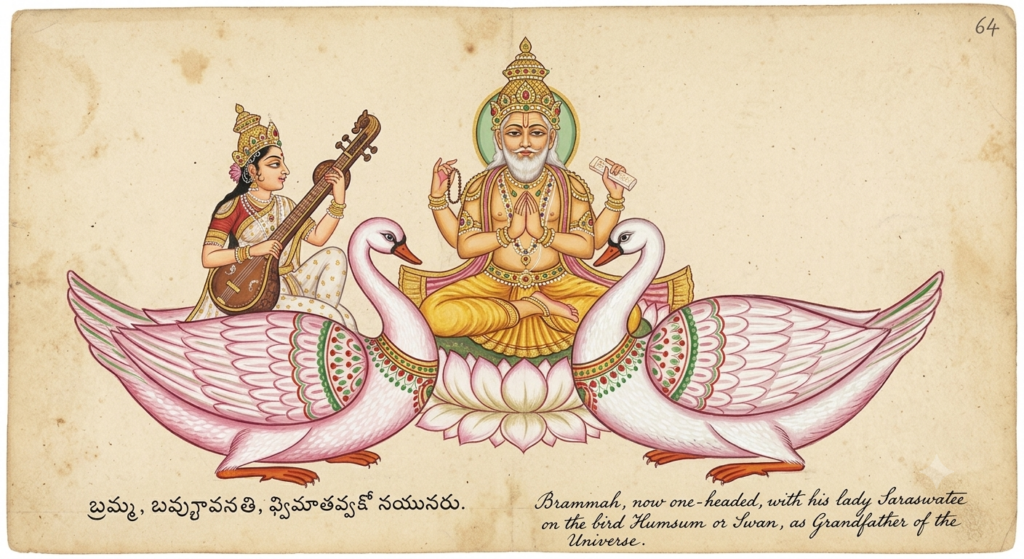
In the lower chakras, Brahma was the primordial drive to create—the intense, focused intellect and abstract vision, while Saraswati was the “flow” bringing that vision to life. There, his symbolism carried a profound warning: his four heads, eternally gazing upon his creation, represented the egoistic attachment a creator can have for their own work.
But here in the Sahasrara, the energy shifts. Brahma is no longer the youthful impulse of creation; he is the Grandfather of the Universe, the witness to the Truth. Accompanied by Saraswati as the grandmother of the universe, they represent the sacred moment when our individual creativity and seasoned wisdom finally return to the Universal Source. The swan they ride becomes the ultimate symbol of Viveka (Discrimination)—the quiet, supreme ability to see the One in the many, allowing us to finally let go and let our creations breathe on their own.
Paramashiva: Pure Consciousness
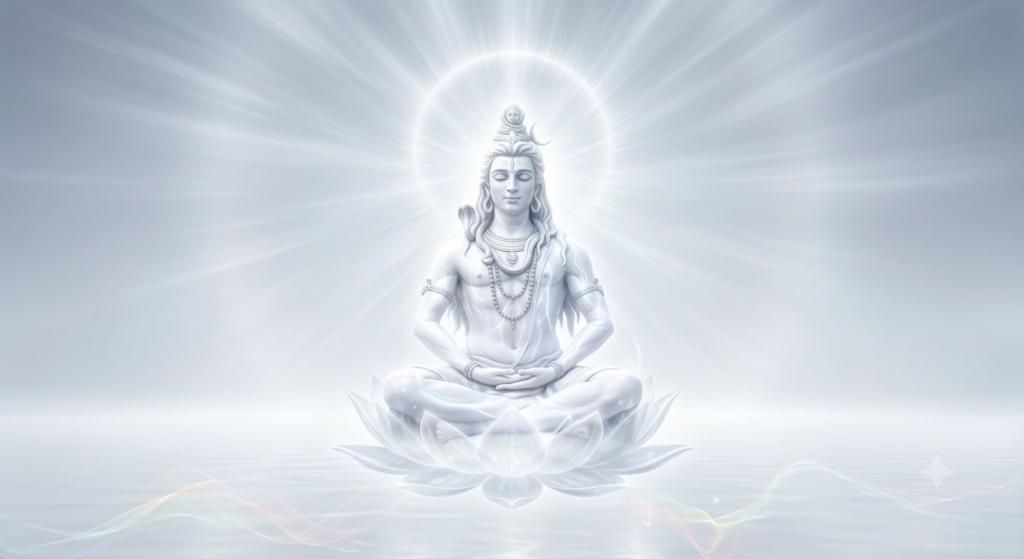
He is depicted as a silent, radiant light — a white Shiva in deep meditation existing entirely beyond all Vrittis (mental ripples). Paramashiva is the vast, silent ocean that remains completely unaffected by the rising and falling of worldly waves. In this space, the restless chatter of the ego falls silent, resting in a deep, quiet peace that cannot be inflated by praise or wounded by criticism. He is the ultimate witness, completely indifferent to honours or humiliations, existing purely as absolute truth. Paramashiva represents the transcendent state prior to creation. He is associated with pure awareness and non-dual oneness.
The Ray of Grace
To attain spiritual bliss and cross the threshold into the Sahasrara Chakra, a final, vital factor is required: Grace. While practices can prepare the mind, entering the Crown is ultimately impossible without the descent of divine favor, often described in various traditions as the Grace of Shankara, God, Shiva, or the Holy Spirit.
This mystical force may flow as a tapestry woven from different traditions, tools, and lineages. The journey often begins in the rich soil of disciplined meditation — such as the precise techniques found in Tibetan Buddhism — which provide the essential framework needed to quiet the fluctuations of the mind. Throughout their spiritual evolution, an individual must seek out spiritual guides, masters, and lineages—whether rooted in the devotion of sacred music, the insights of enlightened monks, or the ancient streams of Taoist and Vedic masters. A true guide serves as a vital bridge, offering the precise direction and cosmic resonance needed to navigate the overwhelming depths of a spiritual awakening.
Ultimately, the role of any external master or tradition is to act as a temporary conduit for this higher, universal power. By emptying oneself of pride and ownership over the journey, the seeker ceases to be a struggling climber and instead becomes the very summit itself.
Imagine climbing a steep, rocky mountain to reach the summit of Truth or Enlightenment. You must make all the effort to climb. You need to have devotion, study, meditate, and live an honest, disciplined life, climbing the mountain step-by-step using your own energy.
When you have almost reached the top, it suddenly becomes impossible to climb further. The summit is covered in thick fog, ice, and snow. No matter how hard you try, your own human strength is prevented from reaching the peak.
It is right here, at the final, impossible step, that a mystical force comes down. The Guru acts as the bridge between the human heart and this Crown energy. Through an act of pure, undeserved help, the ultimate spiritual master reaches down and pulls you to a higher plane. It is a final push of wisdom that you cannot earn on your own—it instantly removes the last bit of illusion and fog in your mind, transforming you from a struggling climber into someone who is suddenly standing on top of the mountain with a perfectly clear view.
Grace is the ultimate spiritual favor and blessing. It is the force that steps in after you have done all the preparation work, beautifully lifting you into an enlightened aura of peace and perfect happiness.
Meditation on Emptiness: The Dissolution into the Unmanifest
To conclude the journey through the Sahasrara, the practitioner must move beyond visualization, sound, and form. This is a practice of complete cessation — an intentional step into the silent, unconditioned space of Paramashiva, where the ego is entirely surrendered to the cosmic whole.
The Preparation
- The Posture: Sit in a steady, comfortable meditation posture with the spine straight. Let the hands rest on the knees in Jnana Mudra (index finger touching the thumb, palms facing upward), symbolizing individual consciousness bowing to the universal consciousness.
- The Breath: Close your eyes. Take three deep, cleansing breaths. Inhale vital energy (prana), and exhale any remaining tension, attachment, or identification with the external world. Let the breath settle into a natural, effortless, and quiet rhythm.
The Stage of Withdrawal (Pratyahara)
- Withdrawing from the Senses: Bring your awareness away from the environment, away from sounds, and away from the physical body. Acknowledge the physical form as a temporary vehicle, then gently step back from it.
- Watching the Mental Ripples: Observe the mind. Thoughts, memories, or concepts may arise. Do not fight them, and do not follow them. See them as mere ripples on the surface of an ocean. As you refuse to engage with them, watch them naturally lose momentum and dissolve back into the stillness from which they came.
The Ascent to the Summit
- The Crown Centre: Shift your attention to the very top of the head—the Sahasrara. Visualize a thousand-petaled lotus of pure, incandescent white light, radiating softly.
- The Mountain Climb: Mentally acknowledge the immense journey you have taken through the lower centres. Recognize that your discipline, your breath, your devotion, and your study have brought you to the absolute edge of human effort. You are standing at the high, icy peak of the mountain. The fog of creation lies below you. Ahead of you is only vast, unmapped space.
The Final Surrender (Sunyata)
- Stripping Away the Ego: To cross this final threshold, you must leave behind everything you own, everything you know, and everything you believe yourself to be. Mentally dissolve your titles, your history, your past relationships, your future ambitions, and even your identity as a “meditator.”
- Entering the Emptiness: Rest in the absolute space of having nothing, knowing nothing, and owning nothing. This is not a dark or stagnant void; it is Sunyata—a vibrant, luminous emptiness that is pregnant with all possibilities. It is the unmanifest source prior to creation.
- Receiving Grace: In this state of total stillness and absolute poverty of the ego, cease all striving. You cannot climb into the absolute; you can only empty the vessel so it may be filled. Sit quietly in this supreme vulnerability, allowing the Ray of Grace — the ultimate spiritual favour — to descend. Feel the boundary between “you” and the “universe” permanently soften and fade away.
The Silent Absorption (Samadhi)
Merge entirely into Paramashiva — the silent, radiant, white light of pure awareness. You are no longer the climber. You are the mountain. You are the sky. You are the vast, silent ocean, completely unaffected by the rising and falling of worldly waves.
Remain in this motionless, timeless expansion of consciousness for as long as your practice allows.